Public study · Singapore · 2026 · From Talks to Terms
CSFTA 4.0 can move one part of the decision. Decide the rest now.
Locating China-facing digital and data operations while CSFTA 4.0 is negotiated
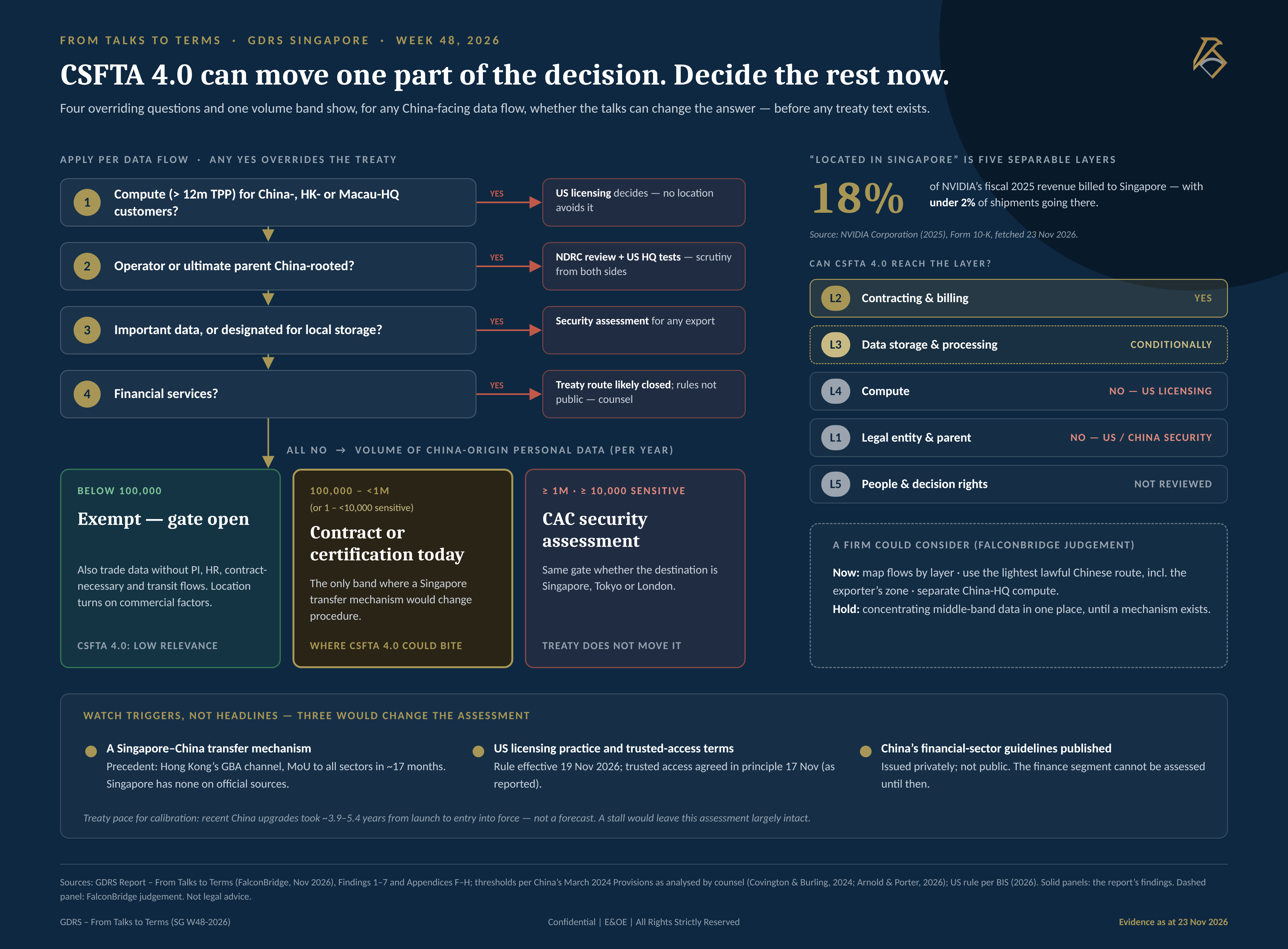
On 20 November 2026 Singapore and China launched negotiations to upgrade their free trade agreement, naming the digital economy and government procurement. No text or timetable exists. The report asked how a firm should decide where to locate and structure regional digital and data operations serving China while the upgrade’s scope and timing remain uncertain. Its answer: the talks can move one narrow part of that decision, and the rest can be decided now. The data-flow commitments the headline implied already exist. RCEP has bound both countries since 1 January 2022 not to prevent business data transfers or require local computing; ACFTA 3.0, reported to enter into force on 1 December 2026, repeats those obligations. Both let the restricting Party judge its own exceptions, and neither lets the data articles be enforced through a dispute (ACFTA 3.0 defers this for five years). The bilateral CSFTA’s e-commerce chapter has no data-flow article and no dispute settlement. CSFTA 4.0 must therefore be judged against ACFTA 3.0, not against a blank page. What binds most flows is domestic and third-country law. China’s outbound regime exempts routine trade, HR and contract-necessary transfers and non-sensitive personal data of fewer than 100,000 individuals; requires a standard contract or certification for the middle band; and requires a security assessment above 1 million individuals, 10,000 sensitive, or for important data — identically for any foreign destination. A US rule effective 19 November 2026 requires licences for advanced computing items to Singapore and for any data centre supplying more than 12 million TPP to China-headquartered companies. China’s NDRC blocked a foreign acquisition of a Singapore-domiciled AI firm with Beijing roots. No China–Singapore treaty can alter either. What a treaty could add that matters is a mechanism, not a principle: a Singapore-specific transfer channel or recognised certification. China built one for Hong Kong — the Greater Bay Area Standard Contract went from memorandum to all sectors in about seventeen months. On the official sources fetched, Singapore has none. Whether China would offer one to a sovereign foreign State is the study’s single most important unknown. Singapore still holds real assets: a dedicated channel to Chongqing, binding digital agreements with third countries and a recognised onward-transfer toolkit. Three areas stay low-confidence because the public record is silent: China’s financial-sector transfer guidelines are not public; firm behaviour after past digital chapters cannot be measured; and the cost of staging an operation across locations is unquantified. Recent China upgrades took about 3.9 to 5.4 years from launch to entry into force — a calibration, not a forecast. A firm could consider deciding per data flow and per layer — billing, data, compute, entity, people — rather than per “hub”; asking first whether it supplies China-headquartered compute, is China-rooted, holds important data or is in financial services; using the lightest lawful Chinese route today, including the exporting entity’s zone; keeping middle-band China-origin data portable until a mechanism appears; and watching named triggers rather than treaty headlines.
1 Jan 2022
RCEP has bound both countries since 1 January 2022 not to prevent business data transfers or require local computing; ACFTA 3.0, reported to enter into force on 1 December 2026, repeats those obligations.
~17 months
China built a transfer channel for Hong Kong: the Greater Bay Area Standard Contract went from memorandum to all sectors in about seventeen months. On the official sources fetched, Singapore has none.
3.9 to 5.4 years
Recent China upgrades took about 3.9 to 5.4 years from launch to entry into force, a calibration and not a forecast.
The China–Singapore talks are real. They are not what decides where your data operations sit.
The complete package
Six elements, tailored to the question and to how readers will use the work
Tell us who is reading and the pack is emailed to you straight away. The package is released under a Type-1 licence for the requester’s own use. Public access does not transfer ownership.
The sample demonstrates the work
Facts and figures above are findings of the source report, each verified against a fetched source on 23 November 2026. The final paragraph is FalconBridge’s judgement on how a firm might act on them, offered for the reader’s own decision, not as instruction. Nothing here is legal advice.
Around this study
Other studies on Singapore
Expanding Wholesale Gold Activity in Singapore Ahead of April 2027
Benchmark or Singapore Exception?
How a study like this is commissioned: a question of your own, answered as a complete research package.

A conversation about your decision
What needs to be understood
before your next decision?
Bring the proposition, question or direction you are working on. Together, we can define the support it requires.
Start a conversation