Public study · North Carolina · 2026
Activism Behind Closed Doors
Minority Influence in PE Is Decided Before the Dispute
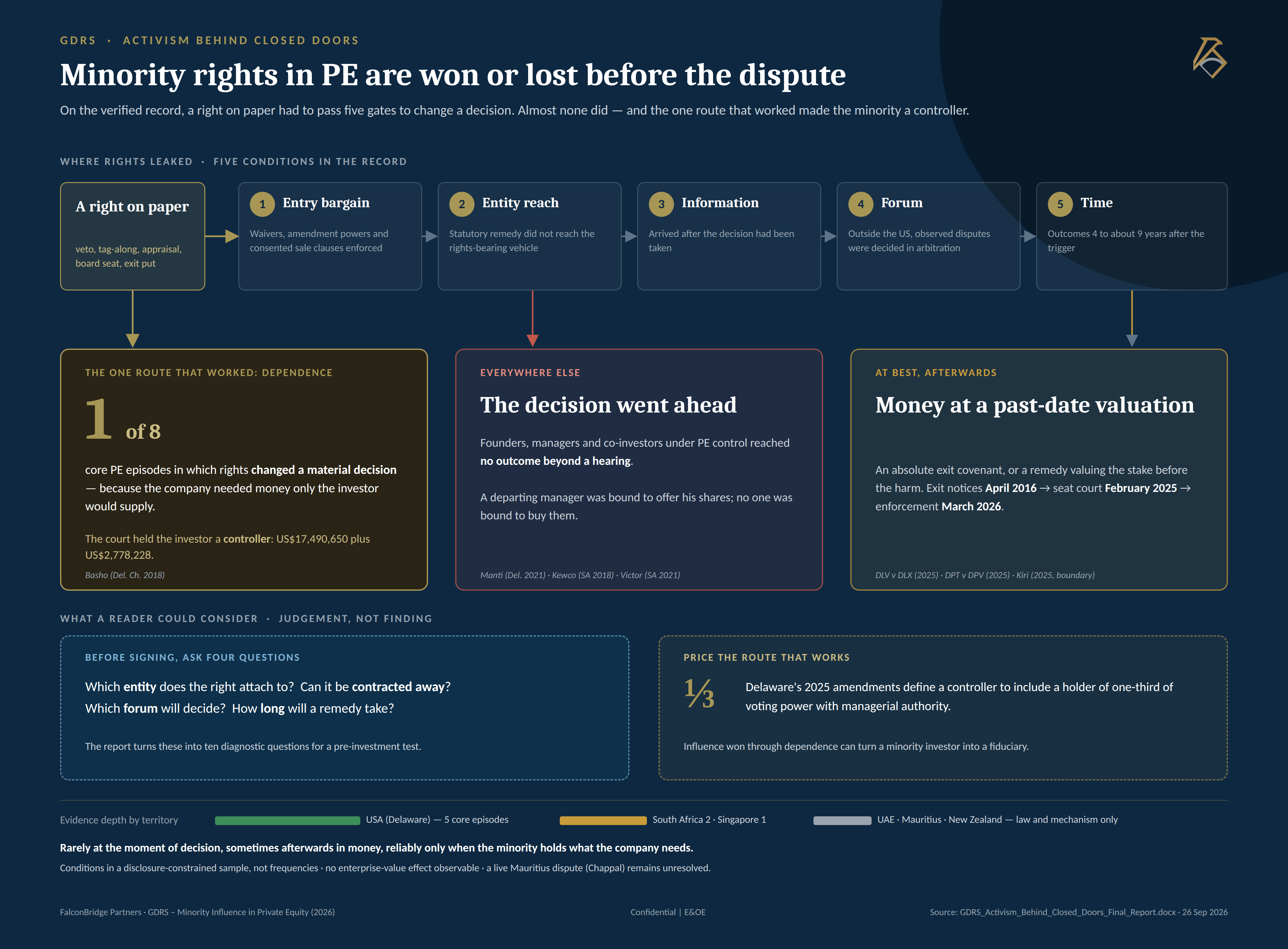
FalconBridge took a South African working paper's distinction — rights on paper are not influence in practice — out of listed companies and into PE-backed private companies in the USA, South Africa, the UAE, Mauritius, New Zealand and Singapore. The study tested it against eight core PE episodes, two cross-border comparators, twelve boundary illustrations and the statutes of seven legal environments. Every cited source was retrieved and confirmed on 26 September 2026. The anchor fact is stark. Only in one of the eight verified core PE episodes did minority rights change a material decision — Basho (Delaware, 2018), where the company needed money only the investor would supply. The court held the investor to be a controller and awarded US$17,490,650 plus US$2,778,228. In every other episode the decision went ahead; minorities obtained, at best, compensation fixed at a past date, four to about nine years later. Five conditions explain the gap. Courts enforced the bargain struck at entry — waivers, amendment powers and consented sale clauses. Statutory remedies often did not reach the entity holding the rights. Information arrived after the decision. Outside the United States, the observed disputes were decided in arbitration. And time turned decision rights into valuation claims. Influence in disagreement is largely settled before the disagreement arises, not by the percentage owned. Rights did produce results where an exit covenant bound the counterparty absolutely, where a remedy valued the stake before the harm, or where the controller lacked a contractual tool it needed (boundary evidence). In cooperation, minority PE investors appear to add value (qualified). But the most powerful minority position is also the most exposed: Delaware's 2025 amendments define a controller to include a holder of one-third of voting power with managerial authority. The findings describe conditions, not frequencies. Evidence is concentrated in Delaware; for the UAE, Mauritius and New Zealand it is legal and mechanistic only. No intervention's effect on enterprise value is observable. A live Mauritius dispute (Chappal) and two partner input gates remain unresolved. Sponsors, minority investors, founders and boards could consider testing any minority position, before signing, against four questions: which entity the right attaches to, whether it can be contracted away, which forum will decide, and how long a remedy would take. The report's ten diagnostic questions turn those into a working pre-investment test. Facts and figures above are verified findings drawn from the final GDRS report. The closing paragraph is FalconBridge's judgement about how readers might use them, offered for the reader's own decision with their own advisers — not legal, investment or tax advice. E&OE. All rights reserved.
One of eight
Only in one of the eight verified core PE episodes did minority rights change a material decision — Basho (Delaware, 2018), where the company needed money only the investor would supply.
Five conditions
Five conditions explain the gap.
Four questions
Sponsors, minority investors, founders and boards could consider testing any minority position, before signing, against four questions: which entity the right attaches to, whether it can be contracted away, which forum will decide, and how long a remedy would take.
The Professional Curiosity piece on this study
Minority rights in private equity are real. They rarely decide anything.
The complete package
Five elements, tailored to the question and to how readers will use the work
Tell us who is reading and the pack is emailed to you straight away. The package is released under a Type-1 licence for the requester’s own use. Public access does not transfer ownership.

A conversation about your decision
What needs to be understood
before your next decision?
Bring the proposition, question or direction you are working on. Together, we can define the support it requires.
Start a conversation