Public study · South Africa · 2026
Aimed at Politicians, Felt by Corporates?
Targeted Sanctions: South Africa
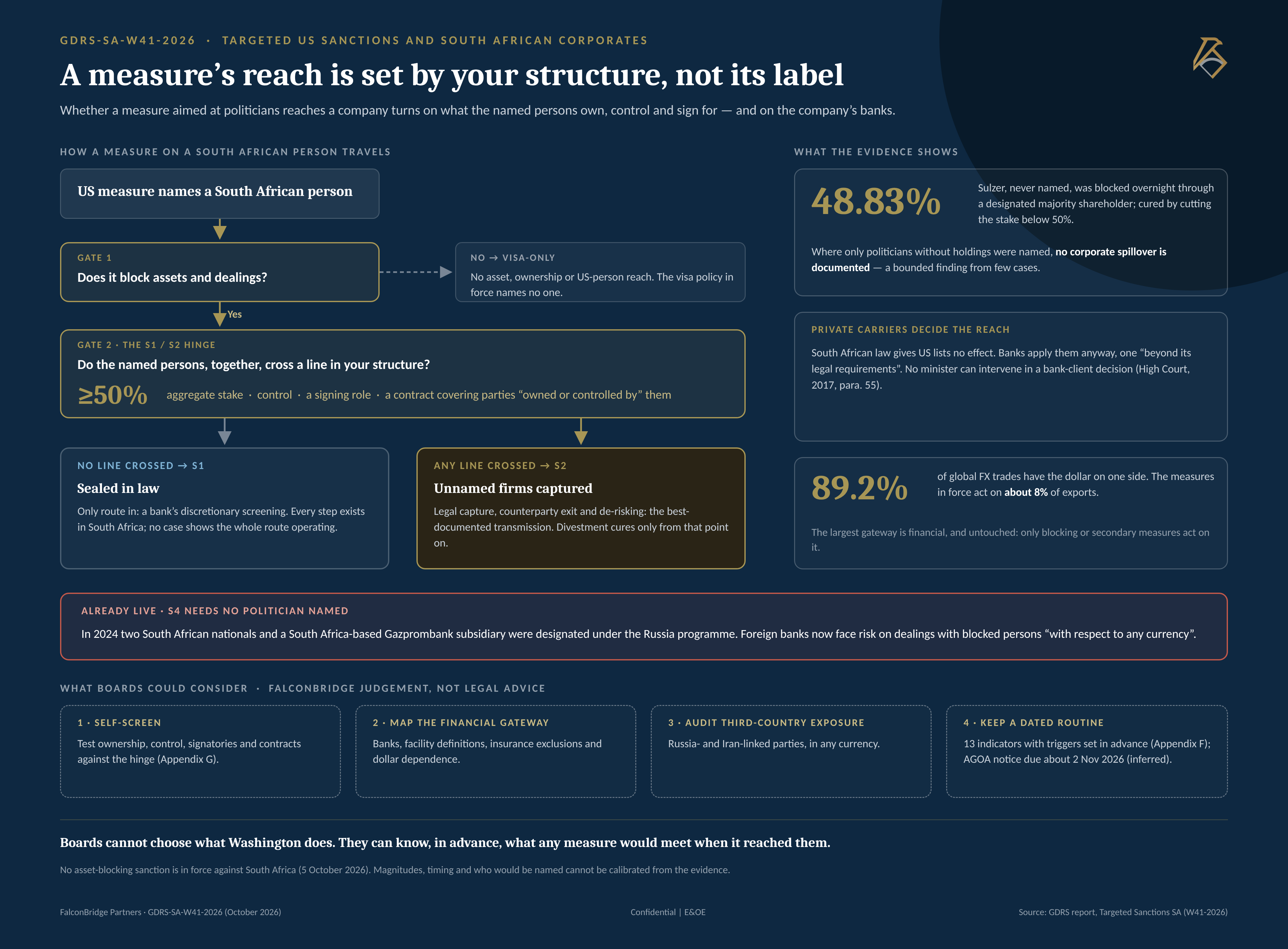
In September 2026 a former chief executive of Sibanye-Stillwater urged Washington to target the individuals behind contested policies rather than the country. The call assumes that a measure aimed at politicians spares companies. This study tested that assumption against the record of US measures elsewhere and South Africa’s own position. No asset-blocking sanction is in force against South Africa; the measures in force are an aid halt, tariffs and a visa policy that names no one. Reach depends on what the named person owns, not on the office they hold. Sulzer, a Swiss listed company that was never named, was blocked overnight because a designated shareholder held more than half of it. It was “in danger of becoming insolvent” until a buy-back cut the stake to 48.83%. Where only politicians without corporate holdings were named, no corporate spillover is documented; that is a bounded finding from a small set of cases, not proof of safety. In South Africa, private carriers decide how far a measure travels. The law gives US lists no effect, yet banks apply them anyway, one “beyond its legal requirements”, and the courts have held that no minister can intervene in a bank-client decision. Under a politicians-only measure, a bank’s discretionary screening would be the only route to a company. Every step of that route exists here; no case anywhere shows the whole route operating. Two exposures do not depend on the label at all. The largest gateway is financial: the US dollar is on one side of 89.2% of global foreign-exchange trades, while the measures now in force act on about 8% of exports. And a secondary-sanctions route is already live: in 2024 two South African nationals and a South Africa-based Gazprombank subsidiary were designated under the Russia programme, with no South African politician named. The evidence cannot size the effect. All five starting hypotheses are partly supported; magnitudes, timing and who would be named cannot be calibrated, and the data boards would need to measure exposure are decaying. Three gates remain open: AGOA eligibility for 2027 (notice due by about 2 November 2026, on the study’s inference), the stalled Global Magnitsky bill, and any new OFAC designation of South African persons. Boards could consider screening their own ownership, control, signing roles and contracts against the 50%, control, signatory and “owned or controlled” lines; mapping their banks, facility terms, insurance exclusions and dollar dependence; auditing Russia- and Iran-linked dealings in any currency; and keeping a dated indicator routine with triggers set in advance. Boards cannot choose what Washington does. They can know, in advance, what any measure would meet when it reached them. Figures and findings above are verified in the source report (evidence fetched and checked on 5 October 2026). The final paragraph’s considerations are FalconBridge Partners’ judgement, offered for the reader’s own decision. Not legal advice; no company is assessed and no government’s policy is evaluated.
No asset-blocking sanction
No asset-blocking sanction is in force against South Africa; the measures in force are an aid halt, tariffs and a visa policy that names no one.
89.2%
The largest gateway is financial: the US dollar is on one side of 89.2% of global foreign-exchange trades, while the measures now in force act on about 8% of exports.
Three gates
Three gates remain open: AGOA eligibility for 2027 (notice due by about 2 November 2026, on the study’s inference), the stalled Global Magnitsky bill, and any new OFAC designation of South African persons.
The Weekly Signal behind this study
South Africa · Week 41, 2026
The complete package
Four elements, tailored to the question and to how readers will use the work
Tell us who is reading and the pack is emailed to you straight away. The package is released under a Type-1 licence for the requester’s own use. Public access does not transfer ownership.

A conversation about your decision
What needs to be understood
before your next decision?
Bring the proposition, question or direction you are working on. Together, we can define the support it requires.
Start a conversation