Public study · North Carolina · 2026
NC Commercialisation Prediction Study
The Constraint Is Observation, Not Knowledge
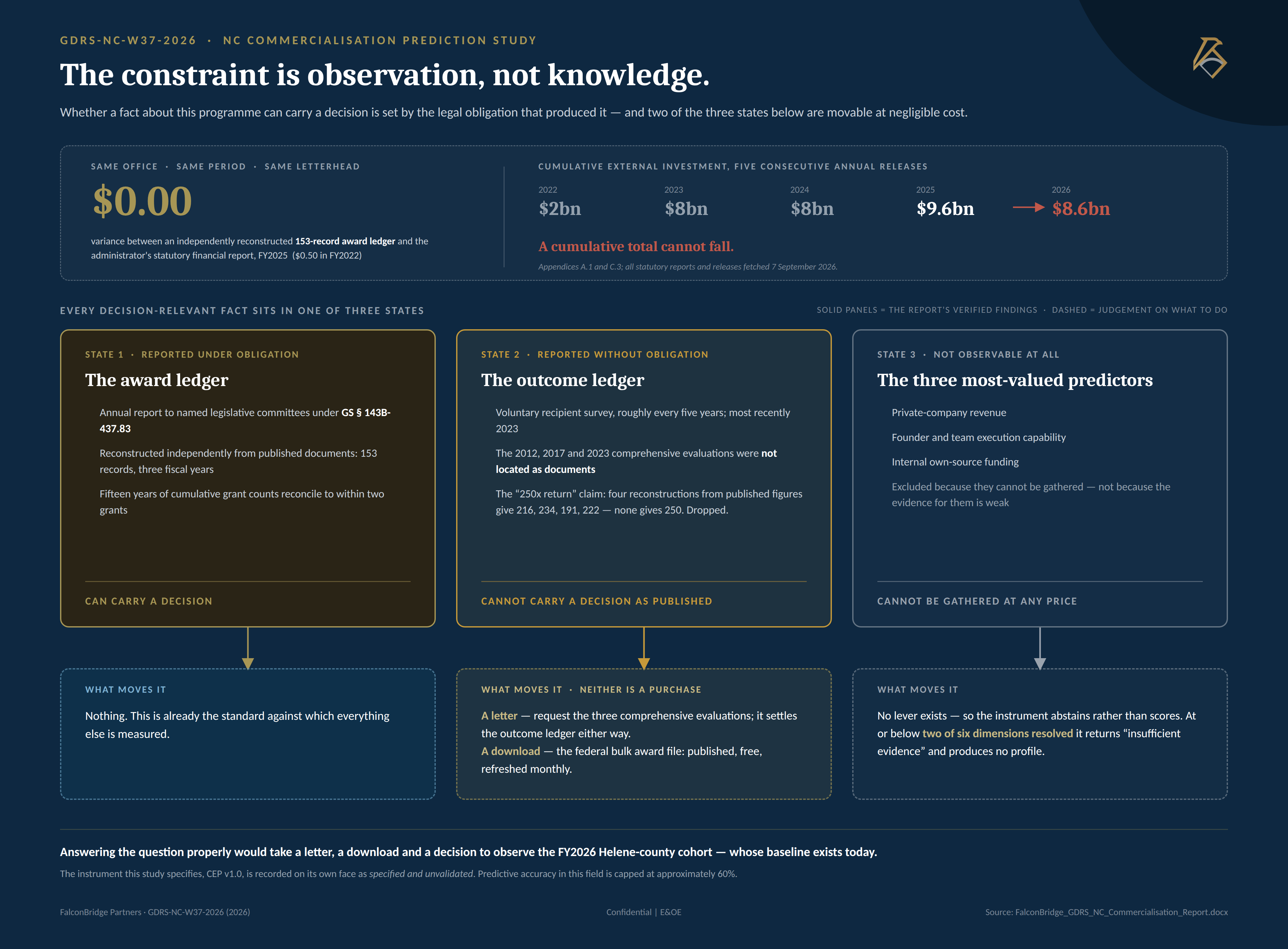
North Carolina has issued 920 grants totalling more than $41.7 million since 2006 to state technology firms that win federal SBIR and STTR awards. This study was asked which observable characteristics predict whether such firms progress from grant-funded innovation into commercially sustainable, investable businesses — and whether that prediction can be made from public evidence at all. It was conducted to a hard-fetch standard: ninety sources registered, seventy-six fetched and confirmed against the specific claim cited, eleven retrieval failures disclosed, and fifteen corrections to previously stated facts recorded openly. An independent reconstruction of the programme's award ledger — 153 matching-award records across three fiscal years, built from the administrator's own published documents — reconciles to $0.00 against the statutory financial report in FY2025, and to $0.50 in FY2022. Over the same period the same office's cumulative external-investment figure runs from more than $2 billion (2022) to over $8 billion (2023 and 2024), $9.6 billion (2025) and more than $8.6 billion (2026). A cumulative total cannot fall. The explanation is obligation, not carelessness. The financial figures are produced under a statutory annual reporting duty to named legislative committees; the outcome figures come from a voluntary recipient survey conducted roughly every five years, most recently in 2023, whose three underlying comprehensive evaluations were not located as documents. Both appear under the same letterhead, often in adjacent sentences. The transferable test is to ask what would happen to the publisher if the number were wrong. The award records themselves are excellent — complete, published, granular, and reconcilable across fifteen years of statutory reports to within two grants. The one usable outcome statistic, 60% of matching-grant winners advancing to a Phase II federal award against a national rate of 54%, rests on a compulsory reporting stream, though an identical pair of figures is attributed to both the 2017 and the 2023 evaluations, and Phase II conversion is the outcome most contaminated by selection. Near-uniform allocation, at an award-value Gini coefficient of 0.077, is the defensible response to a field in which predictive accuracy is capped at approximately 60%. The limits are stated plainly. The selection effect cannot be quantified: it is present by construction, because the state's eligibility gate is a federal award decision and no independent quality screen is applied. Predictors cannot be ranked by measured strength within this population, because outcome data of sufficient cohort age does not exist in public form. The instrument the study specifies is recorded as specified and unvalidated. And three of the characteristics rated most highly — private-company revenue, founder and team execution capability, internal own-source funding — are structurally unobservable from public records. Three steps would change what can be said, and none of them is a purchase: requesting the 2012, 2017 and 2023 comprehensive evaluations, which is a letter; acquiring and parsing the published federal bulk award file, which is a download; and deciding now to observe the FY2026 Hurricane Helene-county cohort, whose baseline exists today and whose outcome window opens around FY2029. Of five purchase options assessed one is judged worth making, and packaged third-party company risk scores are suggested against, since they substitute an undisclosed model for a traceable evidence trail. Figures and findings above are drawn from the source report, where each is traced to a fetched primary source and carries its own confidence marking. The three steps in the closing paragraph are offered as considerations for the reader's own decision, not as directions the source report issues.
920 grants
North Carolina has issued 920 grants totalling more than $41.7 million since 2006 to state technology firms that win federal SBIR and STTR awards.
$0.00
An independent reconstruction of the programme's award ledger — 153 matching-award records across three fiscal years, built from the administrator's own published documents — reconciles to $0.00 against the statutory financial report in FY2025, and to $0.50 in FY2022.
60% against 54%
The one usable outcome statistic, 60% of matching-grant winners advancing to a Phase II federal award against a national rate of 54%, rests on a compulsory reporting stream, though an identical pair of figures is attributed to both the 2017 and the 2023 evaluations, and Phase II conversion is the outcome most contaminated by selection.
The Weekly Signal behind this study
North Carolina · Week 37, 2026
The complete package
Five elements, tailored to the question and to how readers will use the work
Tell us who is reading and the pack is emailed to you straight away. The package is released under a Type-1 licence for the requester’s own use. Public access does not transfer ownership.

A conversation about your decision
What needs to be understood
before your next decision?
Bring the proposition, question or direction you are working on. Together, we can define the support it requires.
Start a conversation