Public study · South Africa · 2026
Corporate Insurance Governance: Board Assurance of Effective Risk Transfer
What a board can establish before approving an insurance programme
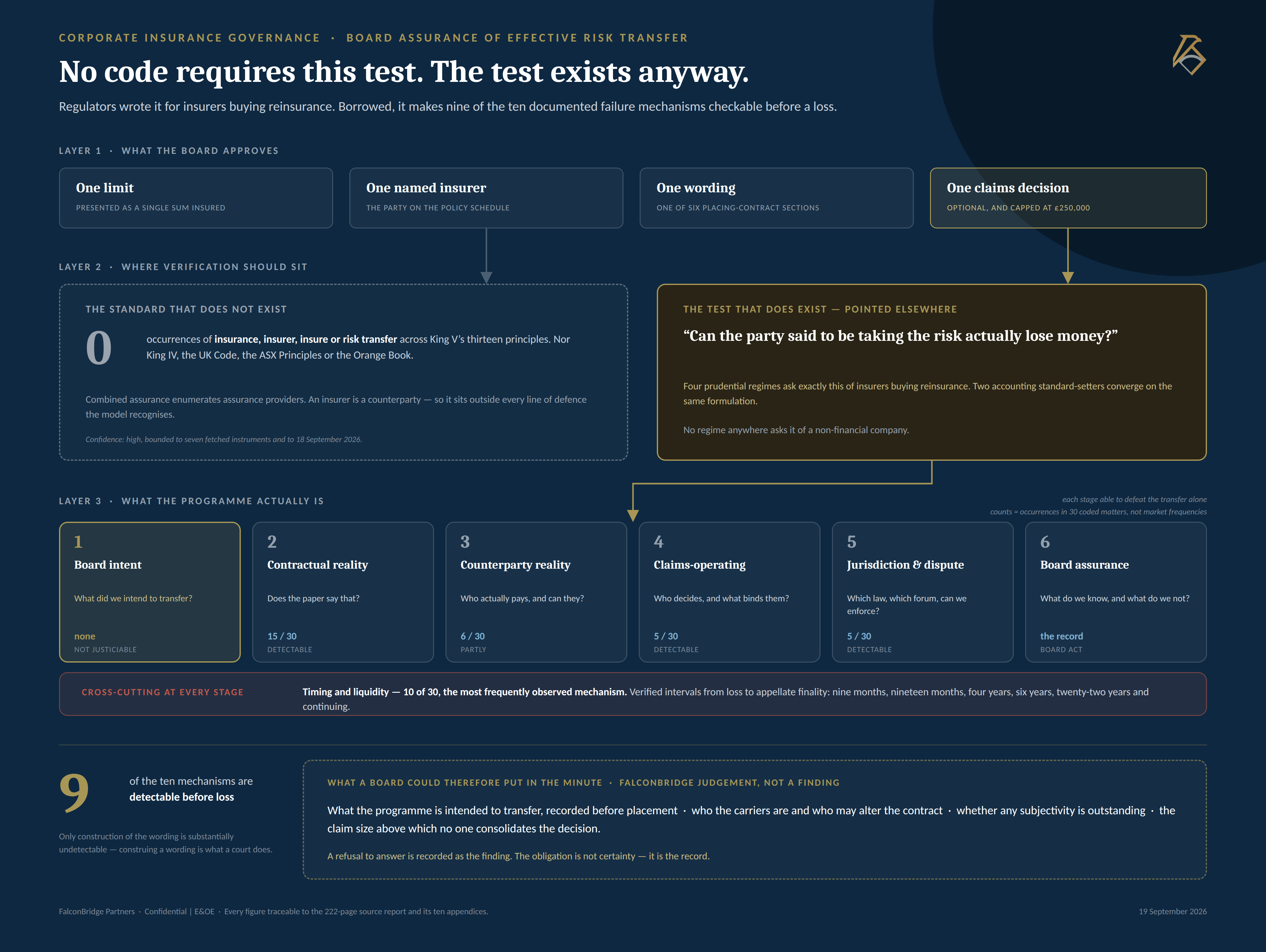
Boards approve insurance programmes standing behind their organisation’s largest exposures. Unlike acquisitions, financing and major capital investment, those approvals are made without any governance standard telling the board what it should have established first. This study asked what a board can determine before approval, and what framework would let it test the answer. There is no standard, and the gap is structural. The Code on Corporate Governance for South Africa 2025 — King V, in force for financial years beginning on or after 1 January 2026 — contains no occurrence of insurance, insurer, insure or risk transfer across its thirteen principles. Neither does King IV’s Chapter 5 Code, nor the United Kingdom Code and its guidance in the internal-control context, nor the ASX Principles beyond directors’ own indemnity, nor HM Treasury’s Orange Book. Confidence is recorded as high, bounded to seven fetched instruments and to 18 September 2026. The silence has a cause. Combined assurance enumerates assurance providers, and an insurer is a counterparty — so the organisation’s largest contractual dependency sits outside every line of defence its own assurance model recognises. Nor is the programme one contract. Each insurer contracts severally for its own share and is not responsible for a co-subscriber’s default; the standard placing contract has six sections, of which a board is usually shown one; and the market’s contract certainty regime permits final documentation to follow inception by thirty calendar days for a commercial buyer. The encouraging finding is that the test does not have to be invented. Four developed regimes already ask the right question of insurers in their capacity as buyers of reinsurance, and two accounting standard-setters converge on the same formulation: can the party said to be taking the risk actually lose money? Of ten failure mechanisms coded from thirty documented matters, nine are detectable before loss — visible in a subjectivity register, a carrier schedule, a governing-law clause. Only construction of the wording is substantially undetectable, because construing a wording is what a court does. Four questions could not be resolved from public sources: the prevalence of pay-as-paid clauses in South African fronting, which could not be established from any source and is not adopted; the proper law absent an express choice; co-insurers’ several liability; and promissory warranties. No regulator or ombud in either primary jurisdiction publishes commercial-lines claims acceptance or denial rates or dispute durations, so no market benchmark exists. The framework itself is proposed and reasoned rather than observed — no instance of a corporate board adopting such a model was located. A board could consider recording, before placement, what the programme is intended to transfer and what is retained; asking for the security and subscription sections of its placing contract, not the wording alone; and computing the claim size above which its programme no longer has a consolidated claims decision. Delay rather than denial is the consequence that recurs, at verified intervals from nine months to twenty-two years and continuing. A board that can say whether it is covered, but not for how long it might be unpaid, has answered the less important question. Findings and figures above are drawn from the source report, where each is traced to a dated primary source and carries its own confidence marking. Statements of what a board could consider doing are FalconBridge’s judgement, offered for the reader’s own decision rather than as requirements. E&OE. All rights reserved.
No standard
There is no standard, and the gap is structural.
Nine of ten
Of ten failure mechanisms coded from thirty documented matters, nine are detectable before loss — visible in a subjectivity register, a carrier schedule, a governing-law clause.
Nine months to twenty-two years
Delay rather than denial is the consequence that recurs, at verified intervals from nine months to twenty-two years and continuing.
The complete package
Five elements, tailored to the question and to how readers will use the work
Tell us who is reading and the pack is emailed to you straight away. The package is released under a Type-1 licence for the requester’s own use. Public access does not transfer ownership.

A conversation about your decision
What needs to be understood
before your next decision?
Bring the proposition, question or direction you are working on. Together, we can define the support it requires.
Start a conversation