Public study · North Carolina · 2026
From Entitlement to Equity
Charlotte TOD: Can the Dirt Carry a Stack?
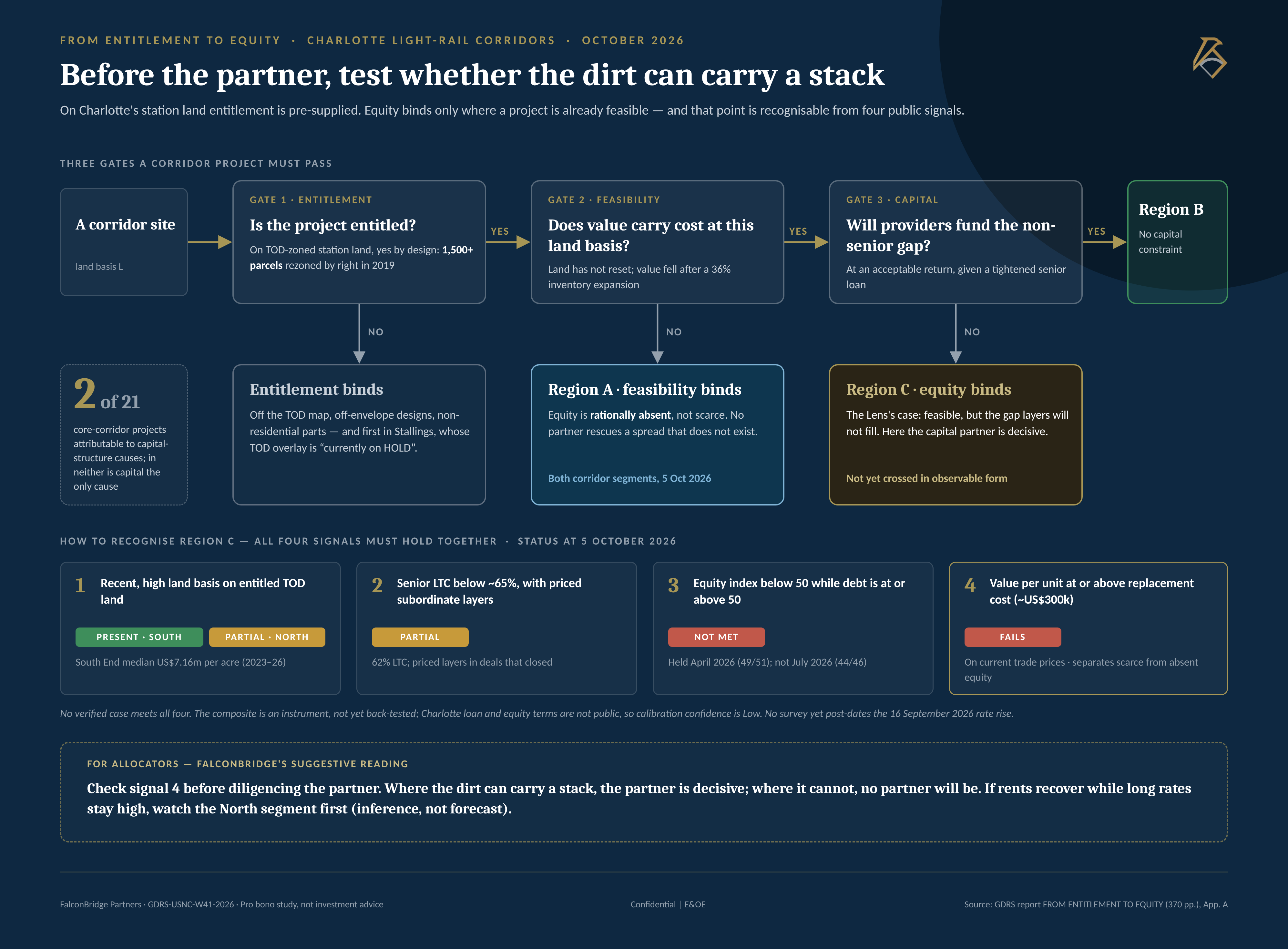
FalconBridge’s Week 41 Weekly Signal concluded that in Charlotte’s transit corridors “the equity stack — not the entitlement — is the binding constraint on delivery”. The study tested that claim rather than illustrating it, and the transaction cited in its support did not survive the county register: no US$27.5m sale is recorded, the site lies north of Uptown rather than in South End, and the Signal’s “suburban transit node” has no funded rail (errata ER-01 to ER-06). Entitlement is not the constraint on station land, by design. In April 2019 Charlotte rezoned more than 1,500 Blue Line parcels into districts where stacked multifamily is permitted by right, and height is bought at a posted fee. No verified corridor project was killed by entitlement; it still binds off the transit-zoned map and in suburbs such as Stallings. Most current stalls are a feasibility problem, not an equity shortage. Land prices did not reset — South End’s median rose from US$3.83m to US$7.16m per acre while deal volumes roughly halved — and value fell after a 36% inventory expansion, with concessions at 14.5%. Where value cannot carry cost, equity is rationally absent rather than scarce. Only 2 of 21 core-corridor projects can be attributed to capital-structure causes, and in neither is capital the only cause. Equity does bind at the margin. Nationally, debt recovered first while the equity index stayed below 50 for ten consecutive quarters, and the Charlotte deals that closed relied on lower-leverage senior debt, priced mezzanine and structured or offshore equity. The September 2026 rate rise and a 10-year yield of 5.28% may widen that margin in the recovery, most likely in the North segment first — an inference, not a forecast. The threshold is recognisable only as a composite of four public signals: a recent, high land basis on entitled land; senior loan-to-cost below about 65% with priced gap layers; an equity index below 50 while debt is at or above 50; and corridor value at or above replacement cost. At 5 October 2026 no verified case meets all four, and the composite has not been back-tested. Charlotte-specific loan and equity data do not exist publicly, so confidence is Moderate overall and Low on calibration. Allocators could consider testing whether a corridor project clears its residual before underwriting the partner, starting with value per unit against replacement cost. Where the dirt can carry a stack, the partner is decisive; where it cannot, no partner will be. FalconBridge could consider maintaining the diagnostic quarterly, because the public record that would reveal the equity constraint is decaying. Facts and figures above are findings of the GDRS report, verified against primary sources on 5 October 2026; market readings may have moved since. The final paragraph is FalconBridge’s suggestive judgement for the reader’s own decision. It is not investment, legal or financial advice.
2 of 21
Only 2 of 21 core-corridor projects can be attributed to capital-structure causes, and in neither is capital the only cause.
1,500 parcels
In April 2019 Charlotte rezoned more than 1,500 Blue Line parcels into districts where stacked multifamily is permitted by right, and height is bought at a posted fee.
Four public signals
At 5 October 2026 no verified case meets all four, and the composite has not been back-tested.
The Weekly Signal behind this study
North Carolina · Week 41, 2026
The complete package
Five elements, tailored to the question and to how readers will use the work
Tell us who is reading and the pack is emailed to you straight away. The package is released under a Type-1 licence for the requester’s own use. Public access does not transfer ownership.

A conversation about your decision
What needs to be understood
before your next decision?
Bring the proposition, question or direction you are working on. Together, we can define the support it requires.
Start a conversation