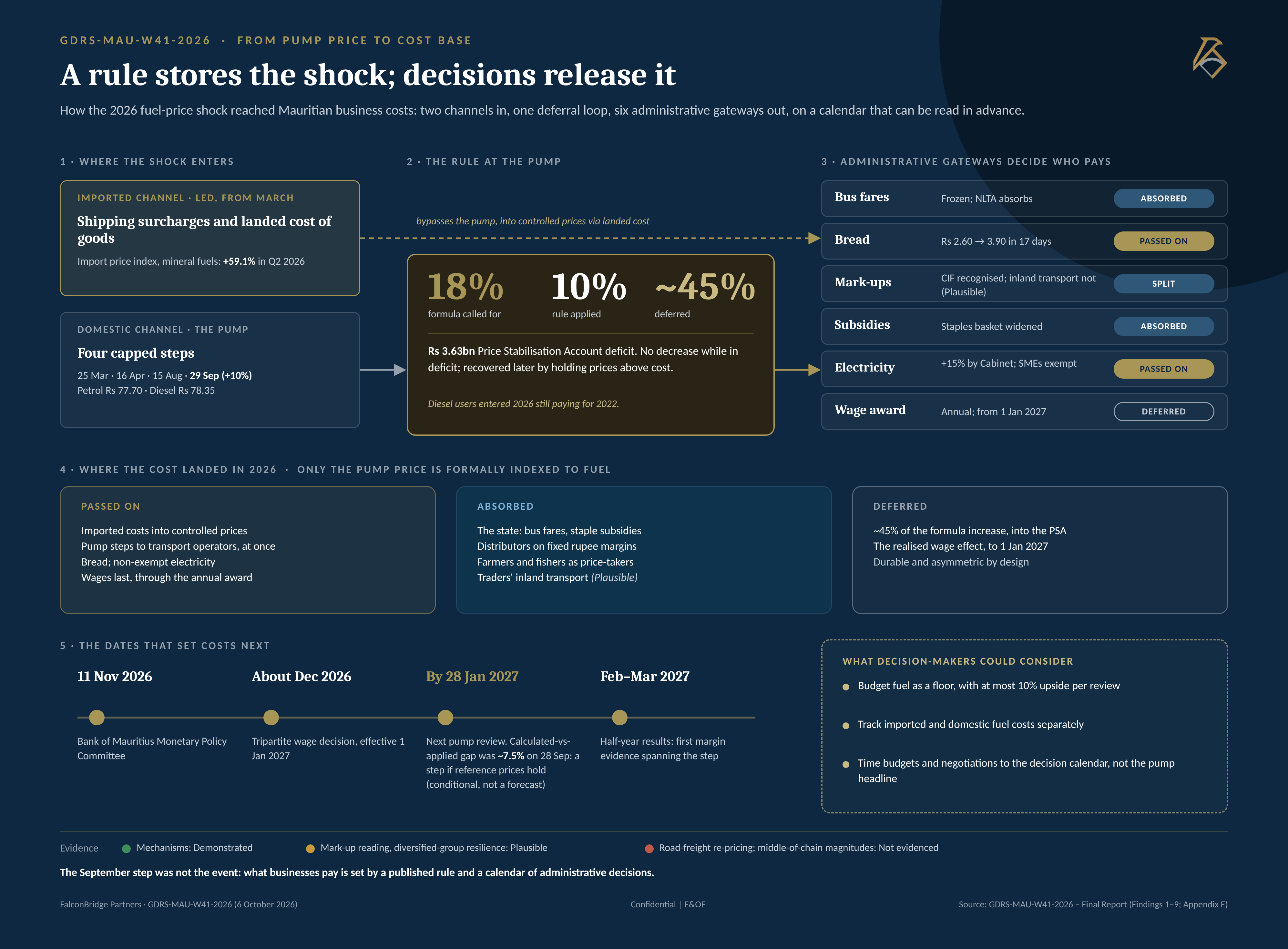
On 29 September 2026 Mauritian pump prices rose about 10%: petrol to Rs 77.70 a litre, diesel to Rs 78.35. FalconBridge’s Weekly Signal called this a second-round cost event and a leading indicator for wages and margins. This study tested that claim against primary sources, asking through which channels, and in what order, such a step reaches business costs. The September step was the capped part of a larger shock. The pricing formula called for about 18%; the rule allowed 10%, deferring about 45% into a Rs 3.63 billion Price Stabilisation Account deficit. No decrease is permitted while that account is in deficit, and the deferral is recovered later by holding prices above cost. Diesel users entered 2026 still paying for 2022: a diesel decrease was refused as late as 2 March 2026. The shock arrived through two channels, and the imported one led. Shipping surcharges rose from March, and the import price index for mineral fuels rose 59.1% in the second quarter. Downstream, administrative decisions rather than markets set who paid: bus fares were frozen, bread was raised within 17 days of the March diesel step, subsidies on staples were widened, electricity rose 15% by Cabinet decision, and wages respond through an annual award from 1 January. Of nine domestic price mechanisms examined, only the pump price is formally indexed to fuel. The Signal’s “second-round” label mostly describes indirect first-round effects. Wages are the slowest channel: private wage rates rose 4.8% against 3.7% inflation, reflecting the scheduled award, with no sign of a wage-price spiral. The system is also unusually transparent: the pump computation, the deferral and the account balance are published at every review. The mechanisms are well evidenced; the magnitudes in the middle of the chain are not. Road-freight re-pricing is not evidenced in any public source, the reading that controlled mark-ups exclude inland transport is plausible and awaits a legal check, and diversified groups’ resilience is plausible but not demonstrated. Three items stay open at dated gates: the September and October CPI, the 2027 wage award, and half-year results to December 2026. Businesses could budget fuel as a floor with a bounded upside of at most 10% per review, track imported and domestic fuel costs separately, and time budgets and negotiations to the decision calendar: the Bank of Mauritius on 11 November, the tripartite wage decision around December, and the next pricing review by 28 January 2027. The rule supplies its own leading indicator, the gap between calculated and applied prices, which stood at about 7.5% on 28 September. If reference prices hold, the rule implies a further step; this is conditional, not a forecast. Figures and findings above are drawn from the source report and carry its evidence grades (Demonstrated, Plausible, Asserted, Not evidenced). The final paragraph is FalconBridge’s suggestive judgement about what decision-makers could consider, offered for their own decision; it is not a forecast or advice.
Rs 3.63 billion
The pricing formula called for about 18%; the rule allowed 10%, deferring about 45% into a Rs 3.63 billion Price Stabilisation Account deficit.
Nine mechanisms
Of nine domestic price mechanisms examined, only the pump price is formally indexed to fuel.
About 7.5%
The rule supplies its own leading indicator, the gap between calculated and applied prices, which stood at about 7.5% on 28 September.
The Weekly Signal behind this study
Mauritius · Week 41, 2026
The complete package
Five elements, tailored to the question and to how readers will use the work
Tell us who is reading and the pack is emailed to you straight away. The package is released under a Type-1 licence for the requester’s own use. Public access does not transfer ownership.

A conversation about your decision
What needs to be understood
before your next decision?
Bring the proposition, question or direction you are working on. Together, we can define the support it requires.
Start a conversation