Public study · North Carolina · 2026
Grievance, Evidence And Social Licence – Private Equity (US)
Private Equity's Social Licence: Grievance, Evidence and the Path Back
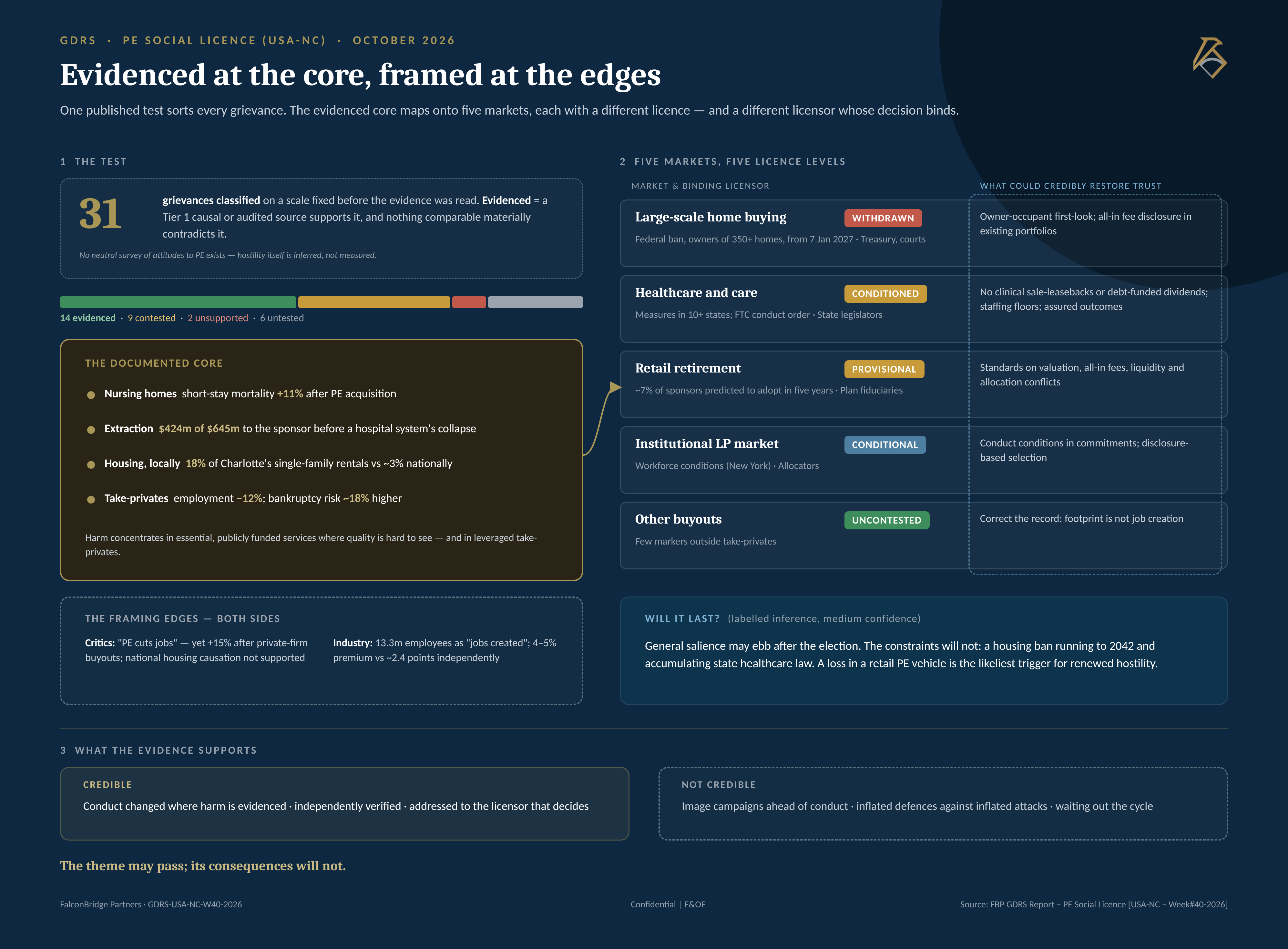
A column in The New Republic on 2 October 2026 argued that “everyone hates private equity” just as federal policy opens 401(k) savings to private assets. The study asked how far that hostility rests on documented outcomes rather than political framing, and which levers could credibly restore the industry's social licence as it enters retail retirement savings. The hostility is real but has never been measured: no neutral, recurring survey of attitudes to private equity exists. The grievances themselves can be tested. Of 31 grievances classified on a scale fixed before the evidence was read, 14 are evidenced — among them an estimated 11% rise in short-stay mortality after PE acquisition of nursing homes, $424m of $645m in payouts to a sponsor before a hospital system collapsed, and employment 12% lower two years after take-privates of listed firms. The edges are framing, on both sides. “PE cuts jobs” ignores employment growth of about 15% after buyouts of private firms; the industry presents 13.3 million employees at PE-backed firms as jobs created, and claims a 4–5% annual return premium against an independent benchmark of about 2.4 points. Figures degrade as they travel: nine of the fifteen factual claims in the trigger article required correction. There is no single licence to restore. It is withdrawn for large-scale home purchases (a federal ban for owners of 350 or more homes from 7 January 2027), conditioned in healthcare by measures in at least ten states, provisional in retail retirement — where asset managers and consultants predict only about 7% of plan sponsors will adopt within five years — and largely uncontested elsewhere. As labelled inference, with medium confidence, the study judges that the theme may pass after the election but these constraints will not. What remains open: the retail and housing findings are conditional on the Department of Labor's final rule, the SEC's 30 September 2026 proposals, the Supreme Court's decision in Anderson v. Intel and Treasury's implementation of the ban. Newer hospital studies could not be retrieved, and North Carolina evidence is thin. The comparator evidence and the trust-repair literature point the same way: communication without conduct change fails or backfires. The levers most likely to restore trust change conduct where grievances are evidenced, make that change independently verifiable, and reach the licensor whose decision binds: commitments on extraction, leverage and staffing in care; retail-vehicle standards on valuation, fees and liquidity; and a US public-reporting code with an independent monitor. Those holding the levers could consider a sequence — correct the record, then change conduct, then verify it. Figures above are verified findings drawn from the source report, with its qualifiers. The final paragraph's options are FalconBridge's judgement, offered for each reader's own decision; FalconBridge takes no position on contested public policy. E&OE. All rights reserved.
14 of 31
Of 31 grievances classified on a scale fixed before the evidence was read, 14 are evidenced — among them an estimated 11% rise in short-stay mortality after PE acquisition of nursing homes, $424m of $645m in payouts to a sponsor before a hospital system collapsed, and employment 12% lower two years after take-privates of listed firms.
Nine of fifteen
Figures degrade as they travel: nine of the fifteen factual claims in the trigger article required correction.
No single licence
There is no single licence to restore.
The complete package
Five elements, tailored to the question and to how readers will use the work
Tell us who is reading and the pack is emailed to you straight away. The package is released under a Type-1 licence for the requester’s own use. Public access does not transfer ownership.

A conversation about your decision
What needs to be understood
before your next decision?
Bring the proposition, question or direction you are working on. Together, we can define the support it requires.
Start a conversation