Public study · New Zealand · 2026
One Result, Two Obligations
One Rebound, Read Two Ways
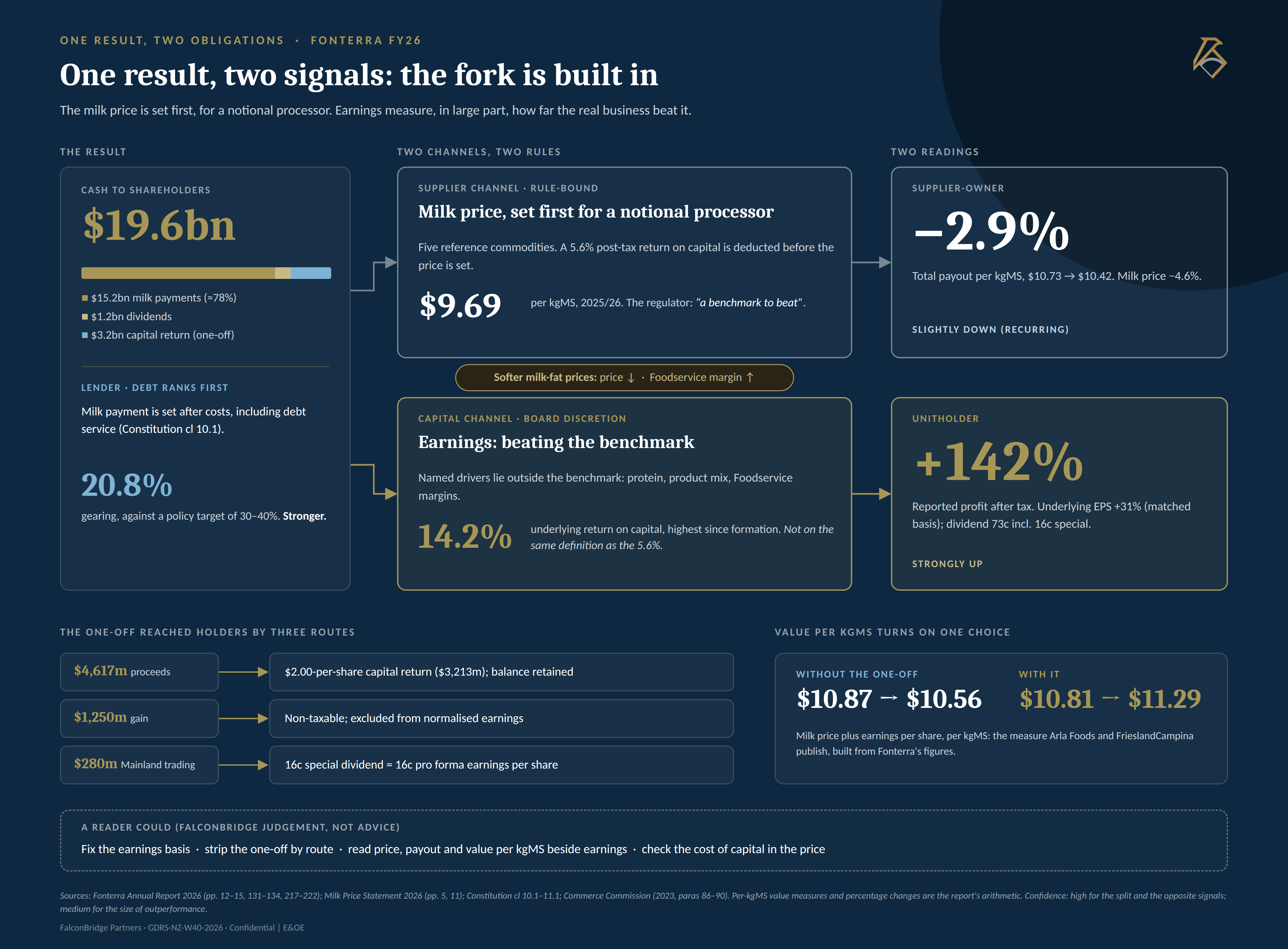
On 24 September 2026 Fonterra reported profit after tax of $2.6 billion, up 142%. FalconBridge's Weekly Signal warned that the result mixed continuing operations with a large one-off. The study asked a sharper question: how does a co-operative's dual obligation, a milk price to the farmers who supply and own it and earnings to shareholders, including outside investors who supply no milk, change how an earnings rebound should be read? The same result sent opposite signals. Reported profit after tax rose 142% and underlying earnings per share 31% on a matched basis; total payout per kgMS fell 2.9%, from $10.73 to $10.42, and the milk price 4.6%, to $9.69. The direction differed, not merely the size. Lenders saw a stronger balance sheet: gearing of 20.8% against a policy target of 30–40%. The cause is structural. Fonterra's Constitution makes the milk payment a residual of income after costs, including debt service, bound to a regulated method; distributions to capital are at the Board's discretion. The price is calculated for a notional processor allowed a 5.6% post-tax return on capital, which the regulator calls “a benchmark to beat”. Fonterra's earnings therefore measure, in large part, how its real business beat that benchmark. In FY26 the drivers it names (protein, product mix and Foodservice margins helped by softer milk-fat prices) lay outside the benchmark; the same fall in milk-fat prices lowered the supplier's price. The one-off reached holders by three routes. Proceeds of $4,617 million from the sale of Mainland Group to Lactalis funded a $2.00-per-share capital return ($3.2 billion); a $1,250 million non-taxable gain was excluded from normalised earnings; and a 16-cent special dividend matched Mainland's pro forma earnings per share. Removing one “benefit” figure does not remove the one-off. A value-per-kgMS measure of the kind Arla Foods and FrieslandCampina publish, built from Fonterra's own figures, fell from $10.87 to $10.56 without the one-off and rose from $10.81 to $11.29 with it. Fonterra's disclosure is complete for a reader who goes to the Annual Report, which reconciles seven earnings bases and states how cash reached shareholders. The difficulty lies in the results release, which uses the same “71 cents” on two bases a year apart, and in key documents that have become harder to retrieve. Confidence is high for the decomposition, the cash split, the constitutional ranking and the opposite signals; medium for the size of the outperformance (a 14.2% return on capital and a 5.6% allowed return are not on the same definition) and for durability; low for holder-level tax. How farmers' shareholdings are distributed is not published. FY27 guidance of 65–85 cents per share and a $9.50 milk-price forecast are Fonterra's forecasts. Readers of a co-operative's result could fix the earnings basis, strip the one-off by route, and set the milk price, total payout and value per kgMS, with and without one-offs, beside earnings before concluding. Boards could consider publishing that value measure in the release itself. The report's Dual-Lens Reading Framework sets out the nine steps. Figures above are findings of the source report, drawn from Fonterra's Annual Report 2026, Milk Price Statement 2026, Constitution and the Commerce Commission's reviews; per-kgMS value measures and percentage changes are the report's arithmetic on those figures. The final paragraph is FalconBridge's judgement, offered for the reader's own decision. Not investment, lending or supply advice.
Up 142%
Reported profit after tax rose 142% and underlying earnings per share 31% on a matched basis; total payout per kgMS fell 2.9%, from $10.73 to $10.42, and the milk price 4.6%, to $9.69.
20.8%
Lenders saw a stronger balance sheet: gearing of 20.8% against a policy target of 30–40%.
Three routes
The one-off reached holders by three routes.
The Weekly Signal behind this study
New Zealand · Week 40, 2026
The complete package
Five elements, tailored to the question and to how readers will use the work
Tell us who is reading and the pack is emailed to you straight away. The package is released under a Type-1 licence for the requester’s own use. Public access does not transfer ownership.

A conversation about your decision
What needs to be understood
before your next decision?
Bring the proposition, question or direction you are working on. Together, we can define the support it requires.
Start a conversation