Public study · UAE / GCC · 2026
Preserving Strategic Optionality Under Prolonged Disruption
What Could Be Preserved Was Decided Before the Shock Began
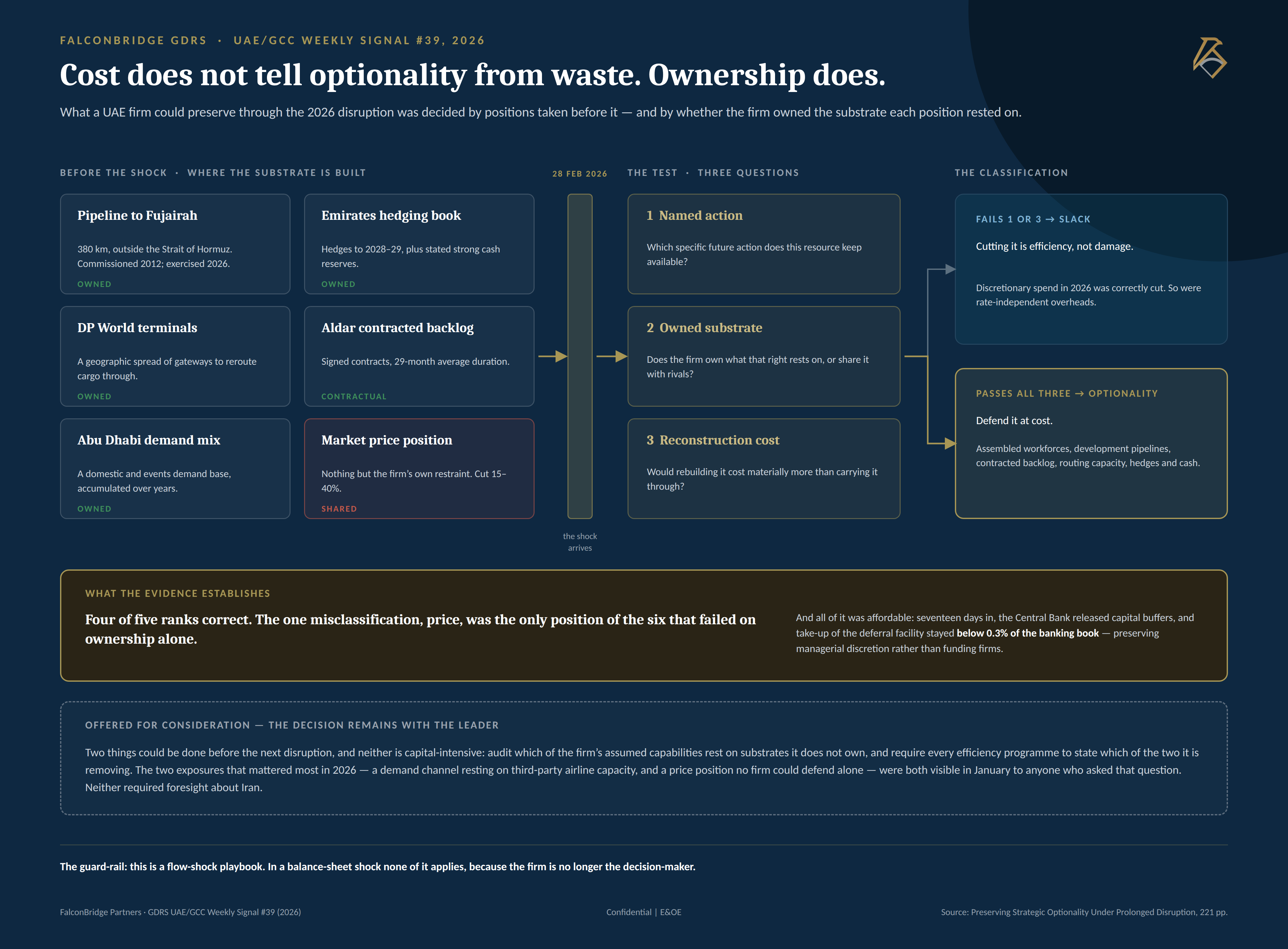
Between 28 February and 21 September 2026 the United Arab Emirates absorbed a severe regional disruption. Four independently managed hospitality groups, facing the same shock in the same market at the same time, made an identical set of choices: they cut price, withdrew physical capacity, and redirected demand generation — and not one cut headcount or cancelled a development pipeline. That is not a resilience story. It is a revealed preference about which resources can be rebuilt after a shock and which cannot, expressed simultaneously by managers under identical pressure, and this study exists to test whether the ranking they revealed was correct. It was, at four of five levels. The exception was price, and it failed on a single property: it was shared. No firm could hold rate alone, because once competitors discounted, holding became a decision to lose volume; by September the sector's own diagnosis placed full recovery at the fourth quarter of 2027, with the shortfall “primarily driven by rate pressure rather than occupancy challenges”. The mirror image appeared in aviation, where Emirates held capacity while four foreign carriers suspended into 2027 — converting a shared option into a proprietary one. The structural finding sits behind both. The decisive option exercised anywhere in the UAE that year was a pipeline commissioned in 2012 — 380 kilometres to Fujairah, outside the Strait of Hormuz — which could not have been built after the Strait closed, at any price, and which would have read as redundant capacity on any efficiency analysis for fourteen consecutive years. Optionality is therefore not distinguishable from waste by cost. It is distinguishable by three properties: whether it names a specific future action, whether it rests on a substrate the firm owns rather than shares, and whether rebuilding it would cost materially more than carrying it through. The behaviour was also affordable, and that is this report's central conditional. Seventeen days into the conflict the Central Bank released capital buffers and instructed banks to keep lending; take-up of the deferral facility stayed below 0.3% of the banking book. The instrument worked through availability rather than drawdown — it removed the fear that supporting a distressed borrower would trigger immediate capital consequences, and so preserved managerial discretion, the condition that fails first in most severe shocks. In a balance-sheet shock none of this transfers, because the firm is no longer the decision-maker. Two boundaries travel with the findings. Every widely watched indicator reassured during the worst months — the PMI reached a twenty-month high, national trade set a record, quarterly property sales were published as a 23.4% increase for a quarter that ended with the worst month since the pandemic — and not one of them was defective; five identifiable failure modes account for all of them. And the study describes approximately five per cent of UAE companies, because the other ninety-five per cent leave no public record: insolvency is unsuited to small firms, the observable exit is a lapsed trade licence, and Dubai's two-year licence extension deferred even that signal until 2028. The rate assessment is stated as the study's assessment and not as a settled finding, because no matched counterfactual exists. A board could therefore consider putting every proposed cut through three questions before it is taken — does this keep a specific future action available, does the firm own the substrate it rests on, and would rebuilding cost materially more than carrying it through — and, separately, auditing which of its assumed capabilities rest on substrates it does not own. The two exposures that mattered most in 2026, a demand channel resting on third-party airline capacity and a price position no firm could defend alone, were both visible in January to anyone who asked that question. Neither required foresight about Iran. Figures and findings above are drawn from the source report, where each was verified by live fetch of a primary source and is traceable to the literature review that established it. Statements of what a board could consider are offered as judgement for the reader's own decision, in the register the firm publishes: the decision remains with the leader. E&OE. All rights reserved.
Four of five levels
It was, at four of five levels. The exception was price, and it failed on a single property: it was shared.
380 kilometres
The decisive option exercised anywhere in the UAE that year was a pipeline commissioned in 2012 — 380 kilometres to Fujairah, outside the Strait of Hormuz — which could not have been built after the Strait closed, at any price, and which would have read as redundant capacity on any efficiency analysis for fourteen consecutive years.
Below 0.3%
Seventeen days into the conflict the Central Bank released capital buffers and instructed banks to keep lending; take-up of the deferral facility stayed below 0.3% of the banking book.
The Weekly Signal behind this study
UAE / GCC · Week 39, 2026
The complete package
Five elements, tailored to the question and to how readers will use the work
Tell us who is reading and the pack is emailed to you straight away. The package is released under a Type-1 licence for the requester’s own use. Public access does not transfer ownership.

A conversation about your decision
What needs to be understood
before your next decision?
Bring the proposition, question or direction you are working on. Together, we can define the support it requires.
Start a conversation