Public study · North Carolina · 2026
Public-Interest Guardrails in Healthcare Consolidation
Telling a Promise from a Protection, Before the Deal Closes
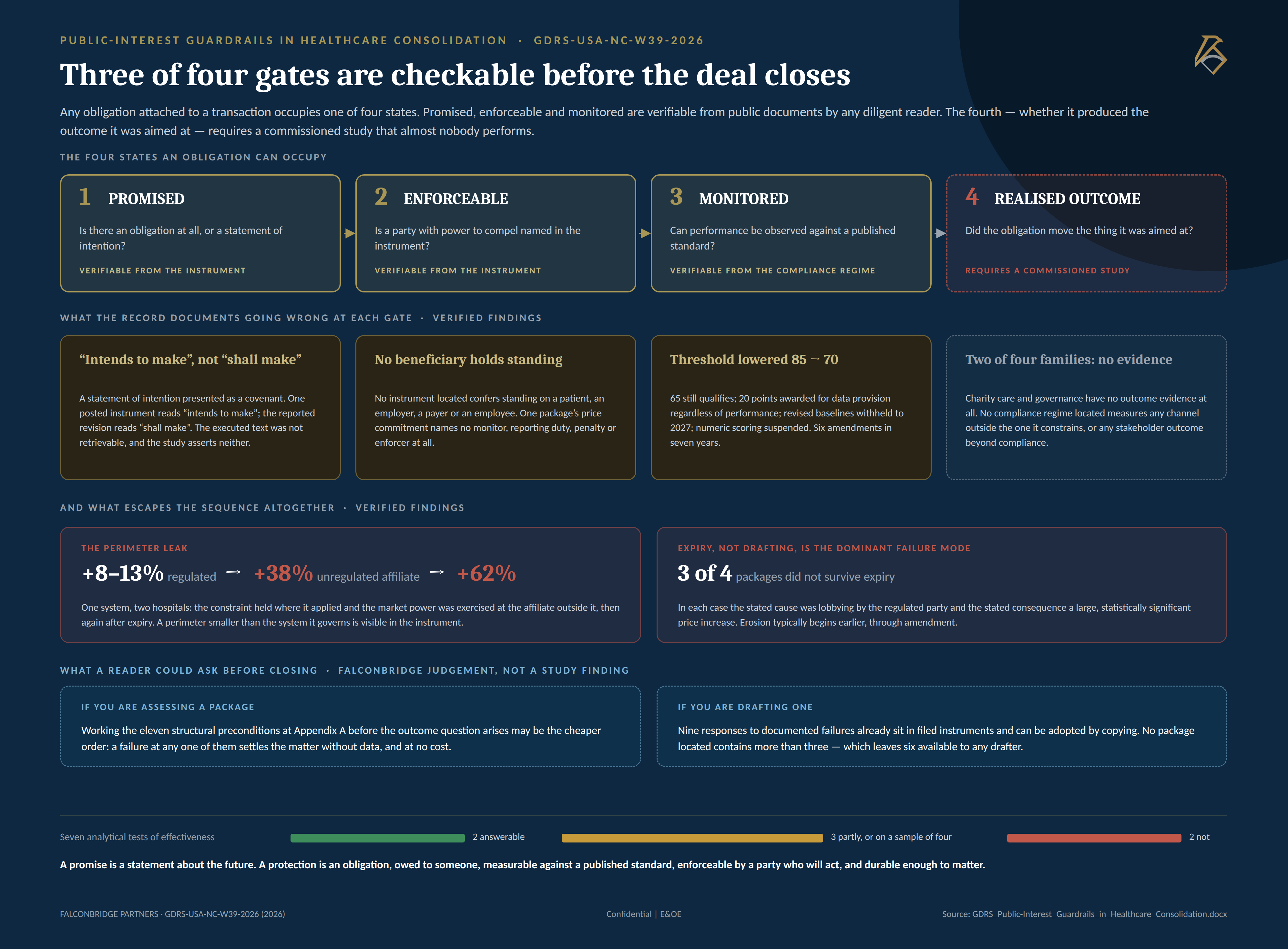
Over four days in September 2026 a proposed North Carolina health-system combination acquired a package of public-interest commitments — a price cap at 1.5× Medicare reimbursement increases, a $2 billion investment, an indigent-care floor raised from 4.8% to 8% of adjusted revenues, and county-appointed governance — and the State’s Governor moved from stated concern to stated non-opposition. The study asks the question every board, attorney general, county authority and employer coalition faces when such a package arrives: is it worth anything? It answers from the instruments themselves, assessing seven verified packages across six jurisdictions and four decades, with every cited claim confirmed by fetching the source and reading the claim on the page. One finding governs everything else. Three of the four states an obligation can occupy — promised, enforceable, monitored — are verifiable from public documents by any diligent reader; the fourth, whether the obligation produced the outcome it was aimed at, requires a commissioned study that almost nobody performs. Of the seven analytical tests the commission specified, two are answerable on present evidence, one on a sample of four transactions by a single study, two are partly answerable, and two — additionality and substitution — are barely or not answerable at all. That asymmetry is the shape of the field rather than a gap in the research, and it is useful. A package that controls the wrong quantity, has a perimeter smaller than the system it governs, names no enforcer, or is not published cannot be effective whatever outcome data might later show, because the mechanisms through which it would operate are absent — and each of those defects is legible in the instrument before the transaction closes. The record supplies the demonstration: under one certificate a regulated hospital’s prices rose 8–13% against peers while the unregulated affiliate inside the same system rose 38%, and 62% after expiry. Little is risked by binding tightly: the benefit that genuinely requires common ownership is a financing-cost reduction of approximately one per cent of operating costs, arising once on entry into system ownership, alongside a six per cent price increase. The instruments are not futile, and they are visibly improving. The field’s only systematic evaluation finds that properly designed conditions “can effectively constrain prices in the absence of competition among providers.” Nine design responses to documented failures already exist in filed documents — among them a level cap expressed as a multiple of an external schedule, a site-neutrality prohibition, a pricing term outliving supervision, and an external consent requirement for amendment — and can be adopted by copying. No package located contains more than three of them. What remains unestablished is stated as such. Three of four packages did not survive expiry, in each case following lobbying by the regulated party. Two of the four guardrail families examined — charity care and governance — have no outcome evidence at all. No compliance regime located measures any channel outside the one it constrains, or any stakeholder outcome beyond compliance itself. The operative pricing text of the most extensively supervised package in the United States is not published, so the study asserts no figure for it. A board or authority receiving such a package might therefore consider working the eleven structural preconditions at Appendix A before the outcome question arises, since a failure at any one of them settles the matter without data and at no cost. It might equally consider treating publication, ex ante metrics and independent measurement as design properties rather than administrative detail — a guardrail that does not build in its own verifiability is unlikely to have verifiability supplied from outside, because the apparatus that might have supplied it is thinning. Figures and findings above are drawn from the source study, where each is verified against a fetched primary source and carries its own confidence marking. The final paragraph, and the reading of what the asymmetry is useful for, are FalconBridge’s judgement offered for the reader’s own decision — not the study’s conclusions. The study offers no view on whether the North Carolina transaction should proceed. E&OE. All Rights Reserved.
Seven packages
It answers from the instruments themselves, assessing seven verified packages across six jurisdictions and four decades, with every cited claim confirmed by fetching the source and reading the claim on the page.
Three of four
Three of four packages did not survive expiry, in each case following lobbying by the regulated party.
Nine design responses
Nine design responses to documented failures already exist in filed documents — among them a level cap expressed as a multiple of an external schedule, a site-neutrality prohibition, a pricing term outliving supervision, and an external consent requirement for amendment — and can be adopted by copying.
The complete package
Five elements, tailored to the question and to how readers will use the work
Tell us who is reading and the pack is emailed to you straight away. The package is released under a Type-1 licence for the requester’s own use. Public access does not transfer ownership.

A conversation about your decision
What needs to be understood
before your next decision?
Bring the proposition, question or direction you are working on. Together, we can define the support it requires.
Start a conversation