Public study · North Carolina · 2026
Re-Pricing Permission
Data-Centre Site Selection in North Carolina
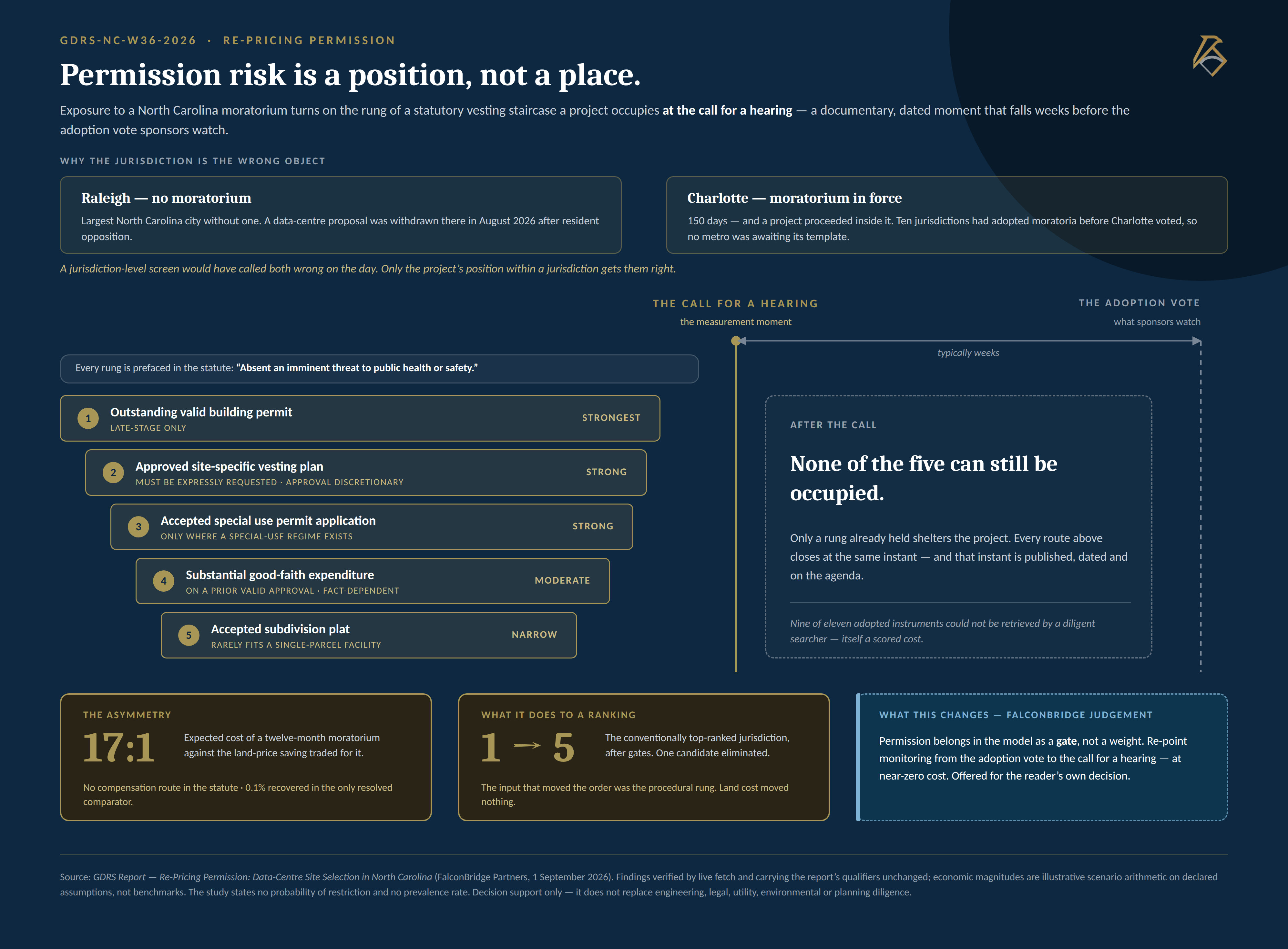
A weekly scan recorded two North Carolina events in August 2026 — a data-centre proposal withdrawn in Raleigh after resident opposition, and Charlotte midway through a 150-day moratorium — and read them as one market turning hostile. The study tested whether acceptance, water stress and political risk had become material enough to change how a site is chosen. They have, but not in the way the pairing suggested. Raleigh has no moratorium and remains the largest North Carolina city without one; Charlotte had one and a project proceeded inside it. A jurisdiction-level screen would have called both wrong; ten jurisdictions had adopted moratoria before Charlotte voted. The consequential finding is arithmetical. On the study’s illustrative frame the expected cost of a twelve-month moratorium encountered after land acquisition is roughly seventeen times the land-price saving from choosing a cheaper jurisdiction — most of it the probability of losing an anchor tenant during the delay. The asymmetry is legal as well as commercial: G.S. 160D-107 provides expedited injunctive review and no compensation route, and the only resolved comparator recovered approximately 0.1% of the sum claimed. A weighted score therefore licenses a trade that at realistic values is never favourable. The mechanism sits below the variables the brief named. Exposure turns on the highest rung of a statutory vesting staircase a project occupies at the call for a hearing — a documentary, dated moment falling weeks before the adoption vote sponsors watch. Two of the three named variables were also misspecified: acceptance is measurable only as mobilisation, a function of notice and process design; and water stress is three variables whose mitigation pulls against grid draw — itself the live political exposure here. Two conventional advantages create risk-layer exposures. By-right permitting removes discretionary refusal but forfeits the shelter reserved for accepted special-use applications; one developer ran that argument with $11.3 million of itemised spend behind it and lost 5–0. The $250m sales-tax exemption is unavailable in Tier 3 counties, steering the largest projects toward the thinnest planning capacity. Permissive outcomes nonetheless remained available throughout: on one day in September 2025 a jurisdiction denied a project 7–1 while another approved one 8–0. Four things could not be established, and are reported as findings, not omissions: no data-centre water-reporting duty exists in North Carolina; the state’s own task force records that no reliable count of its data centres exists; no realised-loss dataset for delayed developments exists anywhere; and no empirical acceptance literature exists for this asset class. The study therefore states no probability of restriction and no prevalence rate, reports association rather than causation, and presents its economic magnitudes as scenario arithmetic on declared assumptions. Coded variables remain provisional. Applied illustratively to six jurisdictions, the framework moved the conventionally top-ranked location from first to fifth and eliminated one candidate; the input that changed the ordering was the procedural rung, and land cost changed nothing. Offered for the reader’s own decision: replacing the single weighted score with gates, then compensatory scoring among survivors; re-pointing monitoring from the adoption vote to the call for a hearing, at near-zero cost; evaluating design-for-exemption before design freeze; and treating any shelter appearing only in a municipal FAQ as a red flag — where the two could be compared, the FAQ described protection present in neither the statute nor the adopted ordinance. Figures above are the source report’s findings, verified by live fetch, with its qualifiers unchanged; every rung of the statutory staircase is prefaced in the enacted text by “Absent an imminent threat to public health or safety”, so it is a strong default, not a guarantee. The implications, and the considerations in the closing paragraph, are FalconBridge Partners’ judgement. Decision support only; it does not replace engineering, legal, utility, environmental or planning diligence.
Seventeen times
On the study’s illustrative frame the expected cost of a twelve-month moratorium encountered after land acquisition is roughly seventeen times the land-price saving from choosing a cheaper jurisdiction — most of it the probability of losing an anchor tenant during the delay.
Ten jurisdictions
A jurisdiction-level screen would have called both wrong; ten jurisdictions had adopted moratoria before Charlotte voted.
First to fifth
Applied illustratively to six jurisdictions, the framework moved the conventionally top-ranked location from first to fifth and eliminated one candidate; the input that changed the ordering was the procedural rung, and land cost changed nothing.
The Weekly Signal behind this study
North Carolina · Week 36, 2026
The complete package
Five elements, tailored to the question and to how readers will use the work
Tell us who is reading and the pack is emailed to you straight away. The package is released under a Type-1 licence for the requester’s own use. Public access does not transfer ownership.

A conversation about your decision
What needs to be understood
before your next decision?
Bring the proposition, question or direction you are working on. Together, we can define the support it requires.
Start a conversation