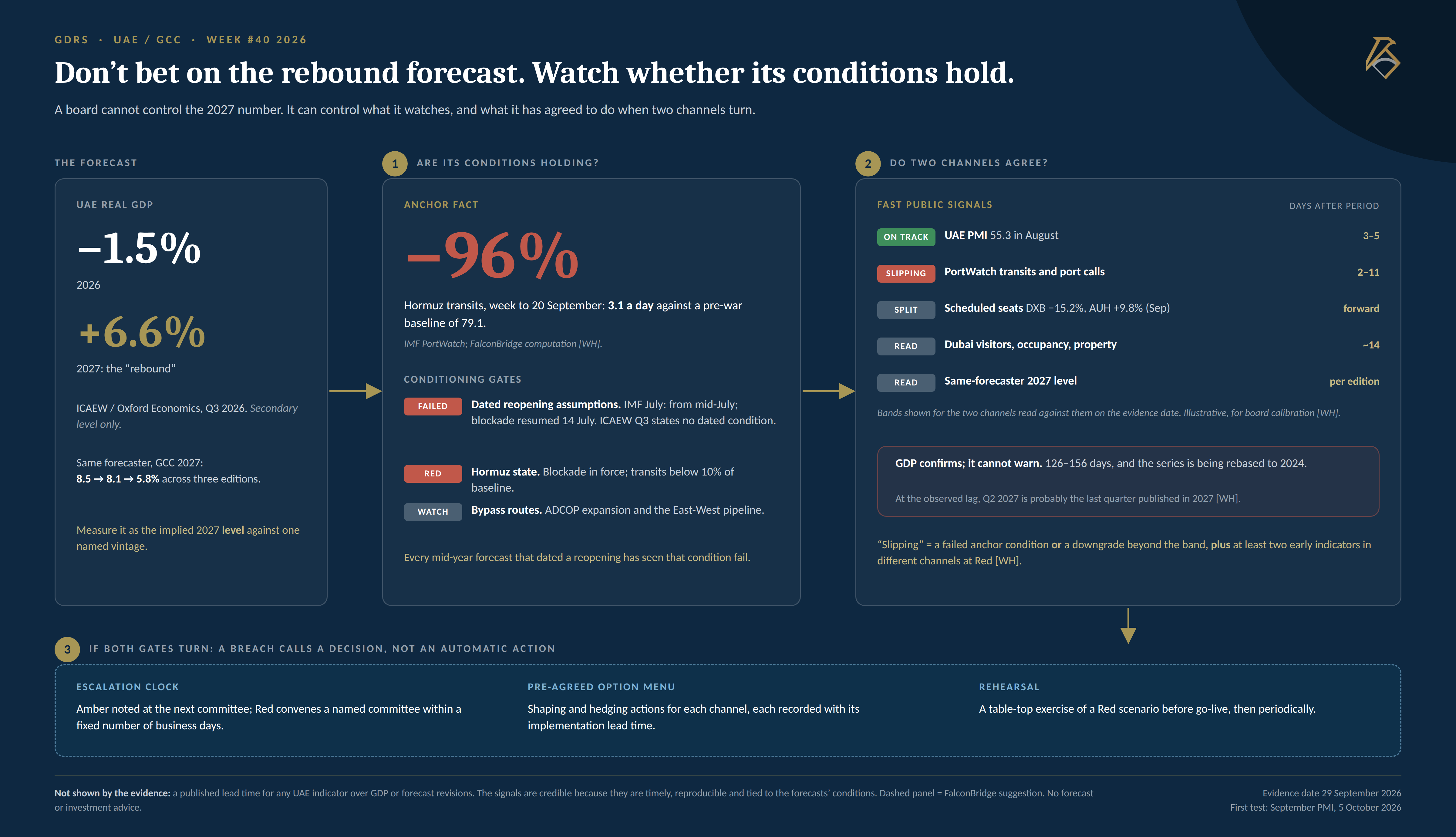
This study asked which public indicators would tell UAE and GCC boards, early and credibly, whether the projected 2027 rebound is on track or slipping, and how those indicators could map to pre-agreed triggers. The rebound is a forecast. ICAEW and Oxford Economics project UAE real GDP to fall by 1.5 per cent in 2026 and grow by 6.6 per cent in 2027. These figures could be confirmed only through secondary reports. The condition behind that forecast is failing. Hormuz transits averaged 3.1 a day in the week to 20 September, 96 per cent below the pre-war baseline. Every mid-year forecast that dated a Hormuz reopening has seen that condition fail. The IMF's July update assumed reopening would begin in mid-July; the United States resumed its blockade on 14 July. The benchmark is also moving: the same forecaster's GCC 2027 figure fell from 8.5 to 8.1 to 5.8 per cent across three editions. “On track” therefore means something only against a named, dated forecast, and it is best measured as the implied 2027 level of GDP. A growth-rate test reads a deeper 2026 fall as a stronger rebound. A level test does not. The public data are timely. The PMI arrives within 3 to 5 days, PortWatch within 2 to 11 days, and Dubai tourism data in about two weeks. GDP takes 126 to 156 days and is being rebased, so it can confirm but cannot warn. On the evidence date the channels disagreed: the PMI stood at 55.3 in August while transits collapsed, and Dubai and Abu Dhabi diverged. A single aggregate would have hidden both. What remains open is lead. No fetched source publishes a lead time for any UAE indicator over GDP or over forecast revisions; these indicators are credible because they are timely, reproducible and tied to the forecasts’ conditions, not because they have been shown to lead. Relief measures and gold flows mask the underlying picture, and none of the five UAE listed issuers read discloses a pre-agreed trigger. Boards carrying a 2027 recovery assumption could anchor to one named vintage and watch the fifteen-row framework in Appendix A, whose thresholds are illustrative, for board calibration. They could declare “slipping” only when an anchor condition fails or the forecast is downgraded beyond the band, and at least two early indicators in different channels are at Red. They could also agree now the escalation clock, the option menu and a rehearsal, so that a breach calls a decision rather than an automatic action. The first scheduled test is the September PMI, due on 5 October 2026. Forecast figures are attributed to their publishers; ICAEW figures stand at secondary level only. Figures in the first five paragraphs are findings of the source report. The final paragraph, and the reading of any threshold, are FalconBridge judgement offered for the board’s own decision. The study offers no forecast of the 2027 outcome and no investment advice. E&OE. All rights reserved.
3.1 a day
Hormuz transits averaged 3.1 a day in the week to 20 September, 96 per cent below the pre-war baseline.
8.5 to 8.1 to 5.8
The benchmark is also moving: the same forecaster's GCC 2027 figure fell from 8.5 to 8.1 to 5.8 per cent across three editions.
126 to 156 days
GDP takes 126 to 156 days and is being rebased, so it can confirm but cannot warn.
The Weekly Signal behind this study
UAE / GCC · Week 40, 2026
The complete package
Five elements, tailored to the question and to how readers will use the work
Tell us who is reading and the pack is emailed to you straight away. The package is released under a Type-1 licence for the requester’s own use. Public access does not transfer ownership.

A conversation about your decision
What needs to be understood
before your next decision?
Bring the proposition, question or direction you are working on. Together, we can define the support it requires.
Start a conversation