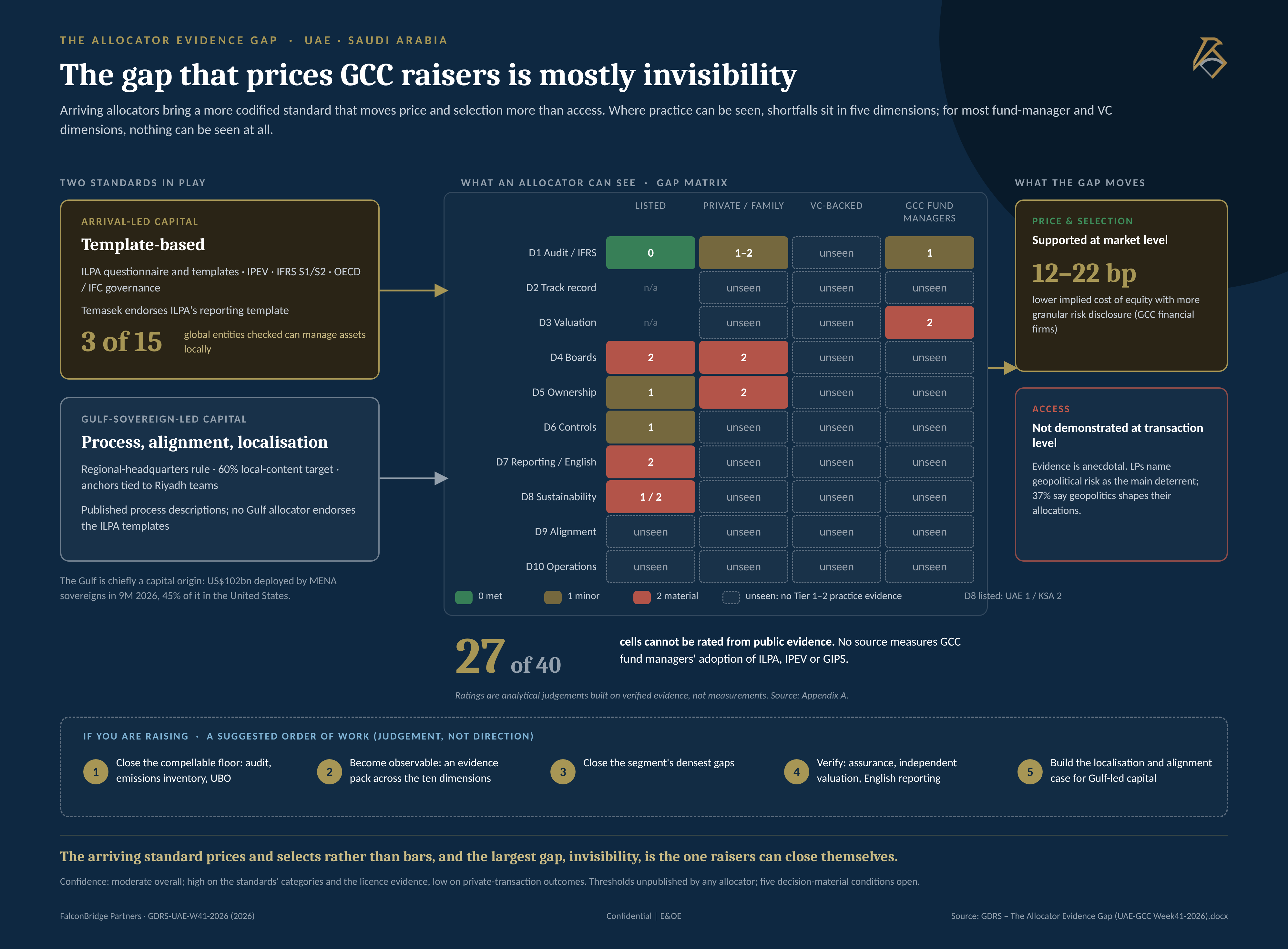
FalconBridge’s Week 41 Signal inferred that Temasek’s planned Abu Dhabi and Riyadh offices, with Pantheon’s and EQT’s new Abu Dhabi bases, mean GCC decision cycles will increasingly be set by institutions with “Temasek-grade governance expectations”. The study tested that inference against around 340 sources, each verified by fetching it on 5 October 2026, across the UAE and Saudi Arabia and four raiser segments: listed corporates, private and family firms, VC-backed firms and GCC fund managers. The arrival is real but mostly distributive. On the ADGM and DIFC registers, only 3 of 15 global private-markets entities checked hold permission to manage assets locally; most are licensed to advise and arrange. The Gulf is chiefly a capital origin: MENA sovereigns deployed US$102bn in the first nine months of 2026, 45% of it in the United States. Standards therefore travel both ways. Arrivals carry a template-based standard; Gulf sovereigns publish process descriptions and weigh localisation and strategic alignment. Allocators agree on ten dimensions of evidence, but none publishes thresholds, and the standard is applied at the due-diligence gate and in selection, with selective enforcement. Where GCC practice can be seen, shortfalls concentrate in five dimensions: English-language information access, sustainability data and assurance, boards in concentrated-ownership firms, ownership transparency, and fund valuation. Yet 27 of 40 segment-dimension cells cannot be rated from public evidence. No source measures GCC fund managers’ adoption of ILPA, IPEV or GIPS, so an arriving allocator starts from no information on most dimensions. The regulatory floor is rising where law can compel: audited statements above AED 50m and for every Qualifying Free Zone Person, mandatory emissions inventories, and e-invoicing from 2027. It has relaxed on boards: UAE listed-company independence fell from a majority to one-third, below Temasek’s stated preference for “predominantly independent” boards. Compliance is not readiness. The gap is supported as affecting price and selection at market level: disclosure is associated with a lower cost of equity in GCC firms. It is not demonstrated as a barrier to access at transaction level, where LPs name geopolitical risk as the main deterrent. Overall confidence is moderate. Five decision-material conditions remain open, among them practitioner thresholds, deal-level governance terms and GCC fund-manager outcome data. Raisers could consider treating the compellable floor as the first tranche of evidence work; making themselves observable with an evidence pack across the ten dimensions before a questionnaire arrives; closing their segment’s densest gaps; and preparing to the international template while building a separate localisation and alignment case for Gulf-led capital. The report’s draft readiness framework supports self-assessment; its thresholds are held open pending practitioner validation. Figures above are verified findings of the source report, stated at the confidence the report gives them. Statements of implication and recommendation are FalconBridge’s suggestive judgement, offered for the reader’s own decision, not directions to any named company.
3 of 15
On the ADGM and DIFC registers, only 3 of 15 global private-markets entities checked hold permission to manage assets locally; most are licensed to advise and arrange.
27 of 40
Yet 27 of 40 segment-dimension cells cannot be rated from public evidence.
Around 340 sources
The study tested that inference against around 340 sources, each verified by fetching it on 5 October 2026, across the UAE and Saudi Arabia and four raiser segments: listed corporates, private and family firms, VC-backed firms and GCC fund managers.
The Weekly Signal behind this study
UAE / GCC · Week 41, 2026
The complete package
Five elements, tailored to the question and to how readers will use the work
Tell us who is reading and the pack is emailed to you straight away. The package is released under a Type-1 licence for the requester’s own use. Public access does not transfer ownership.

A conversation about your decision
What needs to be understood
before your next decision?
Bring the proposition, question or direction you are working on. Together, we can define the support it requires.
Start a conversation