Public study · Mauritius · 2026
The Centre that did not Raise its Taxes
Mauritius raised its prices, not its taxes
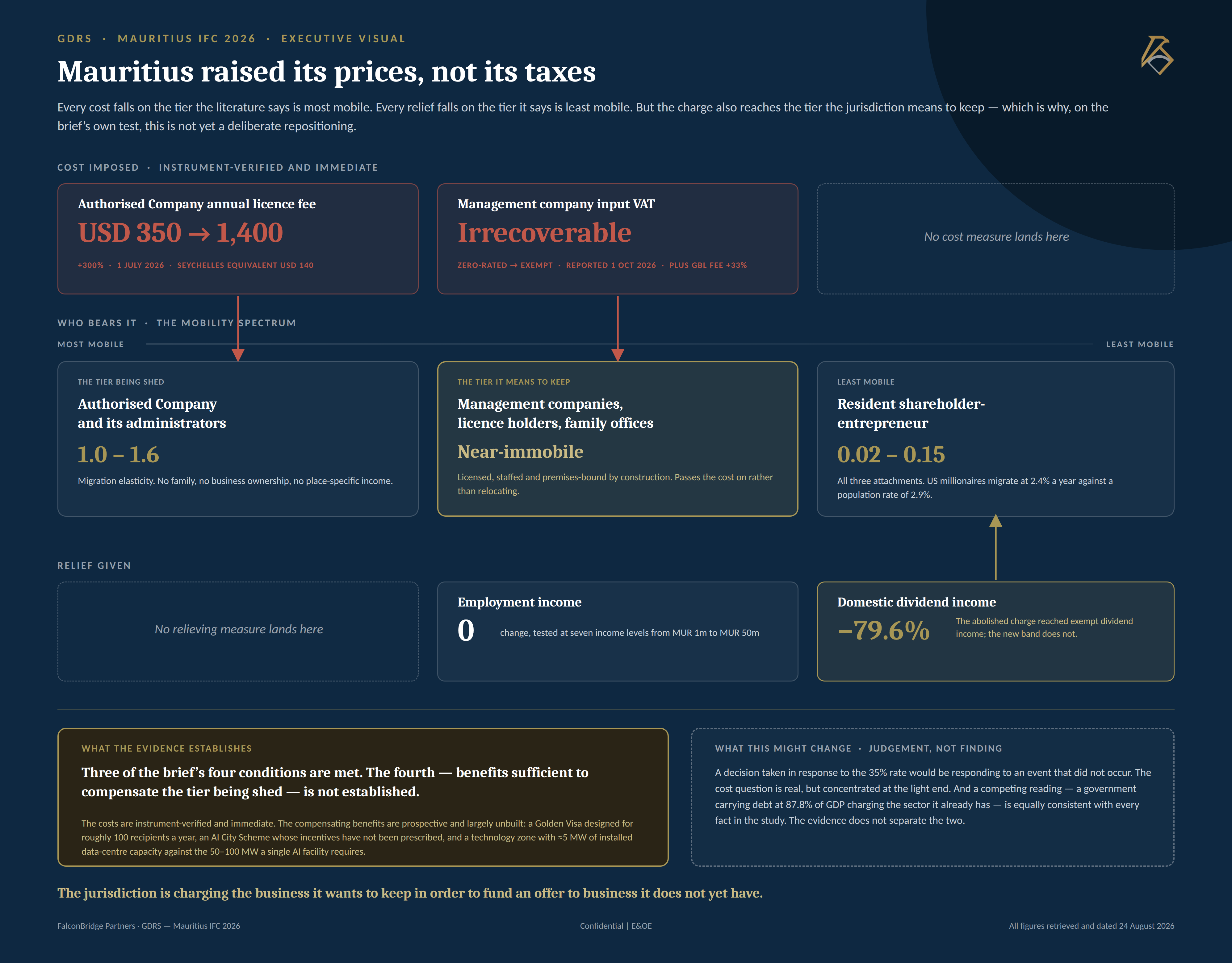
This study was commissioned from one weekly media-scan item reporting that a new 35% top personal income tax band above MUR 12 million risked taxing away Mauritius’s financial competitiveness. The brief required that every provision be independently retrieved and verified before being treated as fact. The premise did not survive verification. The 35% band introduced by the Finance Act 2026 replaces a pre-existing 20% band plus a 15% Fair Share Contribution charged at the identical MUR 12 million threshold. Tested at seven income levels from MUR 1 million to MUR 50 million, the tax payable on employment income is identical, to the rupee, before and after. Because the abolished charge reached exempt domestic dividend income and the new band does not, the reform is a substantial reduction — up to 79.6% — for the resident shareholder-entrepreneur. What did change went almost unremarked, and it is cost rather than tax. From 1 July 2026 the annual licence fee for an Authorised Company rose from USD 350 to USD 1,400, against a Seychelles equivalent at USD 140 — a ratio that moved from 2.5:1 to 10:1 in one instrument. From a reported 1 October 2026, services supplied by a management licence holder to global business clients move from zero-rated to exempt, making input VAT irrecoverable across the sector. The erosion of the low-effective-rate proposition took effect in 2025, under an OECD minimum-tax standard rather than the Act now blamed for it. The pattern beneath those measures is the central finding. Every change that raises cost falls on the population the literature identifies as most mobile — migration elasticities of 1.0 to 1.6 — and every change that reduces burden falls on the least mobile, at 0.02 to 0.15. That is what a deliberate repositioning would look like. But the cost is not confined to the tier a substance-seeking jurisdiction would rationally shed: management companies, substantive licence holders and family offices bear it alongside the near-empty vehicle. The jurisdiction is charging the business it wants to keep in order to fund an offer to business it does not yet have. Against the comparators Mauritian practitioners themselves named, the position is stronger than the domestic debate assumes: 35% is the median top rate and engages at roughly three times the income at which Cyprus applies the identical rate, and on the Basel AML Index 2025 Mauritius is the second-lowest-risk jurisdiction in its own comparator set. Against the brief’s four-condition test, three conditions are satisfied to varying degrees and the fourth — benefits sufficient to compensate the segments being shed — is not established. A competing reading, that a government carrying debt at 87.8% of GDP charged the sector it had to fund an offer to one it does not yet have, is equally consistent with every fact in the study. Two considerations follow, offered for your own judgement. Decisions taken in response to the 35% rate would be responding to an event that did not occur; the cost question is real but concentrated at the light end. The study’s own most actionable conclusion is a different one: Mauritius has already achieved most of the integrity repositioning its critics call for and cannot document it, some seventeen months before a FATF-calendared onsite under a methodology in which effectiveness is proved with data — which makes publishing its own numbers the cheapest competitive improvement available to it. Every figure above is a verified finding of the source report, retrieved and dated 24 August 2026, with the report’s own qualifiers reproduced as it states them. The first two sentences of the final paragraph are FalconBridge’s judgement, offered for your own decision, not findings of the report. Strategic research — not legal, tax, investment or regulatory advice.
Identical
Tested at seven income levels from MUR 1 million to MUR 50 million, the tax payable on employment income is identical, to the rupee, before and after.
USD 350 to 1,400
From 1 July 2026 the annual licence fee for an Authorised Company rose from USD 350 to USD 1,400, against a Seychelles equivalent at USD 140
Up to 79.6%
the reform is a substantial reduction — up to 79.6% — for the resident shareholder-entrepreneur
The complete package
Six elements, tailored to the question and to how readers will use the work
Tell us who is reading and the pack is emailed to you straight away. The package is released under a Type-1 licence for the requester’s own use. Public access does not transfer ownership.

A conversation about your decision
What needs to be understood
before your next decision?
Bring the proposition, question or direction you are working on. Together, we can define the support it requires.
Start a conversation