Public study · New Zealand · 2026
The Emerging Two-Tier Property Market
New Zealand Property: A Signal That Cannot Arrive
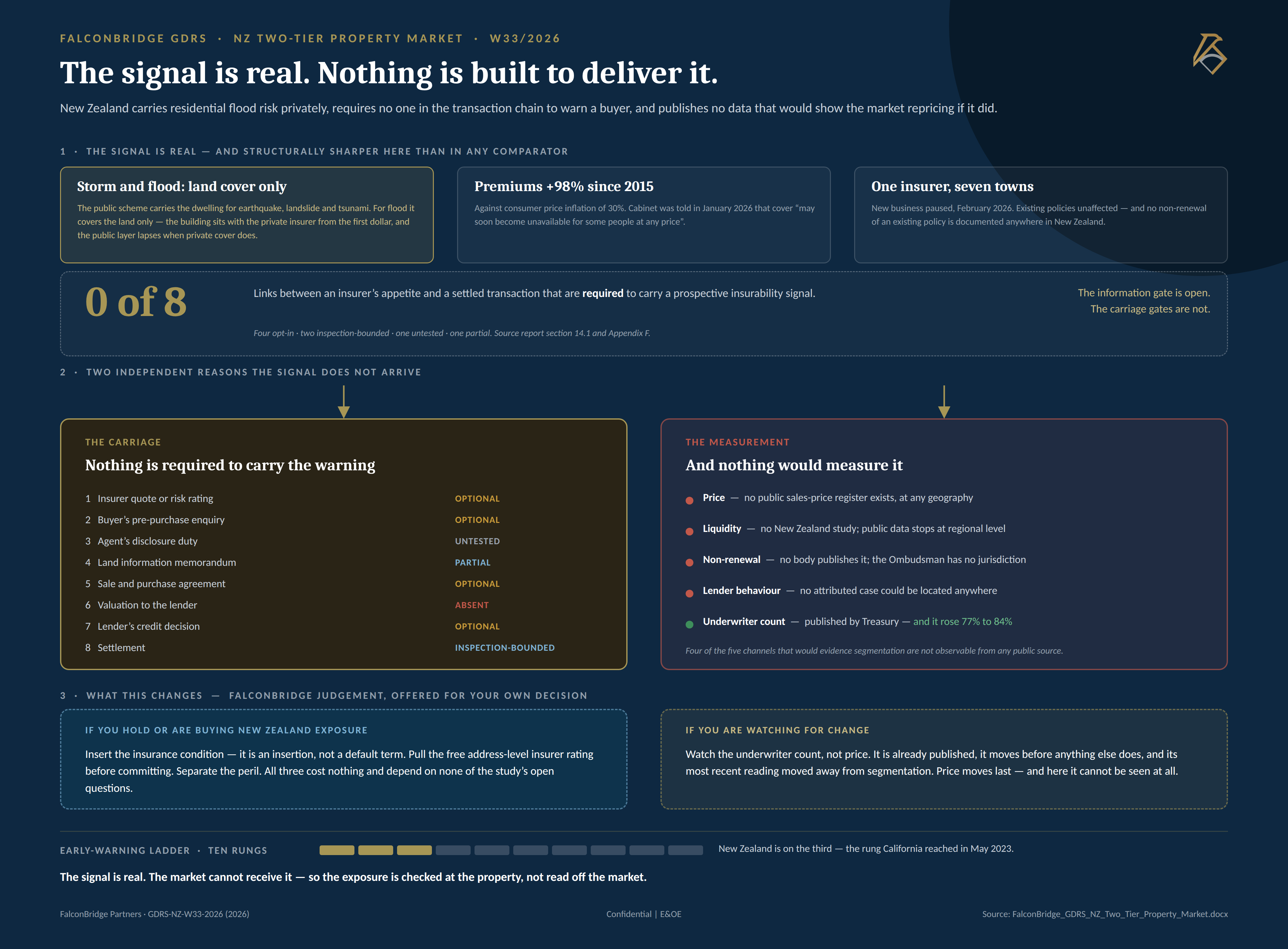
In August 2026 the chief executive of New Zealand's largest general insurer was asked whether his company might have to withdraw cover from flood-prone parts of the country. He answered yes, and tied insurer capacity directly to bank exposure. The study behind this summary was commissioned to test whether that is already segmenting the property market into insurable and uninsurable tiers. It is not — and the reason is more useful than the verdict. Tracing the eight links between an insurer's appetite and a settled transaction — the quote, the buyer's enquiry, the agent's disclosure duty, the land information memorandum, the sale agreement, the valuation, the credit decision and settlement itself — carriage of a prospective insurability signal is required at none of them. Four links are optional, two are bounded to what an inspection can see, one is untested and one is partial. The information itself is freely available: an insurer publishes address-level risk ratings across four perils to non-customers, before purchase. The information gate is open; the carriage gates are not. That matters more in New Zealand than in the markets a reader is likely to be comparing it with. The public natural-hazard scheme covers storm and flood as land cover only: residential building flood loss sits with the private insurer from the first dollar, and the public cover is itself conditional on holding private cover, so a withdrawal removes both layers at once. Of the comparator jurisdictions examined — Florida, California, the United Kingdom and Australia — each has a residual-market insurer or reinsurance pool carrying part of that risk. New Zealand has none for flood. The counterweight is real and belongs on the record. Properties in the highest flood-risk band appreciated 26.1 per cent since January 2020 against 19.8 per cent for unexposed stock, while still trading at a level discount. Availability improved on the only systematic instrument the country has: high flood-risk addresses quoted online by three or more underwriters rose from 77 to 84 per cent in the year to October 2025. And withdrawal is not a ratchet — Florida's insurer of last resort peaked at 1,407,805 policies in September 2023 and fell 80 per cent to 278,196 by July 2026 after reform addressed the cost driver. What remains open is the measurement itself. New Zealand has no public sales-price register at any geography; suburb-level price and days-to-sell are collected monthly and withheld by commercial licence; no body publishes non-renewal, declinature or premium by location, and the dispute-resolution layer has jurisdiction over neither. On the evidence available at the cut-off date, a two-tier property market is not established — but the defensible statement is not that segmentation is not occurring. It is that if it were occurring at market level, the country's present evidence base would not show it. A holder of New Zealand exposure could therefore consider treating this as a property-level check rather than a market call. Three moves cost nothing and depend on none of the study's open questions: inserting an insurance condition into the sale agreement, which is an insertion rather than a default term; obtaining the insurer's address-level rating before committing; and separating the peril, since the public scheme carries the dwelling for earthquake and not for flood. For anyone watching for change, the instrument that moves first is the underwriter count already published — not price, which moves last and cannot be observed here at all. Figures and findings above are drawn from the source report, where each is traced to a source fetched and confirmed on 17 August 2026. The final paragraph is FalconBridge's judgement about what the findings imply for a reader's own decision, offered suggestively; it is not a conclusion of the report itself.
None of eight
carriage of a prospective insurability signal is required at none of them
26.1%
Properties in the highest flood-risk band appreciated 26.1 per cent since January 2020 against 19.8 per cent for unexposed stock, while still trading at a level discount.
77 to 84%
high flood-risk addresses quoted online by three or more underwriters rose from 77 to 84 per cent in the year to October 2025
New Zealand · Week 33, 2026
The complete package
Five elements, tailored to the question and to how readers will use the work
Tell us who is reading and the pack is emailed to you straight away. The package is released under a Type-1 licence for the requester’s own use. Public access does not transfer ownership.

A conversation about your decision
What needs to be understood
before your next decision?
Bring the proposition, question or direction you are working on. Together, we can define the support it requires.
Start a conversation