Public study · USA · 2026 · From Concentration to Contagion
The routes are on record. Who would bear the loss is not.
A setback in one AI-linked domain could reach the others through twenty-two graded channels. The public evidence is strongest where channels exist and weakest exactly where their severity would be decided.
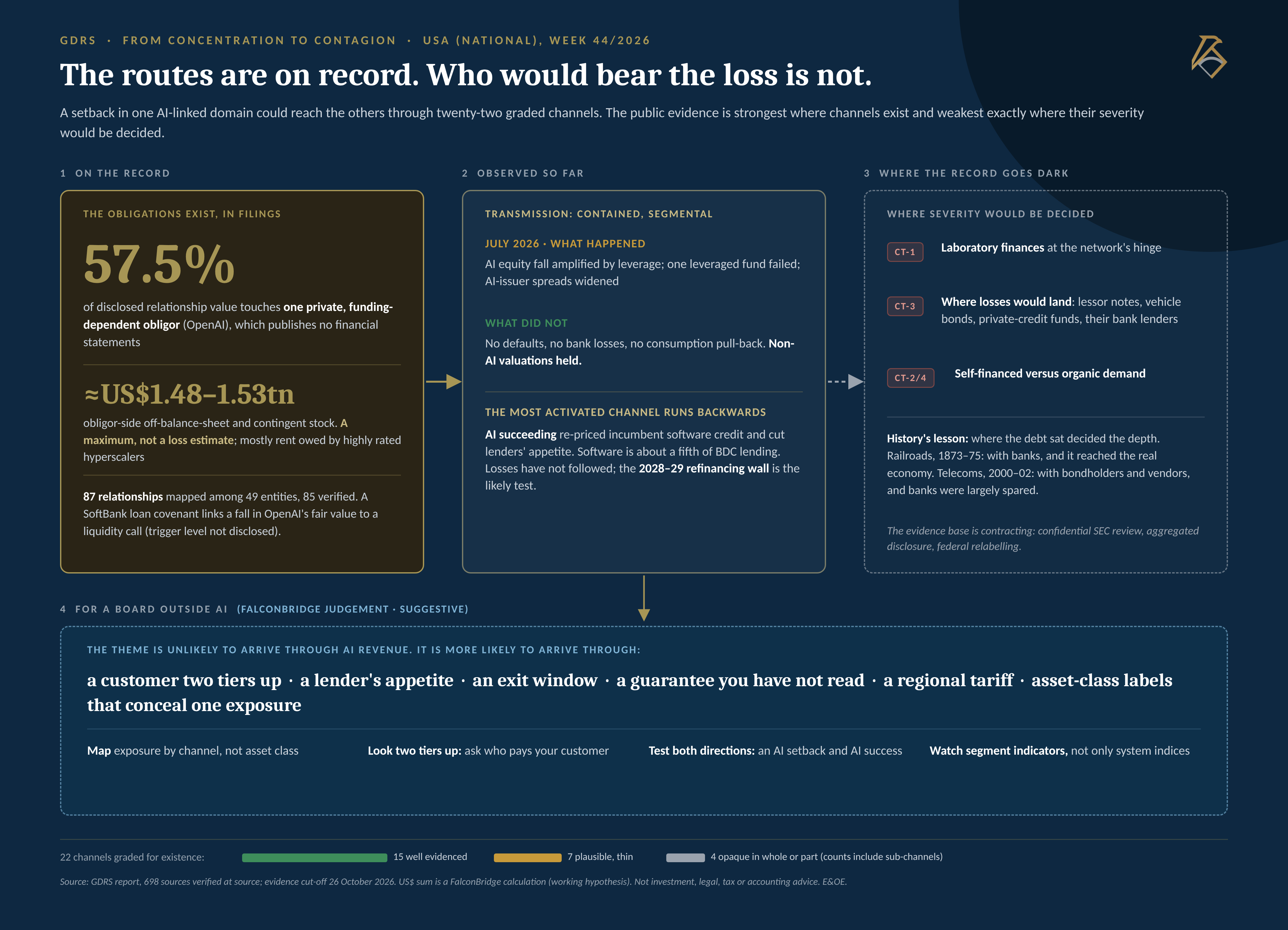
The debate about artificial intelligence asks whether it is a bubble. This study asks a question a board can act on: through which channels could a setback in one AI-linked domain (funding, capacity, demand or valuation, with credit added as a fifth) reach the others, and how strong is the public evidence for each? It tested the question against 698 sources, each verified at source, and offers no investment advice and no bubble call. The routes exist, and most are written in filings rather than headlines. One private, funding-dependent obligor, OpenAI, touches 57.5% of the disclosed value of 87 mapped relationships (85 verified at source). It publishes no financial statements. The obligor-side stock of off-balance-sheet and contingent obligations sums to about US$1.48–1.53 trillion. That figure is a maximum, not a loss estimate; most of it is rent owed by highly rated hyperscalers. A SoftBank loan covenant turns a significant fall in the fair value of its OpenAI shares into a cash call; the trigger level is not disclosed. So far, setbacks have stayed inside the segment. The July 2026 AI equity fall was amplified by leverage and AI issuers' credit was re-priced, but there were no defaults, no bank losses and no pull-back in consumption, and non-AI valuations held. The channel that has activated most runs the other way: AI success re-priced incumbent software credit and cut lenders' appetite, though losses have not yet followed. Lenders are exposed on both sides of AI risk. For companies outside AI, exposure splits three ways. Suppliers are exposed through revenue, disrupted firms through valuation and financing terms, and the non-AI core shows no measured exposure to date. Mitigants are substantial and documented: strong obligors, staged funding, and bank resilience in the IMF's stress test. The evidence is strongest where channels exist and weakest exactly where severity would be decided: laboratory finances, where losses would land, and how much demand the industry finances itself. History shows the location of debt decided how far earlier busts travelled, and that is the least visible fact today. Four disclosures would move the grades: a laboratory S-1, supplier backlog by customer class, supervisory data on AI exposure, and official AI-economy statistics. Boards could consider mapping AI exposure by channel rather than asset class, looking two tiers up the contract chain, testing both an AI setback and AI success, and adding segment indicators to their monitoring. The theme is more likely to reach a board through a customer two tiers up, a lender's appetite, an exit window or an unread guarantee than through AI revenue.
57.5%
Share of disclosed relationship value that touches one private, funding-dependent obligor (OpenAI), which publishes no financial statements
about US$1.48–1.53tn
Obligor-side off-balance-sheet and contingent stock, a maximum and not a loss estimate
698 sources
Each verified at source, with an evidence cut-off of 26 October 2026
USA · Week 44, 2026
The routes by which an AI setback could spread are on the public record. Who would bear the loss is not.
The complete package
Six elements, tailored to the question and to how readers will use the work
Tell us who is reading and the pack is emailed to you straight away. The package is released under a Type-1 licence for the requester’s own use. Public access does not transfer ownership.
Around this study
Other studies on USA
Early-Warning Signals in North America
USA · Week 39, 2026
How a study like this is commissioned: a question of your own, answered as a complete research package.

A conversation about your decision
What needs to be understood
before your next decision?
Bring the proposition, question or direction you are working on. Together, we can define the support it requires.
Start a conversation