Public study · South Africa · 2026
Rate-Resilience Diagnostic
South Africa's Rate Test Starts Above Today's Rate
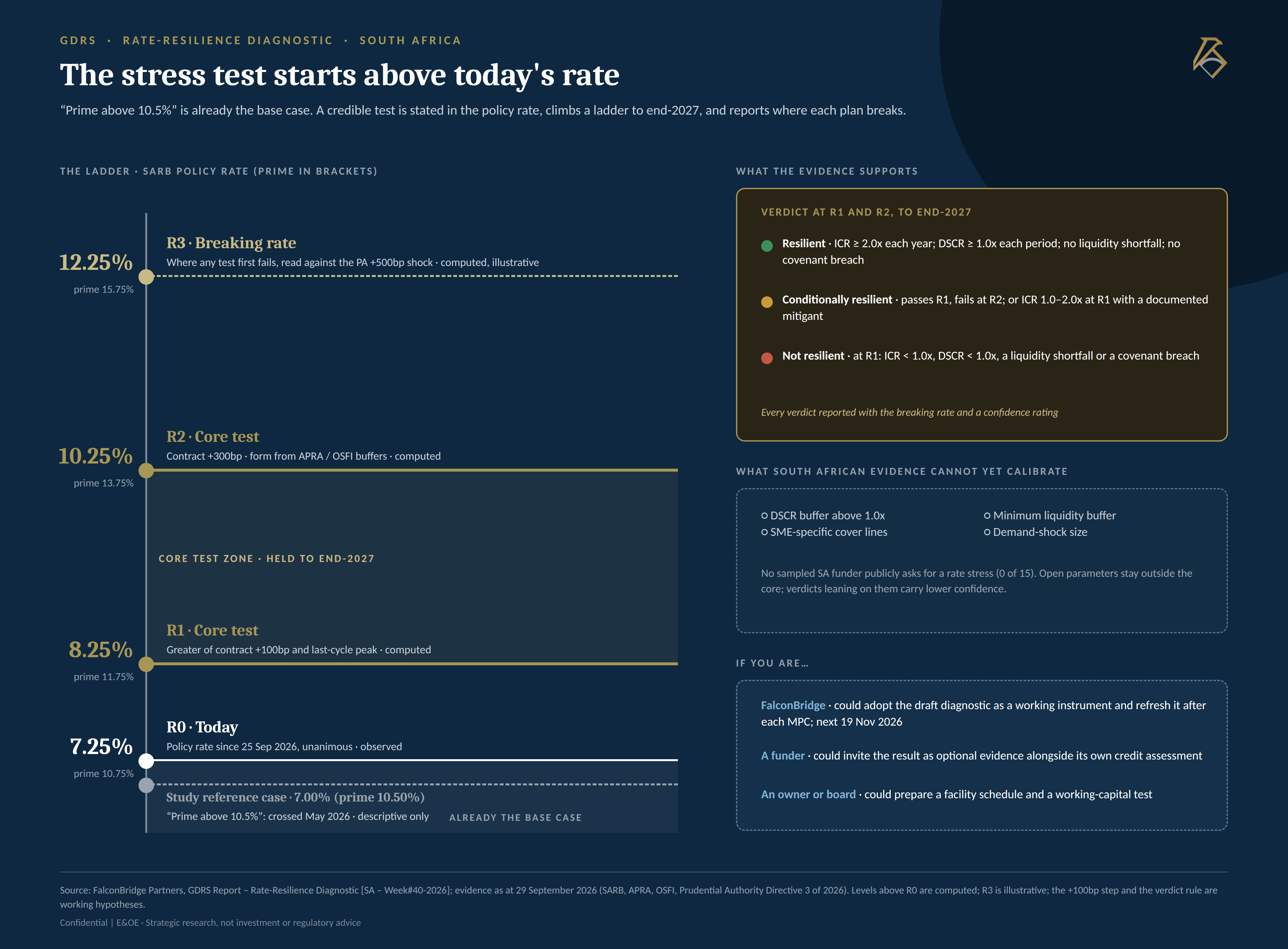
This internal study asked what tests, thresholds and evidence a credible rate-resilience diagnostic for South African business plans and funding requests should contain under a sustained higher-rate environment. It followed the South African Reserve Bank's second increase of 2026 and rests on a structured desktop review of monetary-policy, funder, disclosure, outcome and comparative stress-testing evidence. The reference case set for the study, prime above 10.5% through 2027, is no longer a stress; it is the base case. Prime has stood at 10.75%, and the policy rate at 7.25%, since 25 September 2026, after a unanimous 25bp increase. Seven of the eleven decisions since January 2025 were split, and the January forecast for the fourth-quarter 2026 average policy rate, 6.31%, was revised upward at every meeting. Prime itself is proposed for retirement, with active transition “in 2027 at the earliest”. No sampled South African funder publicly asks for a rate stress. Across fifteen funder entries, no public document requires sensitivity, scenario or rate-stress analysis; the IDC’s convention, “a minimum of prime”, fixes a rate level, not a stress. Company disclosure cannot fill the gap, because IFRS 7 excludes stress tests. A diagnostic would therefore add evidence rather than duplicate a requirement. Some anchors are solid. Pass-through of policy-rate changes to lending rates is “generally complete and symmetric”; interest cover below 1.0x marks distress, about 2 is the South African vulnerability line, and two of three covenant disclosures fetched set 2.0x. The last cycle, with prime at or above 10.5% for about 36 months and at its 11.75% peak for about 16, can anchor a scenario but cannot calibrate failure: compulsory liquidations did not rise at the peak, load-shedding confounds the rate effect, and key series have decayed. Four parameters remain open: a debt-service-cover buffer above 1.0x, SME-specific cover lines, a minimum liquidity buffer and a demand-shock size. SMEs, the study’s primary unit, are the least calibrated segment. These parameters are carried as working hypotheses, outside the core, and verdicts that rely on them carry moderate or low confidence. FalconBridge could consider adopting the draft diagnostic as a working instrument: scenarios stated in the policy rate; a ladder held to end-2027, with R1 at 8.25% (prime 11.75%) and R2 at 10.25% (prime 13.75%), both computed; a three-way verdict reported with the breaking rate and a confidence rating; and a refresh after each Monetary Policy Committee meeting, the next on 19 November 2026. Funders could consider inviting the result as optional evidence alongside their own credit assessment. Figures above are verified findings drawn from the source report; ladder levels above today’s rate are computed, and the verdict rule is a working hypothesis. Statements of implication and recommendation are FalconBridge’s judgement, offered for the reader’s own decision.
10.75%
Prime has stood at 10.75%, and the policy rate at 7.25%, since 25 September 2026, after a unanimous 25bp increase.
Fifteen funder entries
Across fifteen funder entries, no public document requires sensitivity, scenario or rate-stress analysis; the IDC’s convention, “a minimum of prime”, fixes a rate level, not a stress.
Four parameters
Four parameters remain open: a debt-service-cover buffer above 1.0x, SME-specific cover lines, a minimum liquidity buffer and a demand-shock size.
The Weekly Signal behind this study
South Africa · Week 40, 2026
The complete package
Five elements, tailored to the question and to how readers will use the work
Tell us who is reading and the pack is emailed to you straight away. The package is released under a Type-1 licence for the requester’s own use. Public access does not transfer ownership.

A conversation about your decision
What needs to be understood
before your next decision?
Bring the proposition, question or direction you are working on. Together, we can define the support it requires.
Start a conversation