Public study · USA · 2026
AI capex is funded by capital markets, not by payroll
Workforce-Cost Release and AI Capital Expenditure
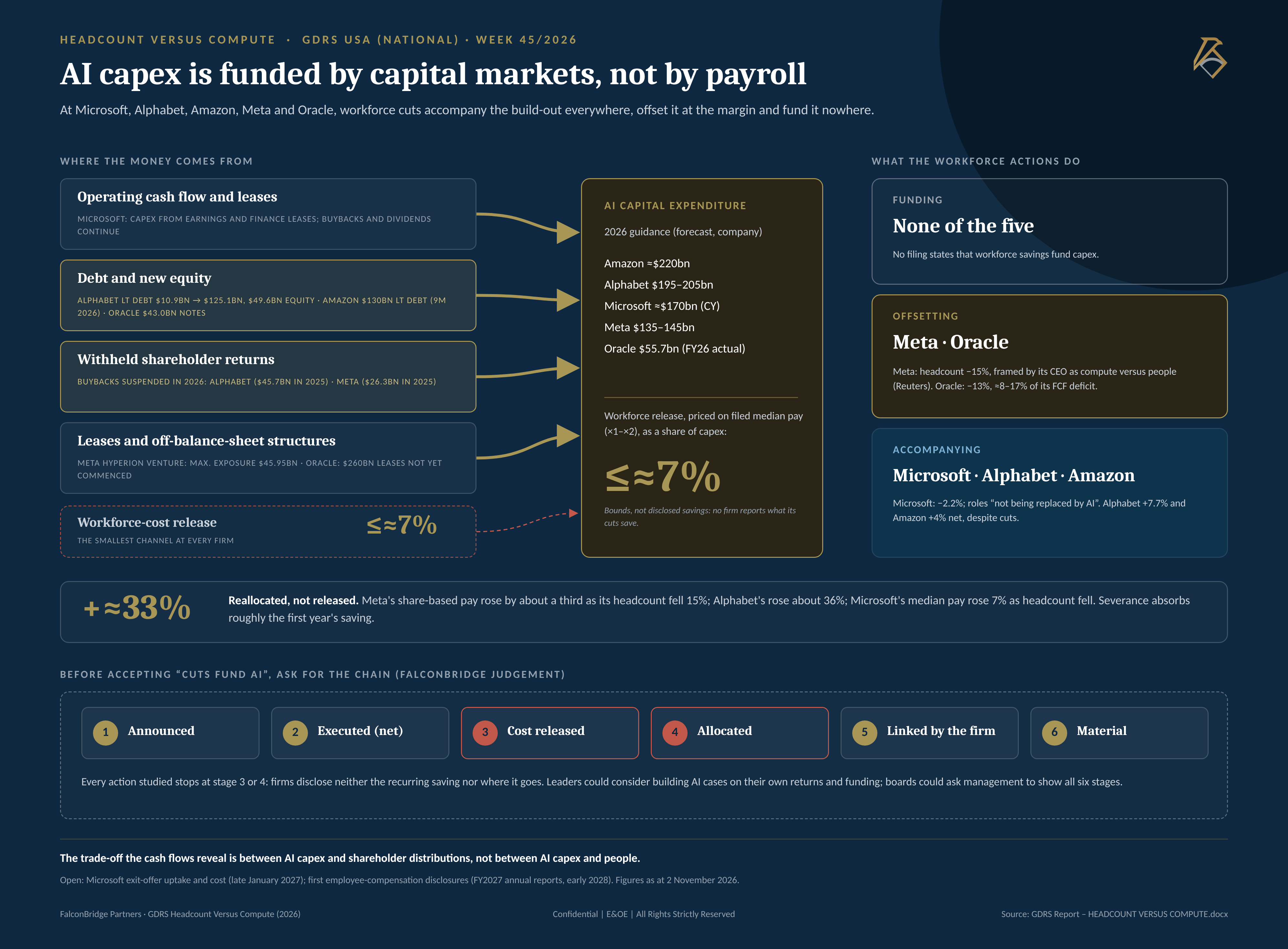
Microsoft's offer of voluntary buyouts to roughly 60,000 employees, reported beside record data-centre spending, invited a familiar inference: that the largest AI spenders are releasing workforce cost to fund compute. The study tested that inference against the filings of Microsoft, Alphabet, Amazon, Meta and Oracle, from 2023 to the third quarter of 2026. Workforce-cost release is not funding AI capital expenditure at any of the five firms. Priced against the median-employee pay each firm must disclose, the annual saving equals about 1–3 per cent of capex at Microsoft, 3–7 per cent at Meta, 4–7 per cent at Oracle and about 3–5 per cent gross at Amazon; at Alphabet it is nil net, because headcount grew 7.7 per cent. These are bounds, because no firm discloses what its workforce actions save. The build-out is financed elsewhere. Alphabet's long-term debt rose from $10.9bn to $125.1bn and it raised $49.6bn of equity; Amazon raised $130bn of long-term debt in nine months; Alphabet and Meta suspended buybacks worth about $46bn and $26bn a year. The trade-off the cash flows reveal is between AI capex and shareholder distributions, not between AI capex and people. Announced cuts also overstate release: Amazon cut about 30,000 corporate roles while its total workforce grew by about 60,000. The narrative is not empty. At Meta, whose chief executive described “two major cost centers … compute infrastructure and people-oriented things” (as reported by Reuters), and at Oracle, where a 13 per cent net reduction equals about 8–17 per cent of its free-cash-flow deficit, workforce release offsets part of the cost. Yet the people budget is being reshaped more than released: share-based pay rose about a third at Meta and Alphabet, and Microsoft states that the roles it cut “are not being replaced by AI”. Two matters remain open: the realised uptake and cost of Microsoft's exit offer, expected with its results in late January 2027, and the first disclosure of total employee compensation, due with fiscal 2027 annual reports in early 2028. Neither is likely to reverse the finding. Meanwhile the public evidence is thinning: voluntary exits fall outside layoff notices and human-capital disclosure is declining. Leaders could consider building any AI business case on its own returns and funding capacity rather than on expected payroll savings, and budgeting for rising, not falling, AI-talent costs. Boards could ask management to show the full chain, from announcement through net execution, cost released and its use, to materiality, before accepting that workforce actions finance AI. Investors could read the build-out first through financing and distribution policy.
None of the five
Workforce-cost release is not funding AI capital expenditure at any of the five firms studied: Microsoft, Alphabet, Amazon, Meta and Oracle.
1–7% of capex
Priced against disclosed median pay, the annual saving equals about 1–3 per cent of capex at Microsoft, 3–7 per cent at Meta and 4–7 per cent at Oracle; these are bounds, not disclosed savings.
$125.1bn
Alphabet’s long-term debt rose from $10.9bn to $125.1bn and it raised $49.6bn of equity; Amazon raised $130bn of long-term debt in nine months.
USA · Week 45, 2026
The job cuts are real. They are not paying for the AI build-out.
The complete package
Six elements, tailored to the question and to how readers will use the work
Tell us who is reading and the pack is emailed to you straight away. The package is released under a Type-1 licence for the requester’s own use. Public access does not transfer ownership.
The sample demonstrates the work
Figures above are verified findings of the report, stated with its bounds and qualifiers. Statements of implication and recommendation are FalconBridge’s judgement, offered for the reader’s own decision.
Around this study
Other studies on USA
A setback in one AI-linked domain could reach the others through twenty-two graded channels. The public evidence is strongest where channels exist and weakest exactly where their severity would be decided.
Early-Warning Signals in North America
USA · Week 39, 2026
How a study like this is commissioned: a question of your own, answered as a complete research package.

A conversation about your decision
What needs to be understood
before your next decision?
Bring the proposition, question or direction you are working on. Together, we can define the support it requires.
Start a conversation