Public study · New Zealand · 2026 · Beyond the Subsidy
Without subsidies, New Zealand defaulted to the hybrid
New Zealand's NEV adoption and transferable lessons
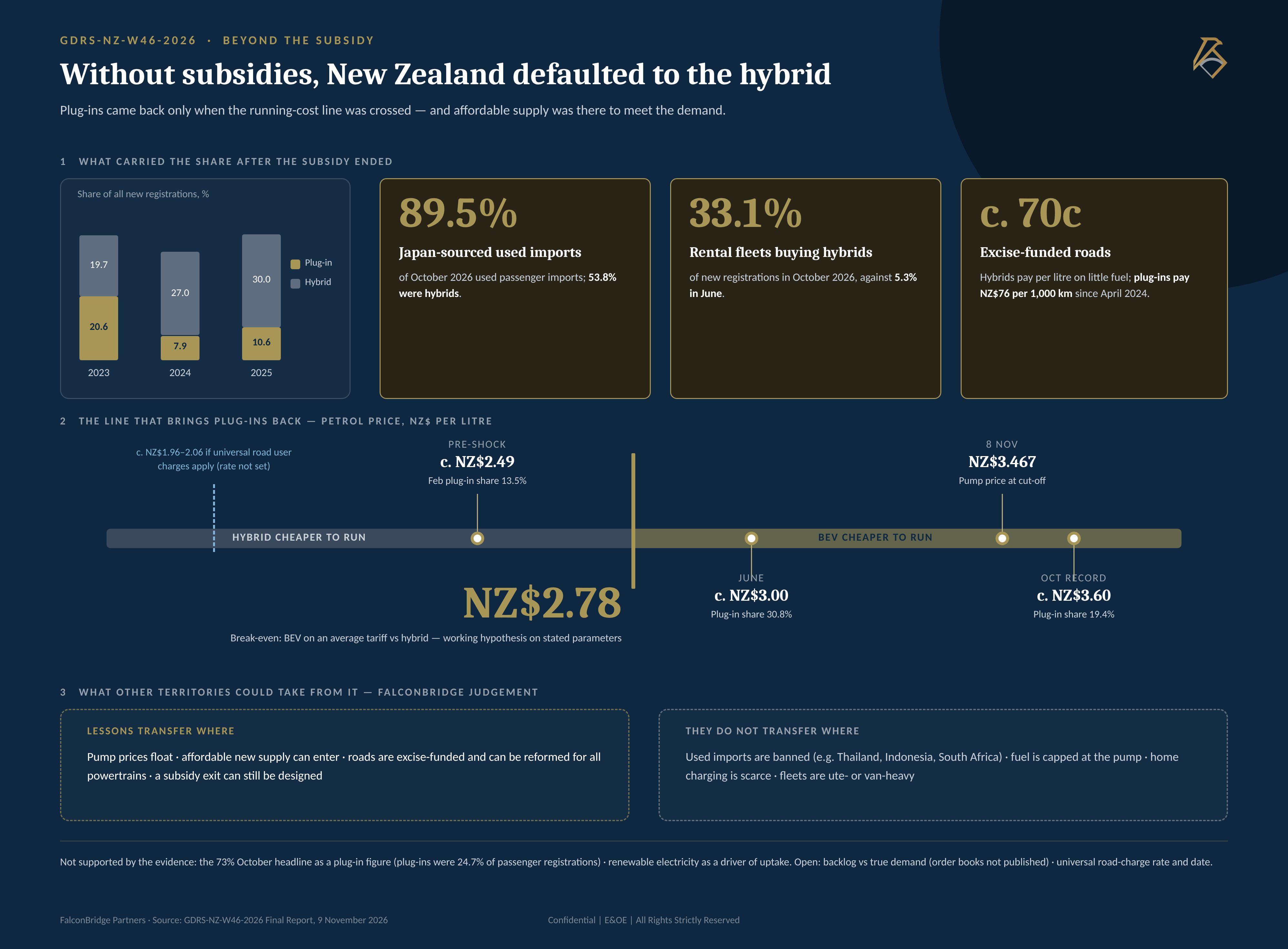
New Zealand is widely reported to have sustained near-record new-energy vehicle adoption since its Clean Car Discount ended on 31 December 2023. The study tested that claim on verified, separated data and asked which of the country's drivers could transfer to other territories. The claim holds only if hybrids are counted. Plug-in share of new registrations fell from 20.6% in 2023 to 7.9% in 2024, and reached only 10.6% in 2025, while conventional hybrids rose from 19.7% to 30%. The widely reported 73% for October 2026 is a passenger-only figure that includes hybrids; plug-ins were 24.7% of passenger registrations that month. Market structure filled the gap. Japan supplied 89.5% of October 2026's used passenger imports, and 53.8% of those were hybrids. Rental fleets, buying hybrid SUVs ahead of the tourist season, took 33.1% of new registrations that month. Road funding relies on fuel excise, so efficient petrol cars pay least, while plug-ins have paid a distance charge since April 2024. Plug-ins returned only when the March 2026 oil shock lifted petrol from about NZ$2.49 to over NZ$3 a litre. Above about NZ$2.78, a battery-electric car is cheaper to run than a hybrid at an average tariff (a working hypothesis on stated parameters), and affordable Chinese models let buyers act. A larger October spike produced a smaller response. Renewable electricity was not a driver. Durability is open. Forecasters project oil normalising through 2027; universal road user charges would favour battery-electric cars, but their rate and date are not set. Whether the mid-2026 peak reflected a delivery backlog is unresolved without distributors' order books. Territories weighing New Zealand's example could consider reading it on separated series, classifying their own market before borrowing, designing any subsidy exit rather than simply ending it, and reforming road funding for all powertrains at once. Markets that ban used imports, such as Thailand, Indonesia and South Africa, can learn from New Zealand's fuel-price experience but not its used channel.
7.9%
7.9% was the plug-in share of new registrations in 2024, down from 20.6% in 2023. It reached 10.6% in 2025, while hybrids rose from 19.7% to 30%.
89.5%
89.5% of October 2026 used passenger imports were Japan-sourced, and 53.8% of those were hybrids.
NZ$2.78
NZ$2.78 a litre is the petrol price above which a battery-electric car is cheaper to run than a hybrid at an average tariff (a working hypothesis on stated parameters).
New Zealand · Week 46, 2026
New Zealand's electrified-car boom is real. It is mostly hybrids.
The complete package
Six elements, tailored to the question and to how readers will use the work
Tell us who is reading and the pack is emailed to you straight away. The package is released under a Type-1 licence for the requester’s own use. Public access does not transfer ownership.
Around this study
Other studies on New Zealand
AI Accountability
Youth Unemployment Pressure
Malaysia: Credible Base, Unproven Gateway
How a study like this is commissioned: a question of your own, answered as a complete research package.

A conversation about your decision
What needs to be understood
before your next decision?
Bring the proposition, question or direction you are working on. Together, we can define the support it requires.
Start a conversation