Public study · New Zealand · 2026
From Government Advice to Actual Market Routes
Malaysia: Credible Base, Unproven Gateway
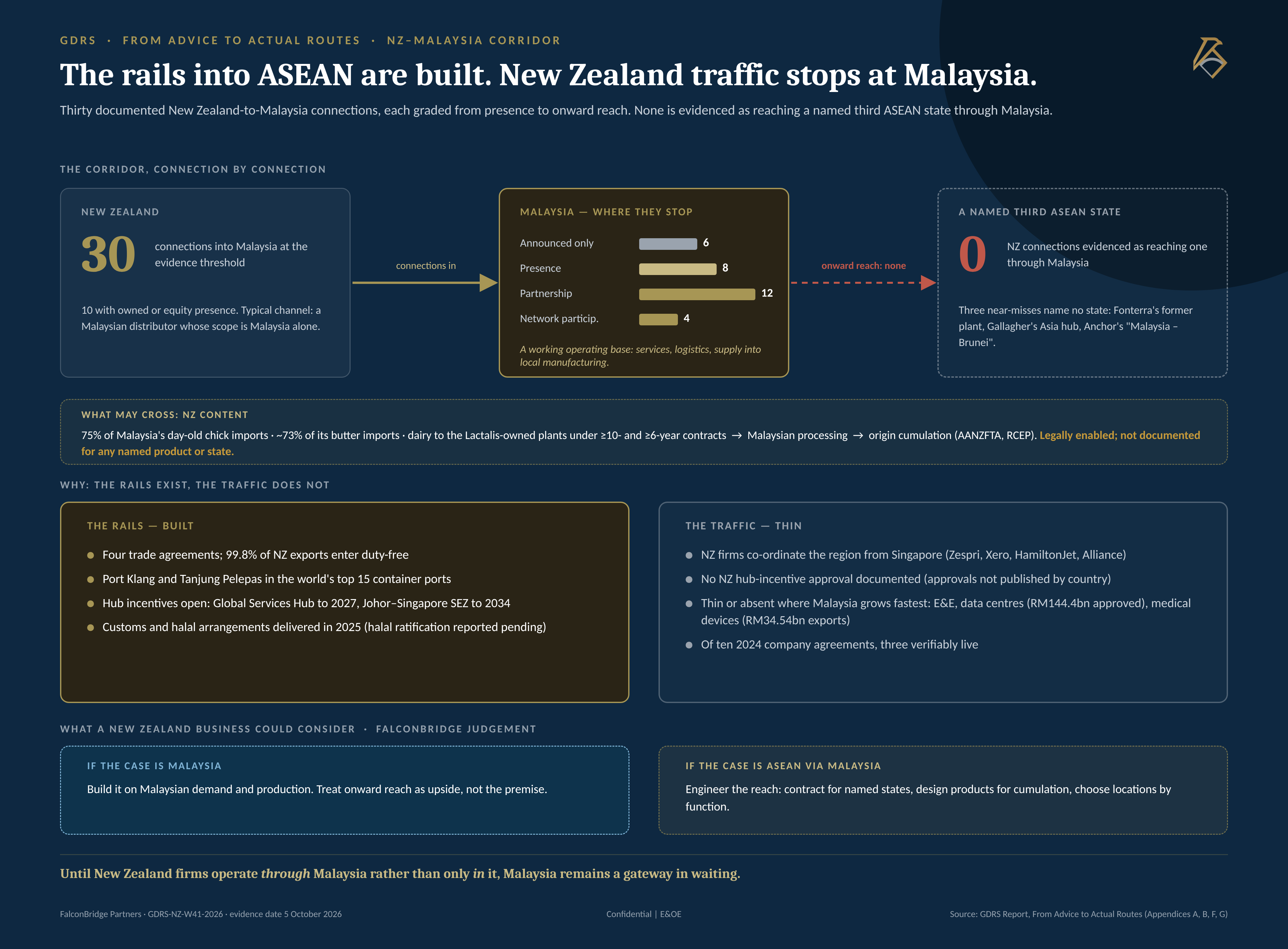
In September 2026 New Zealand’s Ministry of Foreign Affairs and Trade said Malaysia offers New Zealand businesses “access to wider ASEAN production networks”. This study tested that claim rather than adopting it. It asked through which actors, channels and gateways New Zealand businesses actually connect to ASEAN production networks via Malaysia, and where the gaps are. Every documented connection was graded on five stages, from presence to onward reach into a named ASEAN state, against 247 fetched sources. The answer turns on one fact: of 30 documented New Zealand-to-Malaysia connections, none is evidenced as reaching a named third ASEAN market through Malaysia. Twelve stop at partnership, eight at presence and four at network participation; six remain announcements. Three come close — Fonterra’s former plant, Gallagher Security’s Asia hub and Anchor’s “Malaysia – Brunei” business — but none names a state at the evidence threshold. The finding is bounded: the public record does not establish onward reach. The rails are built; the traffic is thin. Four trade agreements apply, 99.8% of New Zealand exports enter duty-free, two Malaysian ports rank in the world’s top 15, and hub incentives stay open to 2027 and 2034. Yet New Zealand firms co-ordinate the region from Singapore and operate in Malaysia, and every named Malaysian partner serves Malaysia only. The corridor is thinnest where Malaysia is growing fastest: electronics, data centres (RM144.4bn approved) and medical devices (RM34.54bn of exports). Two findings run the other way. As an operating base Malaysia holds up: English proficiency ranks 24th in the world, logistics performance equals New Zealand’s, and manufacturing and most services are open to full foreign ownership. And New Zealand content plausibly does cross the border — 75% of Malaysia’s day-old chick imports and about 73% of its butter imports — inside Malaysian production that origin rules let count onward. That content gateway is legally enabled but not documented for any named product reaching any named state. Five points remain open: New Zealand’s investment position in Malaysia since 2015, whether any New Zealand firm holds hub-incentive status, whether New Zealand content uses cumulation through Malaysia, where the Lactalis-owned plants now export, and whether distributor relationships endure. None, if closed, would reverse a finding; each has a named route to closure. A New Zealand business could consider building any Malaysian case on Malaysia itself and treating onward reach as upside to be engineered: contracting for named regional scope, designing ingredient products for origin cumulation, choosing locations function by function, and validating the data-centre, medical-device and agritech openings before committing capital. Figures above are independently verified findings drawn from the GDRS report (evidence date 5 October 2026). The final paragraph is FalconBridge’s judgement about what the findings imply, offered for the reader’s own decision — not the report’s findings themselves.
30 connections
The answer turns on one fact: of 30 documented New Zealand-to-Malaysia connections, none is evidenced as reaching a named third ASEAN market through Malaysia.
99.8%
Four trade agreements apply, 99.8% of New Zealand exports enter duty-free, two Malaysian ports rank in the world’s top 15, and hub incentives stay open to 2027 and 2034.
247 sources
Every documented connection was graded on five stages, from presence to onward reach into a named ASEAN state, against 247 fetched sources.
The Weekly Signal behind this study
New Zealand · Week 41, 2026
The complete package
Five elements, tailored to the question and to how readers will use the work
Tell us who is reading and the pack is emailed to you straight away. The package is released under a Type-1 licence for the requester’s own use. Public access does not transfer ownership.

A conversation about your decision
What needs to be understood
before your next decision?
Bring the proposition, question or direction you are working on. Together, we can define the support it requires.
Start a conversation