Public study · New Zealand · 2026
From Intake to Succession
Youth Unemployment Pressure
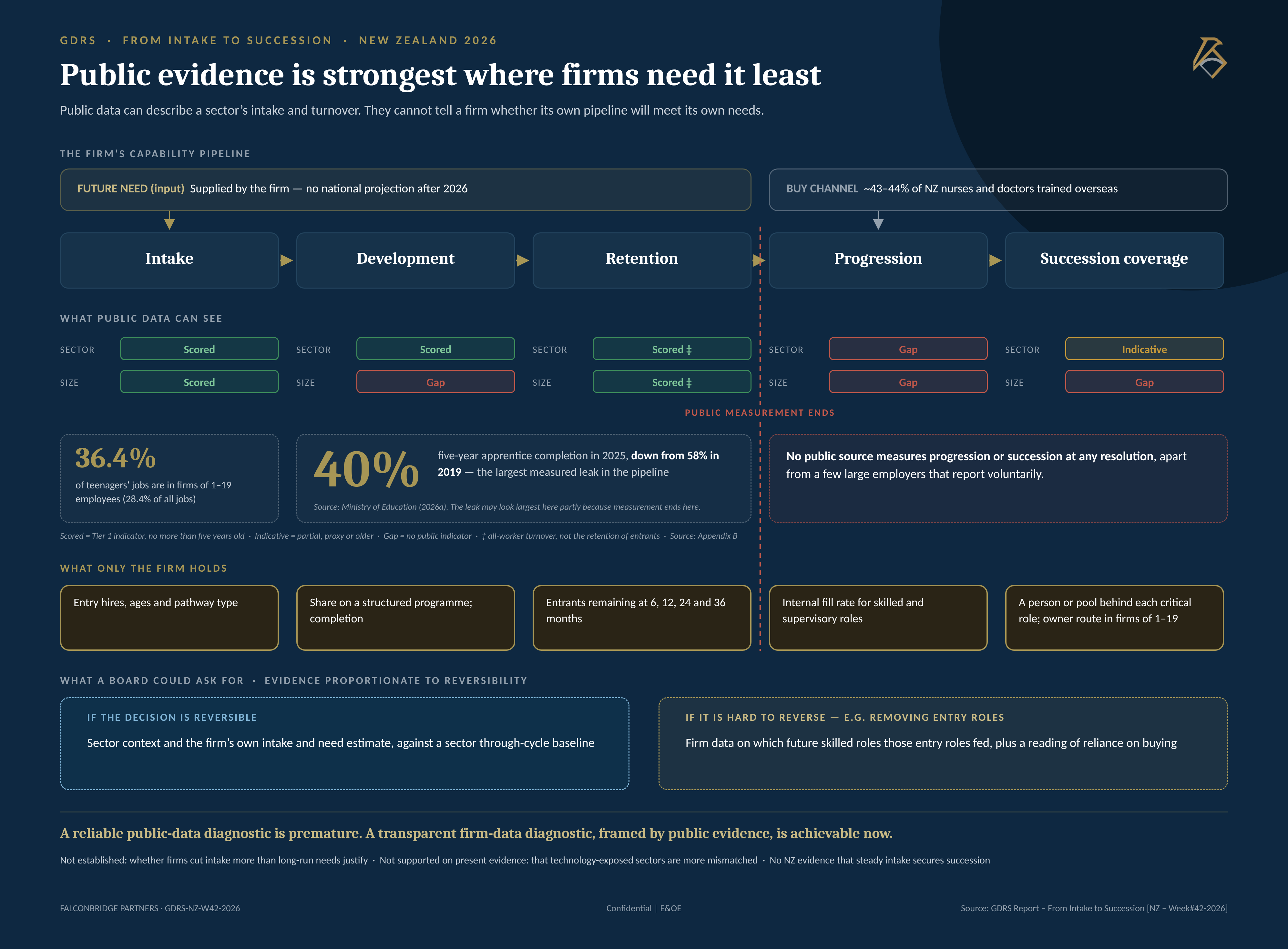
In the June 2026 quarter, unemployment was 25.3% among 15–19-year-olds against 3.5% for those aged 25 and over, and hiring of teenagers fell 30.5% between March 2023 and March 2025, against 21.9% for all ages. The pressure falls on intake, where a firm's future skilled workforce and succession bench begin. FalconBridge asked whether a diagnostic could reliably show a New Zealand firm, by sector and size, whether its entry-level intake can sustain its future skills and succession needs. A reliable diagnostic built on public evidence is premature. A transparent diagnostic built on the firm's own data, framed by public evidence, is achievable now. Public evidence is strongest where firms need it least. It describes intake and turnover by sector reasonably well. The largest measured leak lies between development and retention: five-year apprentice completion fell from 58% in 2019 to 40% in 2025. Beyond that point the evidence stops. No public source measures progression or succession at any resolution, apart from a few large employers that report voluntarily, so the leak may look largest there partly because that is where measurement ends. The gaps are structural. Training records carry no employer size. National employment projections ran only to 2026. No validated readiness measure was found in the sources searched. Bodies and surveys that might have filled these gaps were disestablished, paused or allowed to expire between 2024 and 2026, and confidentiality rules mean even linked administrative data could never score an identifiable firm. Readiness also turns on things the briefed five stages omit: the firm's own estimate of future need; reliance on buying skills (about 43–44% of New Zealand nurses and doctors trained overseas); and, in the roughly 89% of employing firms with fewer than twenty staff (computed from MBIE data), owner succession, on a working hypothesis. Public size data proved better than first believed: firms of 1–19 employees hold 36.4% of teenagers' jobs against 28.4% of all jobs, though they have the highest teenage turnover. A three-way age × industry × size table is catalogued by Stats NZ but not yet retrieved; if usable, it would sharpen sector and size context. It would still not read a firm. Several questions remain open. Whether firms cut intake more than their long-run needs justify is not established; the claim that technology-exposed sectors are more mismatched is not supported on present evidence (the youth-specific hiring fall is largest in the sectors least exposed to AI); and no New Zealand evidence shows that steady intake secures future succession. The four sector archetypes are working hypotheses. A board could consider treating entry-level intake as a capability decision, not only a cost decision: after the GFC, apprentice numbers took about eleven years to regain their 2008 level. The low-regret steps need only records a firm already holds — an estimate of future need by role family, entrant retention at six, twelve and twenty-four months, its reliance on buying, and, in small firms, an intended ownership succession route. Before removing entry roles, a decision that is hard to reverse, a board could map which future skilled roles those roles fed.
25.3%
In the June 2026 quarter, unemployment was 25.3% among 15–19-year-olds against 3.5% for those aged 25 and over.
58% to 40%
The largest measured leak lies between development and retention: five-year apprentice completion fell from 58% in 2019 to 40% in 2025.
36.4%
Firms of 1–19 employees hold 36.4% of teenagers' jobs against 28.4% of all jobs, though they have the highest teenage turnover.
New Zealand · Week 42, 2026
The complete package
Six elements, tailored to the question and to how readers will use the work
Tell us who is reading and the pack is emailed to you straight away. The package is released under a Type-1 licence for the requester’s own use. Public access does not transfer ownership.
The sample demonstrates the work
Figures and findings above are drawn from the source report, which verified each against its originating source and records its evidence class and confidence. The final paragraph is FalconBridge's judgement about what a board could do with them, offered for the reader's own decision. The study takes no position on any party or policy.
Around this study
Other studies on New Zealand
Malaysia: Credible Base, Unproven Gateway
One Rebound, Read Two Ways
One architecture, not three — and a clock set to 2029
How a study like this is commissioned: a question of your own, answered as a complete research package.

A conversation about your decision
What needs to be understood
before your next decision?
Bring the proposition, question or direction you are working on. Together, we can define the support it requires.
Start a conversation