Public study · UAE / GCC · 2026 · Raising the Bar, Choosing the Venue
Two gates decide the venue before the rulebook does
After Saudi Arabia’s 2 November 2026 IPO provisions, a GCC mid-cap’s Riyadh-or-UAE answer turns first on whether Riyadh is legally open to it, then on whether its board can stand behind its forecasts.
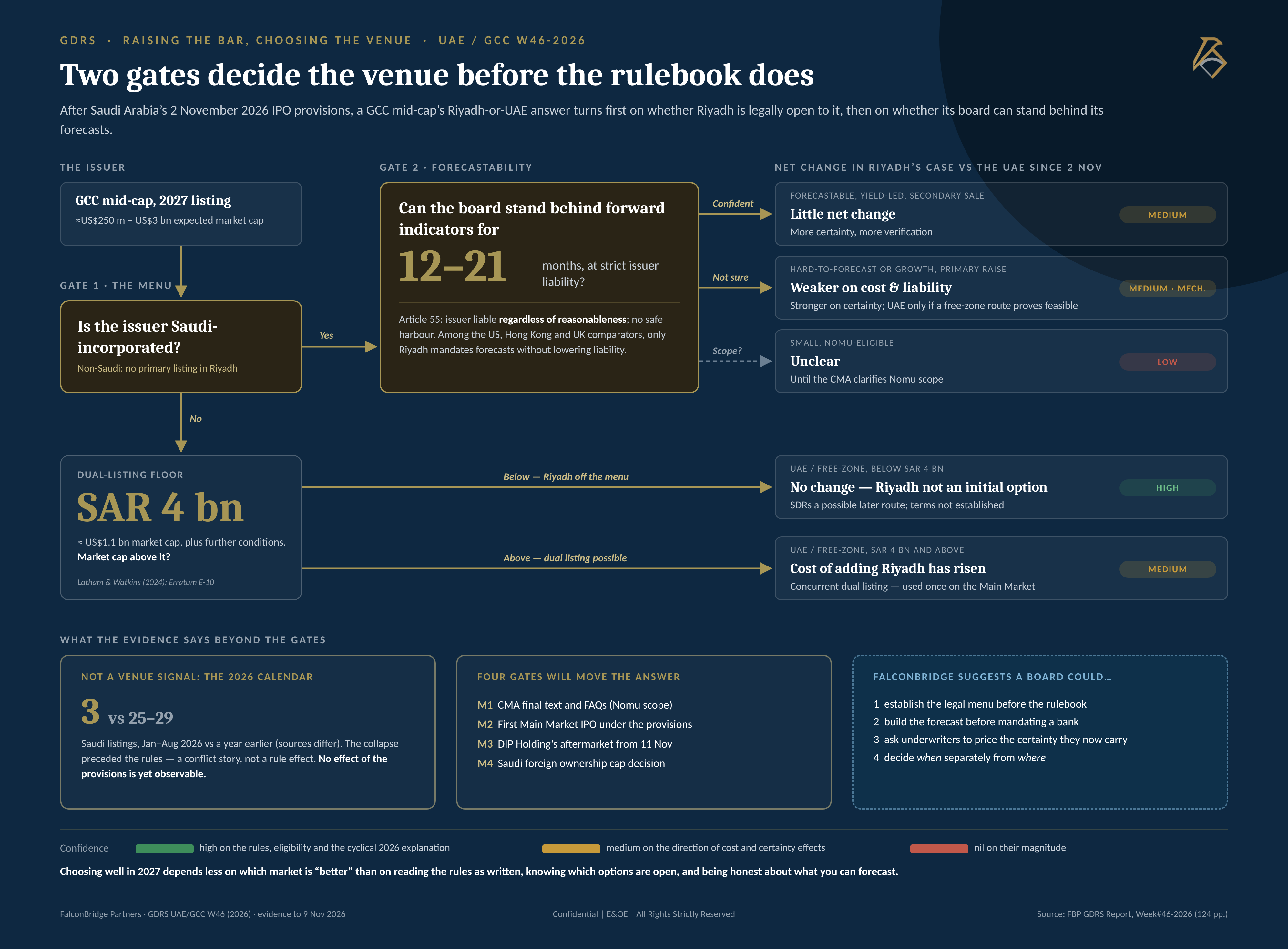
On 2 November 2026 the Saudi Capital Market Authority brought into force provisions that bind IPO underwriters before book-building, require institutional bids to be cash-backed and binding, and put forward-looking financial performance indicators for the rest of the latest period and at least the next year into the prospectus. The study asks whether this changes the case for listing in Riyadh rather than Dubai or Abu Dhabi for a Gulf company of roughly US$250 million to US$3 billion planning a 2027 listing. For many such companies, Riyadh is not on the menu. A non-Saudi company cannot make a primary listing on the Saudi Main Market and may dual-list only at a market capitalisation of at least SAR 4 billion (about US$1.1 billion), with further conditions. For a UAE or free-zone mid-cap below that line, the new provisions are irrelevant to the venue decision; Saudi Depositary Receipts may offer a later route, on terms not yet established. Where Riyadh is open, the provisions move risk to underwriters and liability to issuers. Execution certainty rises; cost, capital consumption and legal exposure rise with it. Forward-looking indicators now sit inside a prospectus regime in which the issuer is liable regardless of reasonableness and no safe harbour applies — making Riyadh an outlier among the US, Hong Kong and UK comparators. Forecastability therefore becomes the pivotal internal test: for a confident forecaster the burden is mainly verification; for an unsure one it is a legal exposure that exists only in Riyadh. The rules answer a real problem. By mid-2026, 29 of 37 Saudi listings of 2025 traded below issue price after institutional books of 100x to 241x; a launched Saudi deal is now near-certain to complete. The UAE has converged on liability rather than forecasts — its 2026 law makes boards, management and advisers liable within their competencies, with fines up to AED 200 million — but does not, on the evidence found, mandate forward-looking indicators. No effect of the provisions is yet observable. Saudi listings fell to three in January–August 2026, against 25–29 a year earlier, before the provisions were published: the collapse is a conflict story, not a rule effect. Confidence is high on the rules and on that explanation, medium on the direction of cost and certainty effects, and nil on their magnitude. The CMA’s FAQs, the first post-rule IPO, DIP Holding’s aftermarket and the Saudi foreign ownership cap decision will move the answer. A board could consider establishing which venues are legally open to it before comparing rulebooks; then testing whether it can stand behind twelve to twenty-one months of forward indicators; completing that model before mandating underwriters; and treating when to list as a separate decision from where.
SAR 4 bn
SAR 4 bn (about US$1.1 billion) is the market capitalisation a non-Saudi company needs to dual-list on the Saudi Main Market, with further conditions. A non-Saudi company cannot make a primary listing.
12–21 months
12–21 months of forward indicators go into the prospectus, at strict issuer liability with no safe harbour. Among the US, Hong Kong and UK comparators, only Riyadh mandates forecasts without lowering liability.
3 vs 25–29
3 Saudi listings in January–August 2026 against 25–29 a year earlier (sources differ). The collapse preceded the rules: a conflict story, not a rule effect.
UAE / GCC · Week 46, 2026
Saudi Arabia has raised the bar for IPOs. For many Gulf mid-caps, Riyadh was never on the menu.
The complete package
Six elements, tailored to the question and to how readers will use the work
Tell us who is reading and the pack is emailed to you straight away. The package is released under a Type-1 licence for the requester’s own use. Public access does not transfer ownership.
Around this study
Other studies on UAE / GCC
Saudi Arabia's Commercial Transactions and Consumer Protection Laws
Benchmarking the UAE's approach to individual accountability
The UAE’s Federal Priorities: A Real Budget, a Narrower Opportunity
How a study like this is commissioned: a question of your own, answered as a complete research package.

A conversation about your decision
What needs to be understood
before your next decision?
Bring the proposition, question or direction you are working on. Together, we can define the support it requires.
Start a conversation