Public study · UAE / GCC · 2026 · From Fragmented Rules to Enforceable Trust
Real in design. Conditional in effect.
Saudi Arabia's Commercial Transactions and Consumer Protection Laws
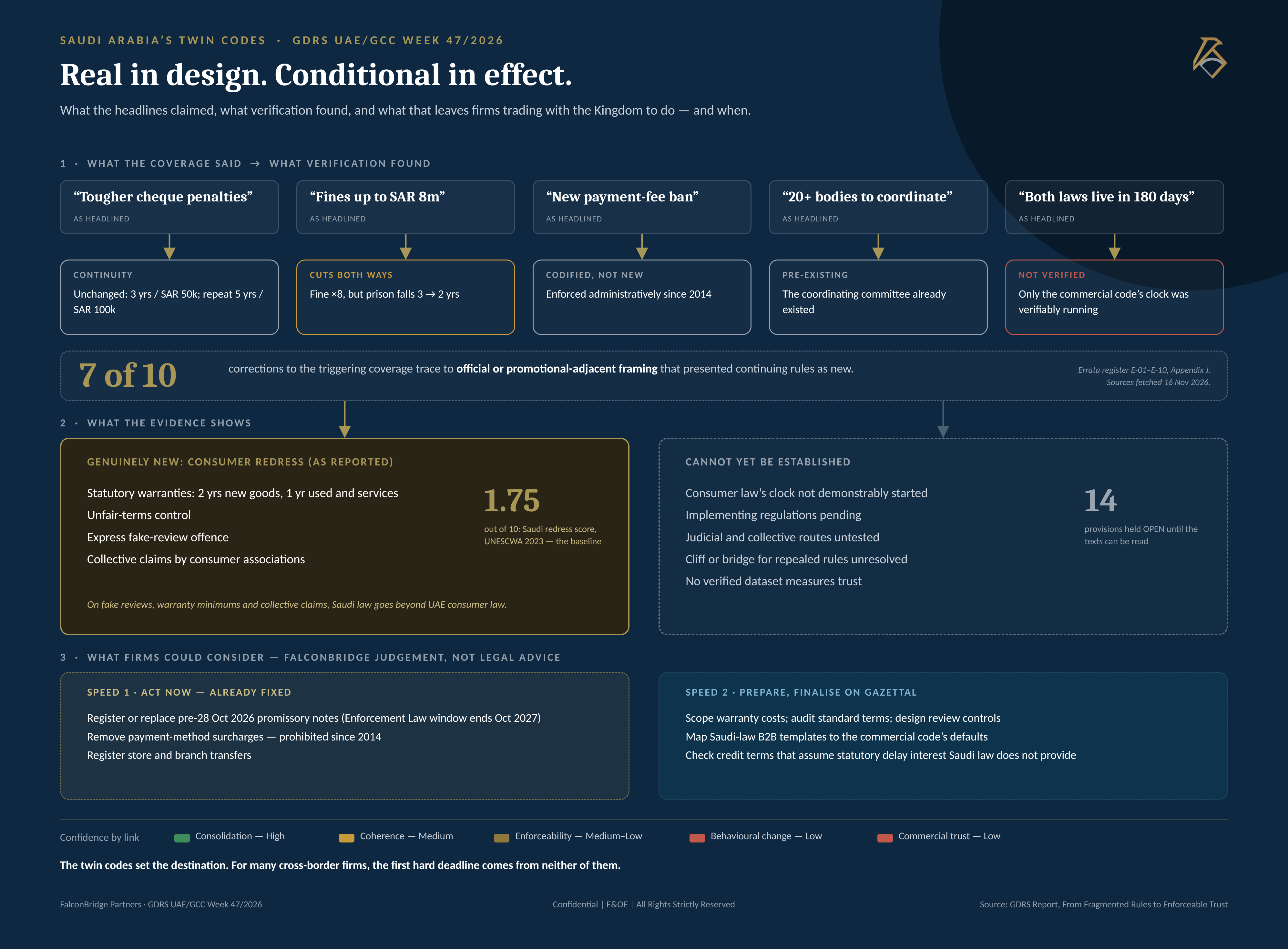
In one week of November 2026 Saudi Arabia published a 271-article Commercial Transactions Law (CTL) and its Cabinet approved a 76-article Consumer Protection Law (CPL). The study asked whether the two, read together, replace fragmented rules with an enforceable framework of commercial trust, and what firms trading with the Kingdom must change before they take effect. Evidence was cut off on 16 November 2026; every cited source was fetched and checked. The headlines overstated what is new. Seven of the ten corrections made to the triggering coverage trace to official or promotional-adjacent framing. The bounced-cheque penalties (three years or SAR 50,000; five years or SAR 100,000 on repeat) are unchanged from the existing law, and cheques are 0.0 per cent of Saudi payment volume. The consumer fine ceiling rises from SAR 1 million to SAR 8 million, but the maximum prison term falls from three years to two. The genuine novelty is consumer redress: as reported, statutory warranties of two years for new goods and one year for used goods and services, unfair-terms control, an express fake-review offence and collective claims by consumer associations. Saudi redress scored 1.75 out of 10 in UNESCWA’s 2023 assessment; on fake reviews, warranty minimums and collective claims the Kingdom now goes beyond UAE consumer law. Enforceability cannot yet be established. Only the CTL’s 180-day clock was verifiably running at cut-off; the CPL text was not displayed on the gazette site. Regulations are pending, the judicial and collective routes are untested, whether the repealed laws’ regulations survive commencement is unresolved, and no verified dataset measures trust. Fourteen provisions stay open until the texts can be read. Exposure is highest for consumer-facing, online and platform businesses. For many cross-border firms the earliest deadline comes from neither code: the 2026 Enforcement Law’s one-year window for unregistered promissory notes, which ends in October 2027. Firms could consider planning at two speeds. Act now on what is fixed: register or replace pre-28 October 2026 promissory notes, remove payment-method surcharges (prohibited since 2014) and register store transfers. Prepare, but finalise only on gazettal, whatever depends on unread text: warranty costs, standard terms, review controls, B2B templates, and credit terms that assume statutory delay interest Saudi law does not provide.
SAR 1m to SAR 8m
The consumer fine ceiling rises from SAR 1 million to SAR 8 million, but the maximum prison term falls from three years to two.
1.75 out of 10
Saudi redress scored 1.75 out of 10 in UNESCWA’s 2023 assessment; on fake reviews, warranty minimums and collective claims the Kingdom now goes beyond UAE consumer law.
October 2027
For many cross-border firms the earliest deadline comes from neither code: the 2026 Enforcement Law’s one-year window for unregistered promissory notes, which ends in October 2027.
UAE / GCC · Week 47, 2026
Saudi Arabia's new commercial laws are real reform. They are not yet enforceable trust.
The complete package
Six elements, tailored to the question and to how readers will use the work
Tell us who is reading and the pack is emailed to you straight away. The package is released under a Type-1 licence for the requester’s own use. Public access does not transfer ownership.
Around this study
Other studies on UAE / GCC
After Saudi Arabia’s 2 November 2026 IPO provisions, a GCC mid-cap’s Riyadh-or-UAE answer turns first on whether Riyadh is legally open to it, then on whether its board can stand behind its forecasts.
Benchmarking the UAE's approach to individual accountability
The UAE’s Federal Priorities: A Real Budget, a Narrower Opportunity
How a study like this is commissioned: a question of your own, answered as a complete research package.

A conversation about your decision
What needs to be understood
before your next decision?
Bring the proposition, question or direction you are working on. Together, we can define the support it requires.
Start a conversation