Public study · UAE / GCC · 2026
From Allocation to Opportunity
The UAE’s Federal Priorities: A Real Budget, a Narrower Opportunity
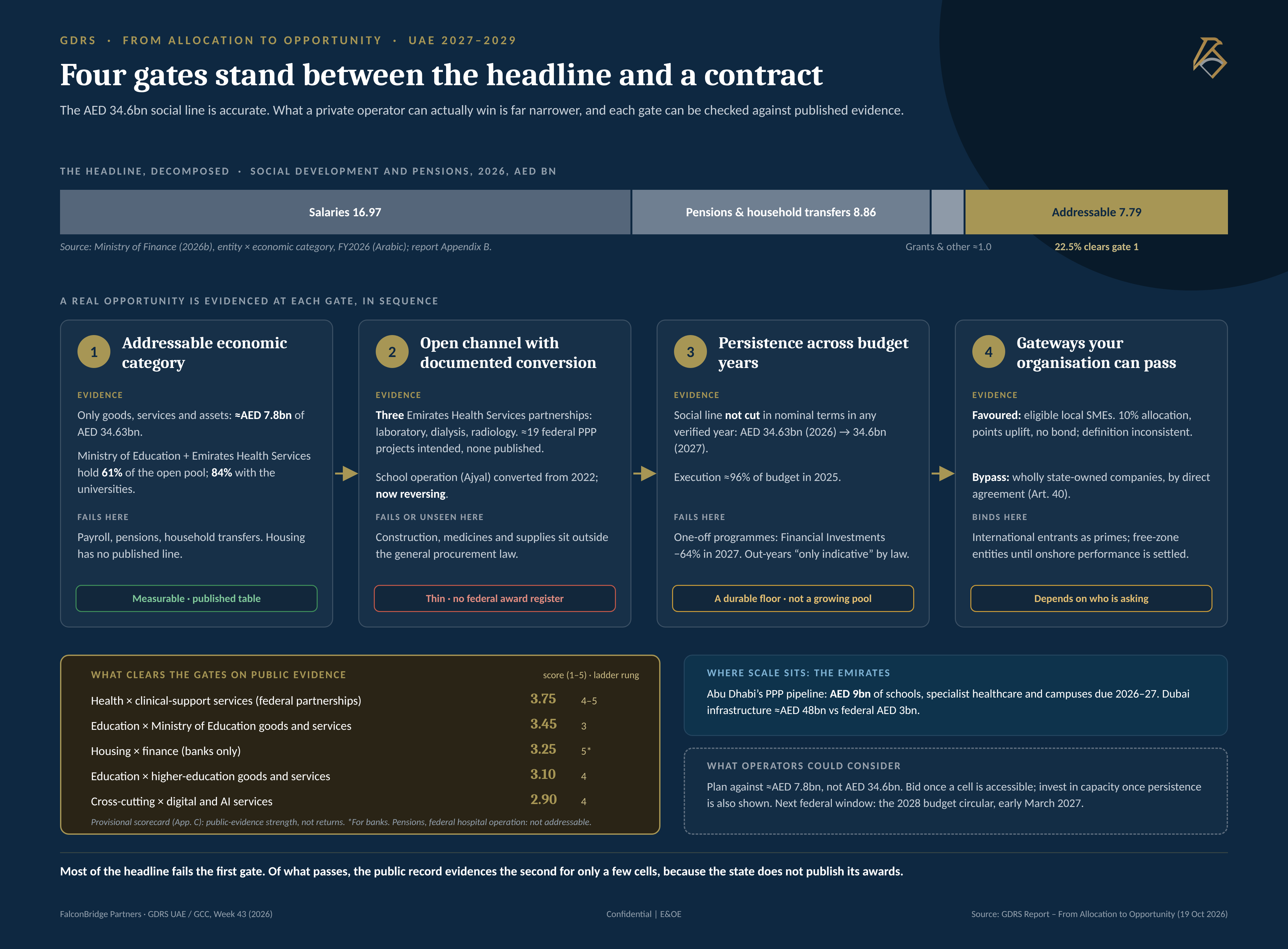
On 12 October 2026 the UAE Cabinet approved a federal budget of AED 292.5bn for 2027–2029 and AED 90.1bn for 2027. It allocated AED 34.6bn to Social Development and Pensions and named education, health, housing, social services and citizens’ quality of life as its priorities. The study asked which sectors and operators are best placed to benefit, and what evidence separates a real opportunity from a headline allocation. Each of its 148 sources was fetched and the specific claim confirmed. The headline is accurate, but it answers a different question. Of the sector’s AED 34.63bn in 2026, AED 16.97bn is salaries and AED 8.86bn is subsidies and social benefits paid to households. Only about AED 7.8bn, or 22.5 per cent, sits in goods, services and assets that private operators can compete for. That figure comes from the Ministry of Finance’s own entity-by-economic-category table. The line did not grow: it was AED 34.63bn in 2026 and is AED 34.6bn in 2027. The “28.3 per cent” increase is growth over budgets already enacted, and by law the out-years are “only indicative”. The open money is concentrated. The Ministry of Education and Emirates Health Services hold 61 per cent of the open pool, and 84 per cent with the federal universities and the Ministry of Higher Education. Social services contribute about 2 per cent and pensions nothing. Housing has no published line and converts mainly through bank-funded finance. Access is open at the door and selective inside. Eligible local SMEs gain a 10 per cent allocation and a points uplift, though their eligibility is defined inconsistently. Wholly government-owned companies may be contracted by direct agreement, outside the procurement law. The social line is a durable floor: it has not been cut in nominal terms in any verified year, and it was held flat through the 2026 shock. Evidence of conversion is thin, because no federal award register exists. The record shows three Emirates Health Services partnerships for laboratory, dialysis and radiology services; an outsourced school-operation channel that is now being reversed; and bank-funded housing finance. The plan is not evidenced as counter-cyclical. For infrastructure, housing and social-infrastructure partnerships, the emirates are where the priorities become contracts. Abu Dhabi’s published PPP pipeline, for example, includes AED 9bn of schools, specialist healthcare and university campuses due to market in 2026–2027. The public record cannot show how much federal spending reaches private operators, the share won by SMEs, the rules for buying construction and medical supplies, or the size of the housing appropriation. The central finding is held with medium-high confidence. Findings on conversion and on specific operator segments carry lower confidence. Operators could consider planning against the addressable figure rather than the headline. A cell is real only when four things are evidenced in sequence: an addressable economic category; an open channel with documented conversion; persistence across budget years; and gateways the operator’s own type can pass. Operators could consider bidding once a cell is accessible, and investing in capacity only once persistence is also shown. The next federal design window opens with the 2028 budget circular, due in early March 2027.
About AED 7.8bn
Of the social sector’s AED 34.63bn in 2026, only about AED 7.8bn, or 22.5 per cent, sits in goods, services and assets that private operators can compete for.
61 per cent
The Ministry of Education and Emirates Health Services hold 61 per cent of the open pool, and 84 per cent with the federal universities and the Ministry of Higher Education.
148 sources
Each of the study’s 148 sources was fetched and the specific claim confirmed.
UAE / GCC · Week 43, 2026
The UAE’s social budget is real. Most of it cannot be won.
The complete package
Six elements, tailored to the question and to how readers will use the work
Tell us who is reading and the pack is emailed to you straight away. The package is released under a Type-1 licence for the requester’s own use. Public access does not transfer ownership.
The sample demonstrates the work
Figures above are verified findings drawn from the source report, which cites the Ministry of Finance, WAM and the operative laws throughout. Statements of implication and recommendation are FalconBridge’s judgement, offered for the reader’s own decision. They are suggestive, not directive.
Around this study
Other studies on UAE / GCC
UAE · Saudi Arabia
UAE / GCC
What Could Be Preserved Was Decided Before the Shock Began
How a study like this is commissioned: a question of your own, answered as a complete research package.

A conversation about your decision
What needs to be understood
before your next decision?
Bring the proposition, question or direction you are working on. Together, we can define the support it requires.
Start a conversation