Public study · New Zealand · 2026 · From Campus to Cashflow
A 14–29% fall in fees would erase four university surpluses
Full-fee international revenue at New Zealand's universities and polytechnics
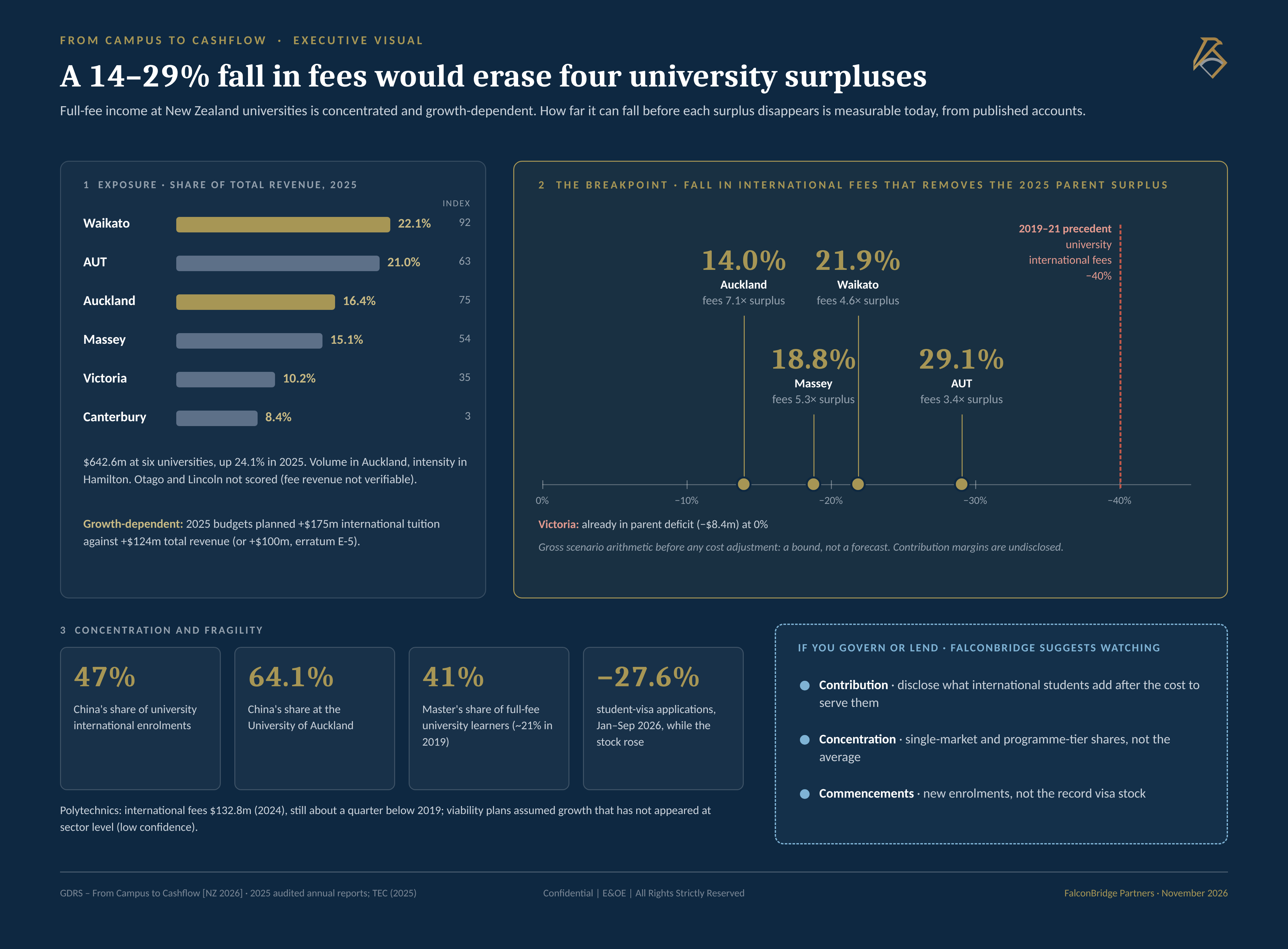
A record 95,553 people held student visas at the end of October 2026. The figure reads as momentum, but it does not measure financial exposure: fewer than half (45,636) pay full fees, and those include school, private training and English-language students. This study asked a narrower question. Which universities and polytechnics depend on full-fee international revenue, and how large a fall could each absorb? The dependence that matters is dependence on growth. University budgets for 2025 planned a $175m rise in international tuition against a $124m rise in total revenue, while expenditure was budgeted to grow faster than revenue (4.7% against 2.5%). The same Tertiary Education Commission paper gives $100m elsewhere; on either figure, international growth carries most or all of planned revenue growth. Dependence is uneven and concentrated. International fees at six universities reached $642.6m in 2025, up 24.1%, ranging from 8.4% of total revenue at Canterbury to 22.1% at Waikato. China supplies 47% of university international enrolments and 64.1% at the University of Auckland; Master's students are 41% of full-fee learners, against about 21% in 2019. Exposure is an upper North Island matter: volume in Auckland, intensity in Hamilton. Resilience can be read from published accounts. International fees equal 3.4–7.1 times the 2025 parent surplus at the four universities with parent-basis data; a gross fall of 14–29% would remove that surplus, before any cost response. The precedent was a 40% fall between 2019 and 2021. Universities recovered above 2019 by 2024; polytechnics did not, and their standalone plans assumed international growth that has not yet appeared at sector level. Three matters remain open. Cross-subsidy of domestic teaching is plausible but not demonstrated, because no institution discloses the cost to serve international students. Fee income by source country is not published, so income concentration is inferred, not measured. Visa applications fell 27.6% in January–September 2026 while the stock rose; whether that signals demand, approval quality or a counting change is undetermined. University councils could consider stress-testing budgets against a fall rather than a slowdown, and disclosing an international contribution margin. Polytechnic boards could test each plan on a no-growth case; lenders could add share, momentum and concentration to covenant monitoring. Commencements, not the record stock, are the signal worth watching.
95,553
A record 95,553 people held student visas at the end of October 2026, but fewer than half (45,636) pay full fees.
$642.6m
International fees at six universities reached $642.6m in 2025, up 24.1%, from 8.4% of total revenue at Canterbury to 22.1% at Waikato.
14–29%
A gross fall of 14–29% in international fees would remove the 2025 parent surplus at the four universities with parent-basis data, before any cost response.
New Zealand · Week 48, 2026
New Zealand's student numbers are at a record. The exposure sits somewhere else.
The complete package
Six elements, tailored to the question and to how readers will use the work
Tell us who is reading and the pack is emailed to you straight away. The package is released under a Type-1 licence for the requester’s own use. Public access does not transfer ownership.
The sample demonstrates the work
Figures are verified findings of the source report (61 sources fetched live; Otago and Lincoln not scored; polytechnic revenue findings low-confidence). The final paragraph is FalconBridge's suggestive judgement, offered for the reader's own decision.
Around this study
Other studies on New Zealand
New Zealand's NEV adoption and transferable lessons
AI Accountability
Youth Unemployment Pressure
How a study like this is commissioned: a question of your own, answered as a complete research package.

A conversation about your decision
What needs to be understood
before your next decision?
Bring the proposition, question or direction you are working on. Together, we can define the support it requires.
Start a conversation