Public study · North Carolina · 2026 · From Tax Rate to Pump Price
The tax returns in full to cost; the channel decides what you pay
North Carolina's gas-tax pause and the restored 41 cents
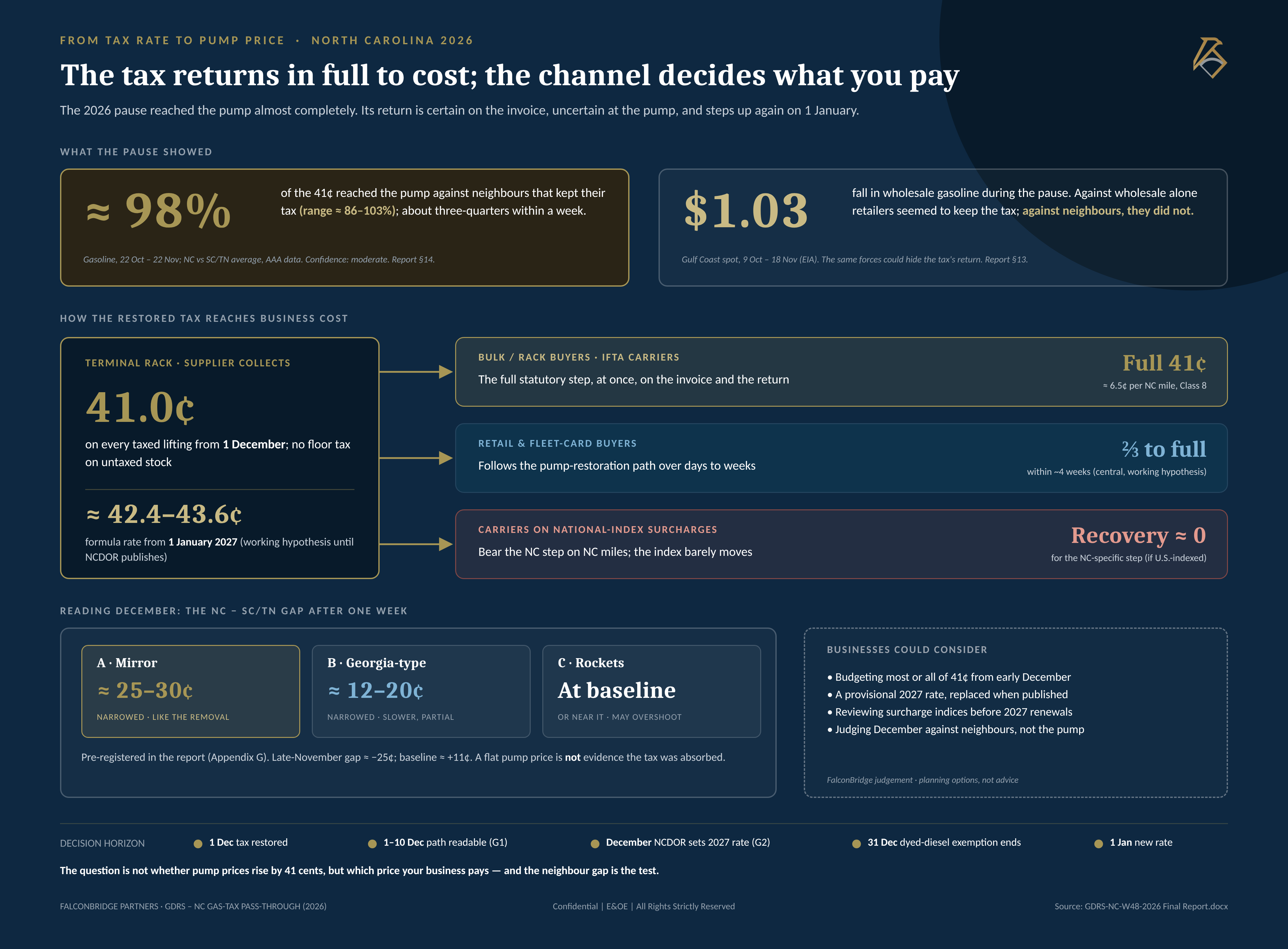
North Carolina suspended its 41.0-cent motor fuel excise from 10 October to 30 November 2026, and the legislature declined to extend it. The tax returns on fuel removed from terminals from 1 December. The question for any business with a material fuel bill is how much of it to build into December and 2027 costs, and when. The pause reached the pump. Measured against South Carolina and Tennessee, which share North Carolina's supply but kept their taxes, about three-quarters of the 41 cents reached drivers within a week, and a central ≈ 98% from late October (range ≈ 86–103%). That beat every published expectation, including Penn Wharton's 30 cents. Confidence is moderate: the estimate rests on state averages at eight dates and two controls. The market nearly hid it. Wholesale gasoline fell by about $1.03 during the suspension, and retail margins widened region-wide. Judged against wholesale alone, retailers seemed to keep most of the tax; judged against neighbours, they did not. The same forces could hide the return: a flat or falling December pump price would not mean the tax was absorbed. The restoration is a statutory certainty and a market uncertainty. Every taxed lifting carries the full 41.0 cents from 1 December, so bulk buyers and IFTA carriers bear it at once. Pump prices are likely to follow over days to weeks, as untaxed stock sells; whether the path mirrors the fast removal or Georgia's slower 2026 reinstatement remains open, and pre-registered diagnostics should tell within about ten days. On 1 January a formula rate applies, about 42.4–43.6 cents on verified inputs (a working hypothesis until NCDOR publishes). What a business pays depends on how it buys. The full step lands at once on the invoice and the IFTA return; fleets at the pump follow the restoration path; carriers on national-index surcharges may bear the North Carolina step without recovering it. These mechanisms are established; their prevalence among North Carolina firms is not. Businesses could consider budgeting most or all of the 41 cents from early December, with a prudent full-41-cent case; carrying a provisional 2027 rate until the published figure replaces it; reviewing surcharge indices before 2027 contracts renew; and judging December against the neighbouring states rather than last week's pump price. Figures above are findings of the source report, with its confidence markings and working-hypothesis labels intact. The planning options in the final paragraph are FalconBridge's judgement, offered for the reader's own decision; they are not forecasts, nor legal, tax or investment advice. E&OE | All Rights Strictly Reserved
≈ 98%
of the 41 cents reached the pump against neighbours that kept their tax (range ≈ 86–103%); about three-quarters within a week.
$1.03
fall in wholesale gasoline during the pause. Against wholesale alone retailers seemed to keep the tax; against neighbours, they did not.
≈ 42.4–43.6¢
formula rate from 1 January 2027 (working hypothesis until NCDOR publishes).
North Carolina · Week 48, 2026
North Carolina's gas-tax pause reached the pump. Its return will not reach every business the same way.
The complete package
Six elements, tailored to the question and to how readers will use the work
Tell us who is reading and the pack is emailed to you straight away. The package is released under a Type-1 licence for the requester’s own use. Public access does not transfer ownership.
Around this study
Other studies on North Carolina
Resolved Risk and Unresolved Risk
North Carolina’s 18 November 2025 award to Vulcan Elements, tested on the FalconBridge Strategic Incentive Scorecard. The downside is bounded; whether the money mattered and whether the recipient can deliver are not settled by the public record.
The shock travels through specific cost channels at different speeds, lands unevenly across sectors, and is being absorbed in margins. A wage trigger decides whether it becomes permanent.
How a study like this is commissioned: a question of your own, answered as a complete research package.

A conversation about your decision
What needs to be understood
before your next decision?
Bring the proposition, question or direction you are working on. Together, we can define the support it requires.
Start a conversation