Public study · North Carolina · 2026 · From Winning Bid to Public Return
Value turns on evidence no one publishes before commitment
North Carolina’s 18 November 2025 award to Vulcan Elements, tested on the FalconBridge Strategic Incentive Scorecard. The downside is bounded; whether the money mattered and whether the recipient can deliver are not settled by the public record.
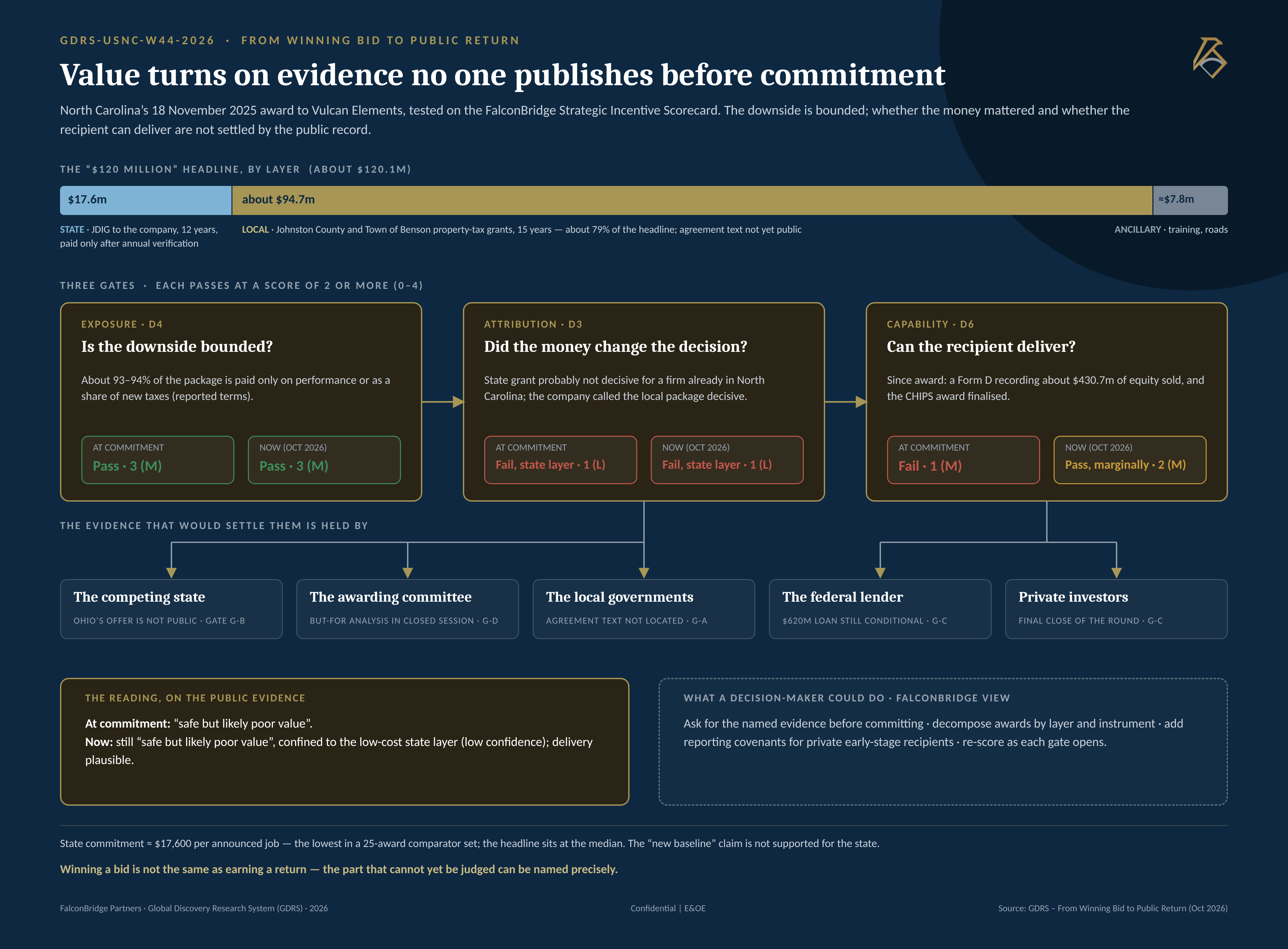
In October 2026 a headline reported that North Carolina had put up $120 million to beat Ohio for a small rare-earth magnet startup, Vulcan Elements. FalconBridge used the award to test a narrower and more useful question: can a transparent scorecard judge, before public money is committed, whether a strategic-manufacturing incentive is likely to deliver risk-adjusted public value? The study tests a decision method; it is not an audit of the award or a review of the company. The headline merges three layers of government. The state’s own commitment is a Job Development Investment Grant of up to $17,584,500 to the company over 12 years, paid only after annual verification approved on 18 November 2025, eleven months before the article. About $94.7 million — some 79 per cent of the headline — is county and town property-tax grants over 15 years, and about $8 million is training and road support. On the reported terms (the local agreement text is not yet public), about 93–94 per cent of the package is paid only on performance or as a share of new taxes. Applied to this award, the FalconBridge Strategic Incentive Scorecard — nine scored dimensions, an explicit “unknown” grade, confidence levels and three gates — establishes with confidence that the public’s downside is bounded and that the price is in line with comparable awards. It establishes the two terms that dominate value, whether the money changed the location decision and whether the recipient can deliver, only at low-to-medium confidence. The evidence that would settle them sits with the competing state, the awarding committee in closed session, the local governments, the federal lender and private investors, none of whom publish it. At commitment the profile reads “safe but likely poor value” on the public evidence: the exposure gate passed clearly, the capability gate failed on the public record, and the attribution gate failed on the state layer. Eleven months on, a securities filing recording about $430.7 million of equity sold and a finalised federal CHIPS award lift capability to a marginal pass; the remaining concern is confined to the low-cost state layer, at low confidence. The state’s commitment, about $17,600 per announced job, is the lowest in a 25-award comparator set and the headline sits at the median, so the “new baseline” claim is not supported for the state. Five external-data gates remain open: the local agreement text, Ohio’s offer, the federal loan’s financial close, the committee’s but-for analysis and the grant schedule. The test does not show whether the award is good or bad policy, or whether the company will succeed; scores are judgement against published rubrics, not findings about any party’s merit. States could consider decomposing strategic awards by layer and instrument type, recording the counterfactual reasoning behind but-for findings, and adding reporting covenants for private early-stage recipients. Companies could negotiate timing terms as carefully as amounts, and investors could read public support as a signal to test rather than a guarantee. Before the next commitment, the named missing evidence is where diligence could most usefully be directed.
$17.6m
The state’s own commitment, a grant to the company over 12 years, paid only after annual verification
about 79%
Share of the $120 million headline that is county and town property-tax grants over 15 years
$17,600
State commitment per announced job, the lowest in a 25-award comparator set
North Carolina · Week 44, 2026
The $120 million headline is real. The state's share of it is $17.6 million.
The complete package
Six elements, tailored to the question and to how readers will use the work
Tell us who is reading and the pack is emailed to you straight away. The package is released under a Type-1 licence for the requester’s own use. Public access does not transfer ownership.
Around this study
Other studies on North Carolina
The shock travels through specific cost channels at different speeds, lands unevenly across sectors, and is being absorbed in margins. A wage trigger decides whether it becomes permanent.
Power and Site Selection in North Carolina
Charlotte TOD: Can the Dirt Carry a Stack?
How a study like this is commissioned: a question of your own, answered as a complete research package.

A conversation about your decision
What needs to be understood
before your next decision?
Bring the proposition, question or direction you are working on. Together, we can define the support it requires.
Start a conversation