Public study · North Carolina · 2026
From Land to Load
Power and Site Selection in North Carolina
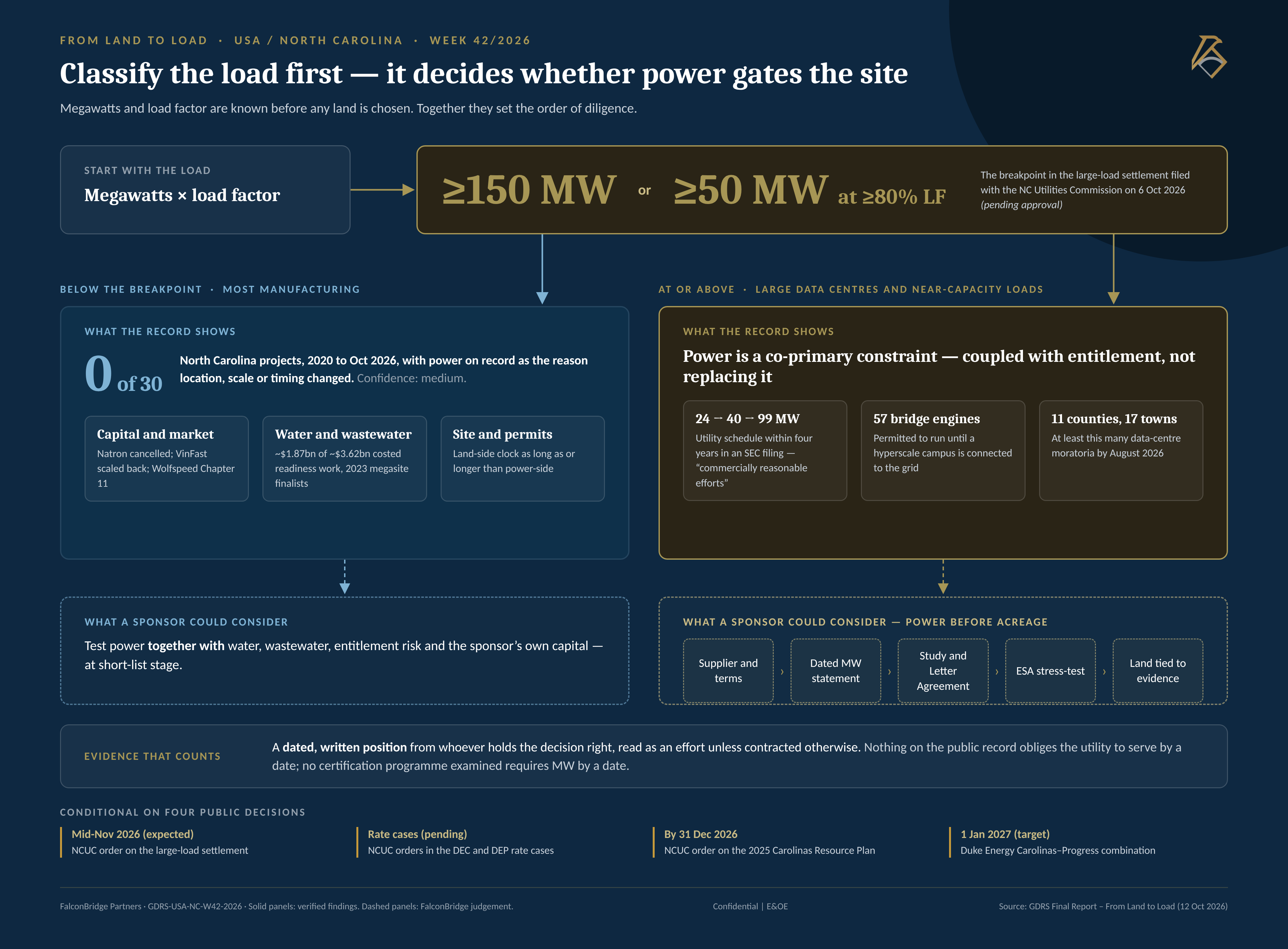
FalconBridge’s Weekly Signal for North Carolina (Week 42/2026) proposed that grid interconnection is replacing land entitlement as the primary bottleneck for large industrial projects, and that sponsors must stress-test utility queue times and power purchase terms early. This study tested that proposition against the public record. As a general statement, the proposition does not hold. Of 30 North Carolina projects from 2020 to October 2026, none has power on record as the reason its location, scale or timing changed (confidence: medium). Data-centre proposals failed at local entitlement; semiconductor and EV/battery projects failed or shrank for reasons of capital and market. For manufacturing, the land-side clock — site assembly, water, wastewater, permits — is as long as or longer than the power-side clock. For the largest loads, it holds in corrected form. For data centres of 150 MW and above, and loads of 50 MW and above that run near capacity, power is a co-primary constraint. One SEC filing records a utility capacity schedule of 24, 40 and then 99 MW within four years, offered as “commercially reasonable efforts”; the state air regulator permitted 57 utility-run engines to bridge a hyperscale campus until grid connection. Even here power is coupled with entitlement rather than replacing it: at least 11 counties and 17 towns had adopted data-centre moratoria by August 2026. The visible constraint is as much regulatory and contractual as physical. On 18 September 2026 the NC Utilities Commission declined to approve new generation against a forecast it found “insufficiently reliable”. Third-party retail PPAs are prohibited in the state, so the operative contract is the electric service agreement. The settlement filed on 6 October 2026 fixes the customer’s minimum bill (75%), term (10 or 15 years), security and exit, all pending approval; nothing on the public record obliges the utility to serve by a date. No certification programme examined requires megawatts deliverable by a date. Four public decisions will change these terms: the Commission’s order on the settlement (expected by mid-November 2026), its rate-case orders, its order on the 2025 Carolinas Resource Plan (due by 31 December 2026) and the Duke Energy Carolinas–Progress combination (targeted for 1 January 2027). Site-level headroom and request-to-energisation durations are not published; their absence is itself a finding. Decision-makers could consider classifying each load by megawatts and load factor before choosing land; treating power as a gating test before acreage is committed only above that breakpoint; testing power together with water, wastewater, entitlement and capital for every project; and obtaining at each stage a dated, written utility position, read as an effort unless contracted otherwise.
0 of 30
Of 30 North Carolina projects from 2020 to October 2026, none has power on record as the reason its location, scale or timing changed (confidence: medium).
150 MW
For data centres of 150 MW and above, and loads of 50 MW and above that run near capacity, power is a co-primary constraint.
11 counties and 17 towns
At least 11 counties and 17 towns had adopted data-centre moratoria by August 2026.
North Carolina · Week 42, 2026
The complete package
Six elements, tailored to the question and to how readers will use the work
Tell us who is reading and the pack is emailed to you straight away. The package is released under a Type-1 licence for the requester’s own use. Public access does not transfer ownership.
The sample demonstrates the work
The first five paragraphs report findings verified in the source report, with its confidence markings and pending-approval qualifiers retained. The final paragraph is FalconBridge’s judgement about how to use those findings, offered for the reader’s own decision.
Around this study
Other studies on North Carolina
Charlotte TOD: Can the Dirt Carry a Stack?
Real, Narrow and Dependent on Counterparties Abroad
Private Equity's Social Licence: Grievance, Evidence and the Path Back
How a study like this is commissioned: a question of your own, answered as a complete research package.

A conversation about your decision
What needs to be understood
before your next decision?
Bring the proposition, question or direction you are working on. Together, we can define the support it requires.
Start a conversation