Public study · Global · 2026
Value Without the Reactor
Real, Narrow and Dependent on Counterparties Abroad
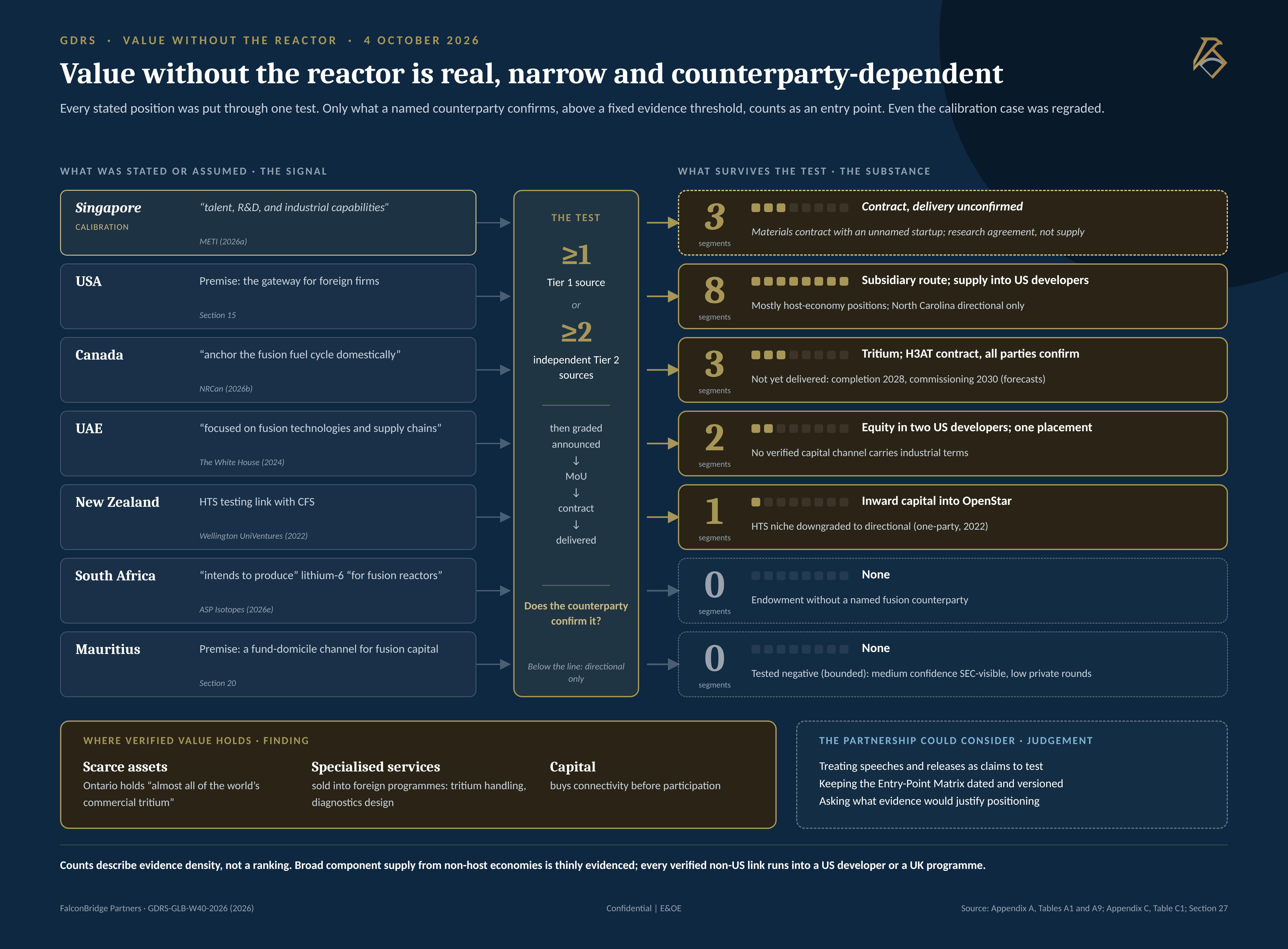
On 1 October 2026 Singapore’s Minister for Energy, Trade and Industry (Energy and Industry) argued that a country without its own fusion reactor can still “support the broader fusion economy” through talent, R&D and industrial capability. FalconBridge tested whether that argument travels to its own territories, assessed as six units: South Africa, the UAE, the USA, Canada, New Zealand and Mauritius. Singapore served as the calibration case. A position counted as an entry point only if it met a fixed threshold: at least one Tier 1 source or two independent Tier 2 sources. The yardstick itself did not survive verification intact. Fourteen of the 46 standing errata concern Singapore. ST Engineering discloses a contract with an unnamed “leading fusion startup”, and no party states delivery. The A*STAR–Commonwealth Fusion Systems instrument is a research agreement, not a supply contract. The Realta diagnostic is still “to be installed”. Singapore therefore meets the threshold in three segments, and its baseline reads “contract, delivery unconfirmed”. Against that baseline, the USA meets the threshold in eight value-chain segments, Canada in three, the UAE in two, New Zealand in one, and South Africa and Mauritius in none. These counts describe evidence density, not a ranking. For the others, the USA is less a peer than the market through which their positions are realised: every verified non-US link runs into a US developer or a UK programme. Verified non-host value attaches to three things. The first is scarce assets: Ontario, through OPG, holds “almost all of the world’s commercial tritium”. The second is specialised services sold into foreign programmes, notably Kinectrics’ role on the UKAEA–Eni H3AT tritium loop. All parties confirm that role, but delivery lies ahead, with completion forecast for 2028 and commissioning for 2030. The third is capital, which buys connectivity before participation: the UAE holds equity in two US developers, yet no verified capital channel carries industrial terms. Broad component supply from non-host economies is thinly evidenced. The negatives are as well evidenced as the positives. South Africa holds helium, rare earths, vanadium and lithium-6 intent without a named fusion counterparty. The Mauritius capital-services hypothesis was tested and found negative: medium confidence for SEC-visible capital, low for non-US private rounds. The speech’s US$419.84 billion market figure names no originator and is excluded. New Zealand’s regulatory readiness is not assessable because its statutes could not be fetched. Every verdict is dated 4 October 2026. The partnership could consider adopting the Entry-Point Matrix and the Signal-versus-Substance scorecard as reusable tools, dated and versioned rather than cited as fixed. It might also treat ministerial speeches and company releases as claims to test. For a territory with no entry point today, the more useful question is not whether to position for fusion, but what evidence would justify doing so. Figures and verdicts above are findings of the source report, verified against fetched sources and dated 4 October 2026. The final paragraph is FalconBridge’s judgement, offered as options for the partnership’s own consideration, not instructions, and not investment, legal or policy advice. E&OE. All rights reserved.
Eight segments
Against that baseline, the USA meets the threshold in eight value-chain segments, Canada in three, the UAE in two, New Zealand in one, and South Africa and Mauritius in none.
14 of 46
Fourteen of the 46 standing errata concern Singapore.
Three things
Verified non-host value attaches to three things.
The complete package
Five elements, tailored to the question and to how readers will use the work
Tell us who is reading and the pack is emailed to you straight away. The package is released under a Type-1 licence for the requester’s own use. Public access does not transfer ownership.

A conversation about your decision
What needs to be understood
before your next decision?
Bring the proposition, question or direction you are working on. Together, we can define the support it requires.
Start a conversation