Public study · North Carolina · 2026
From Pump Price to Budget
In North Carolina’s Budgets, Not Yet Embedded
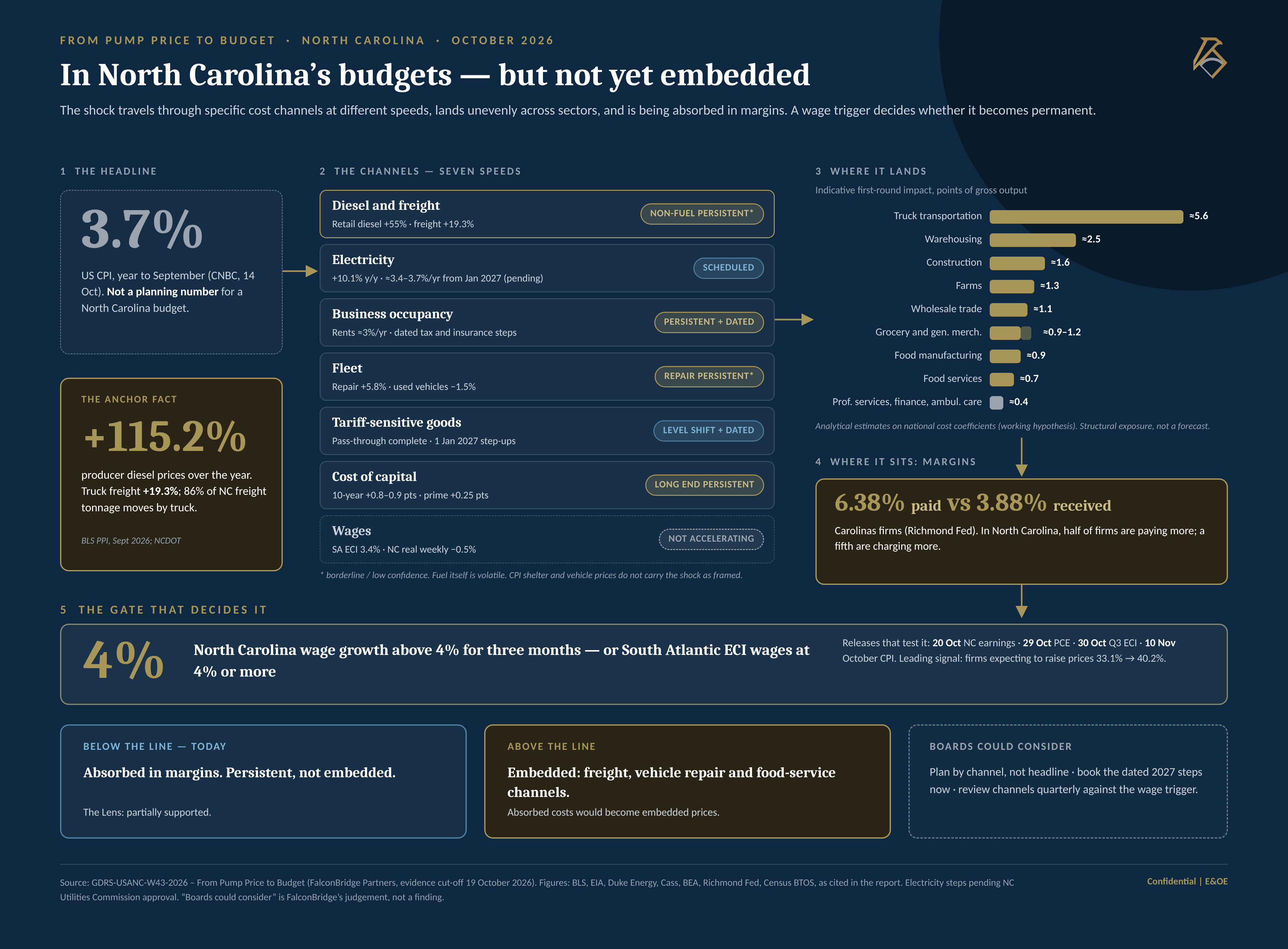
On 14 October 2026 CNBC reported that US consumer prices rose 3.7% over the year to September, with pressure in energy and diesel, shelter, vehicles and tariff-sensitive goods. FalconBridge’s Weekly Signal identified the article, and its Lens read the breadth of the rise as cost pressure “embedded in operating budgets”. The study tested that reading for North Carolina: through which channels the pressure reaches operating budgets, how exposure differs across sectors, and whether any of it has become embedded. The headline is the wrong planning number. While consumer prices rose 3.7%, producer diesel prices rose 115.2% and truck freight prices 19.3%. Direct fuel is a material cost (2% or more of gross output) only for trucking and construction, but purchased freight is material for every goods-handling sector, and trucks carry 86% of North Carolina’s freight tonnage. For most firms the shock arrives on the freight bill, not the fuel bill. The other channels move at different speeds. Commercial electricity rose 10.1% year on year in July, and pending Duke Energy settlements would add about 3.4%–3.7% a year from January 2027. Business occupancy is rising steadily at about 3%, with dated revaluation and insurance steps. Vehicle repair is up 5.8% while used-vehicle prices are down 1.5%. Tariff pass-through to consumers is judged effectively complete, leaving sector-specific step-ups. Two of the four channels CNBC named, shelter and vehicles, do not reach businesses as framed. Indicative first-round impacts range from about 0.4 to 5.6 points of gross output, on national cost coefficients. The pressure sits in margins. Carolinas firms report prices paid rising 6.38% against prices received 3.88%; half of North Carolina firms are paying more, but only a fifth are charging more. Wages are not accelerating: South Atlantic private wages are steady at 3.4%, and North Carolina real weekly wages are down 0.5%. The Lens is therefore partially supported: in budgets, yes; embedded, not yet. What remains open is whether absorbed costs become embedded prices. The study sets the line in advance: North Carolina wage growth above 4% for three months, or South Atlantic ECI wages at 4% or more. Firms expecting to raise their own prices have risen from 33.1% to 40.2%, and the decisive releases fall on 20 October, 29 October, 30 October and 10 November 2026. Public data support a sector-level map, but not reliable firm-size or sub-state maps. Boards could consider replacing the headline inflation assumption with channel-specific assumptions weighted by their own cost shares, entering the dated 2027 steps into budgets now, and asking management for a quarterly channel review against the wage trigger.
115.2%
While consumer prices rose 3.7%, producer diesel prices rose 115.2% and truck freight prices 19.3%.
86%
Trucks carry 86% of North Carolina’s freight tonnage, so for most firms the shock arrives on the freight bill, not the fuel bill.
6.38% against 3.88%
Carolinas firms report prices paid rising 6.38% against prices received 3.88%, so the pressure sits in margins.
The price shock is in North Carolina's budgets. It is not yet embedded in them.
The complete package
Six elements, tailored to the question and to how readers will use the work
Tell us who is reading and the pack is emailed to you straight away. The package is released under a Type-1 licence for the requester’s own use. Public access does not transfer ownership.
The sample demonstrates the work
Figures above are independently verified findings drawn from the source report; sector impacts are analytical estimates on national cost coefficients, as labelled there. Statements of implication and recommendation are FalconBridge’s judgement, offered for the reader’s own decision — not forecasts, and not the source report’s evidence.
Around this study
Other studies on North Carolina
Power and Site Selection in North Carolina
Charlotte TOD: Can the Dirt Carry a Stack?
Real, Narrow and Dependent on Counterparties Abroad
How a study like this is commissioned: a question of your own, answered as a complete research package.

A conversation about your decision
What needs to be understood
before your next decision?
Bring the proposition, question or direction you are working on. Together, we can define the support it requires.
Start a conversation