Public study · UAE / GCC · 2026 · From Order to Recovery
The order is a hinge, not a lever
ADGM Courts’ Binance freezing order
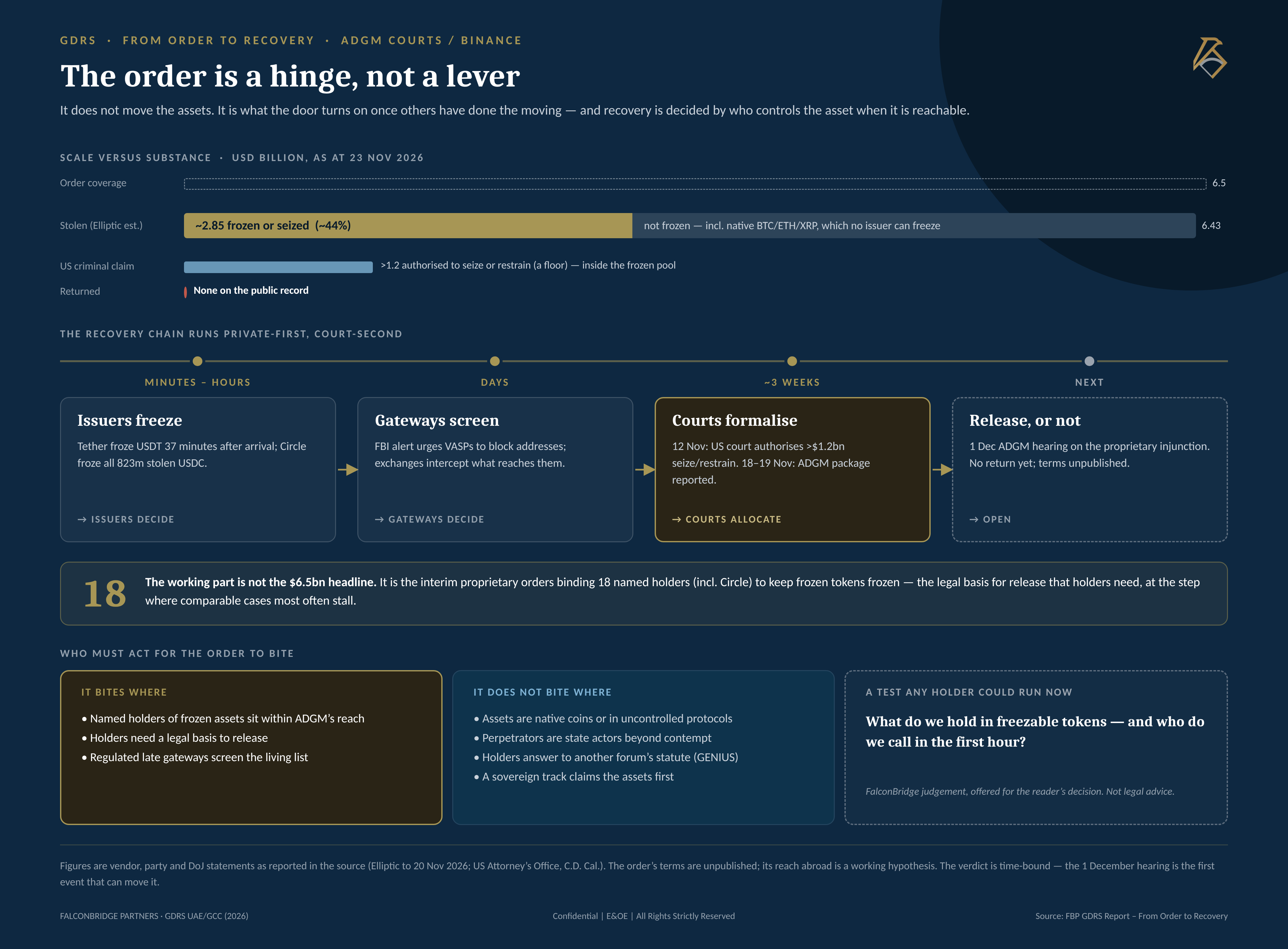
In November 2026 the ADGM Courts granted Binance a worldwide freezing order with $6.5 billion of coverage against the unknown perpetrators of the 29 October theft, served through the blockchain. The headline invited one question: is the order effective? The study answers a better one: who controls the assets when they are reachable, and does the order give them a legal basis to release them? The decisive fact is timing. About 44% of the stolen value (approximately $2.85 billion of $6.43 billion, Elliptic estimates to 20 November) was frozen or seized, most of it by stablecoin issuers within minutes or hours — Tether in 37 minutes, Circle all 823 million USDC — roughly three weeks before the order was reported. The order could not have caused those freezes. What can be frozen depends on what was stolen. Native bitcoin, ether and XRP have no issuer to freeze them; Bybit, hit by the same attacker with mostly ether, saw 3.84% frozen. Recovery therefore turns on where control exists along the laundering path, not on the forum or the size of the order. The issuers that matter most answer to their own statutes: the US GENIUS Act’s “lawful order” means a US federal order, and an ADGM order is not one. Yet the order is not empty. Its working part is the interim proprietary orders binding 18 named holders, including Circle, to keep frozen tokens frozen. That supplies the legal basis for release that holders say they need, at the step where comparable cases most often stall. ADGM’s jurisdictional base for this relief is also wider than England’s. No return of assets is on the public record as at 23 November 2026, and a US criminal track already claims more than $1.2 billion of the frozen pool. The order’s terms are unpublished, so its reach abroad is a working hypothesis, and no dataset tracks whether orders of this kind recover anything. The verdict is time-bound; the 1 December hearing is the first event that can move it. Holders of material digital assets could consider a pre-arranged first-hours protocol with token issuers and an analytics provider. Victims could consider sequencing legal process around release and documenting ownership and compensation. Anyone choosing a forum could judge it by its reach to the holders and its release pathway, not by headline order size. The first five paragraphs restate verified findings of the source report, with its qualifiers. The final paragraph is FalconBridge’s judgement, offered for the reader’s own decision; it is strategic research, not legal advice. E&OE | All Rights Strictly Reserved
$6.5bn
Order coverage against the unknown perpetrators of the 29 October theft. It is what the order covers, not what it froze.
~44%
About $2.85 billion of the $6.43 billion stolen (Elliptic estimate to 20 November) was frozen or seized, most of it by stablecoin issuers within minutes or hours.
18
Named holders, including Circle, are bound by interim proprietary orders to keep frozen tokens frozen.
UAE / GCC · Week 48, 2026
A record freezing order is a route to release. It is not yet a recovery.
The complete package
Six elements, tailored to the question and to how readers will use the work
Tell us who is reading and the pack is emailed to you straight away. The package is released under a Type-1 licence for the requester’s own use. Public access does not transfer ownership.
Around this study
Other studies on UAE / GCC
Saudi Arabia's Commercial Transactions and Consumer Protection Laws
After Saudi Arabia’s 2 November 2026 IPO provisions, a GCC mid-cap’s Riyadh-or-UAE answer turns first on whether Riyadh is legally open to it, then on whether its board can stand behind its forecasts.
Benchmarking the UAE's approach to individual accountability
How a study like this is commissioned: a question of your own, answered as a complete research package.

A conversation about your decision
What needs to be understood
before your next decision?
Bring the proposition, question or direction you are working on. Together, we can define the support it requires.
Start a conversation