Public study · Mauritius · 2026 · Build, Import or Offshore
Route the talent role by role — not for “digital talent”
The evidence supports a different route for each kind of role, a regulated core that must stay in Mauritius, and waiting only where the activity itself is uncertain.
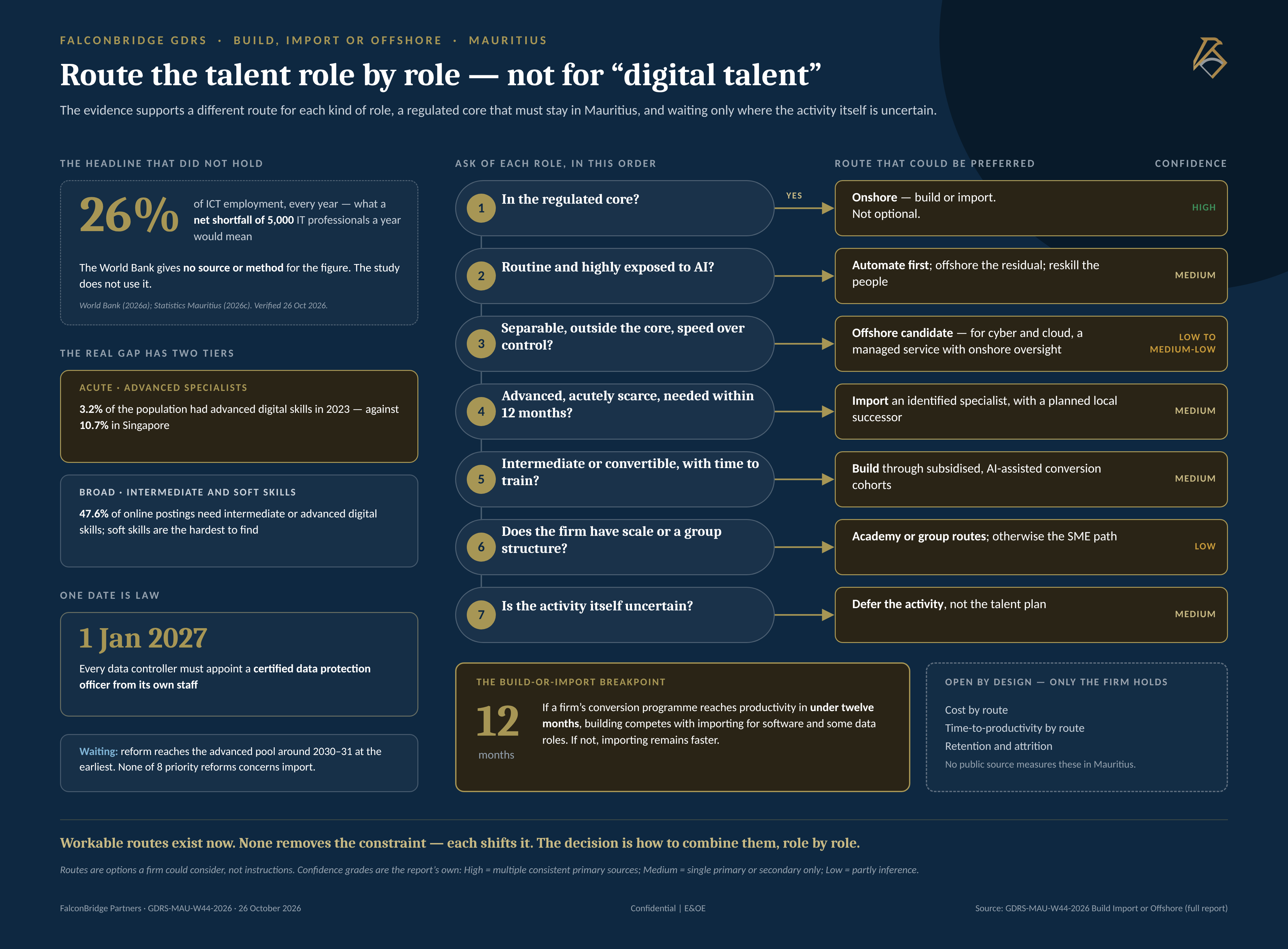
In October 2026, Mauritian media reported that the World Bank had told Mauritius it must close a shortfall of 5,000 IT specialists a year. FalconBridge’s study asks the question this raises for a board: for a firm pursuing higher-value digital or knowledge-intensive activity in Mauritius, when should it build talent locally, bring it in, or offshore it while the gap persists? Its answer is that the question is posed one level too high. There is no single route for “digital talent”; there is a different route for each kind of role. The headline does not hold. The World Bank report states “an estimated annual shortage of 5,000 IT professionals” but gives no source or method; as a net shortfall it would equal 26% of ICT employment every year. The study does not use it. The sound evidence shows two tiers: an acute scarcity of advanced specialists — 3.2% of the population had advanced digital skills in 2023, against 10.7% in Singapore — and a broad gap in intermediate and soft skills, with 47.6% of online postings needing intermediate or advanced digital skills. The routes are more open than the debate suggests. Since 13 August 2026, a single Rs 50,000 monthly permit threshold applies across all sectors, and 1,428 permit-holders were active in ICT and media at June 2024. Offshoring is legally open outside a narrow regulated core since the Bank of Mauritius revised its outsourcing guideline in January 2026. Employers paying the training levy can recover 70–75% of approved training costs — up to 90% for AI courses, subject to scheme limits — to convert a pool of 45,500 tertiary-qualified Mauritians in non-graduate jobs. None of these routes removes the constraint; each shifts it. Imported talent rotates, because permanent residence requires Rs 400,000 a month for five years, and skilled ICT workers are leaving. Some roles have no choice at all: from 1 January 2027 every data controller must appoint a certified data protection officer from its own staff, and bank oversight, internal audit, compliance and the core activity of tax-advantaged GBL holders must stay in Mauritius. Waiting is not neutral either: reform would reach the advanced pool around 2030–31 at the earliest, and none of the World Bank’s eight priority reforms concerns talent import. What remains open is held by firms, not public sources: cost, time-to-productivity and retention by route. The decisive test is whether a firm’s own conversion programme reaches productivity in under twelve months — if so, building competes with importing for software and some data roles; if not, importing remains faster. Only the regulated core, resting on law, is graded High confidence; most route rules are Medium. Whether Mauritian firms are in fact waiting was not tested. A board could consider assigning routes role by role, regulated core first; preparing now for the January 2027 data-protection requirement; importing identified specialists for acute roles, with named local successors; building intermediate capability through subsidised, AI-assisted cohorts and measuring time-to-productivity from the first; automating routine work before relocating it; and treating waiting as an option for uncertain activities, not as a talent strategy.
26%
Of ICT employment, every year, is what a net shortfall of 5,000 IT professionals a year would mean; the World Bank gives no source or method for the figure
3.2%
Of the population had advanced digital skills in 2023, against 10.7% in Singapore
1 Jan 2027
Every data controller must appoint a certified data protection officer from its own staff
Mauritius · Week 44, 2026
Mauritius has a digital-skills problem. It is not the 5,000-a-year one.
The complete package
Six elements, tailored to the question and to how readers will use the work
Tell us who is reading and the pack is emailed to you straight away. The package is released under a Type-1 licence for the requester’s own use. Public access does not transfer ownership.
Around this study
Other studies on Mauritius
What a firm with Mauritius exposure should test
AfCRA Adoption Paths
Mauritius 2026
How a study like this is commissioned: a question of your own, answered as a complete research package.

A conversation about your decision
What needs to be understood
before your next decision?
Bring the proposition, question or direction you are working on. Together, we can define the support it requires.
Start a conversation