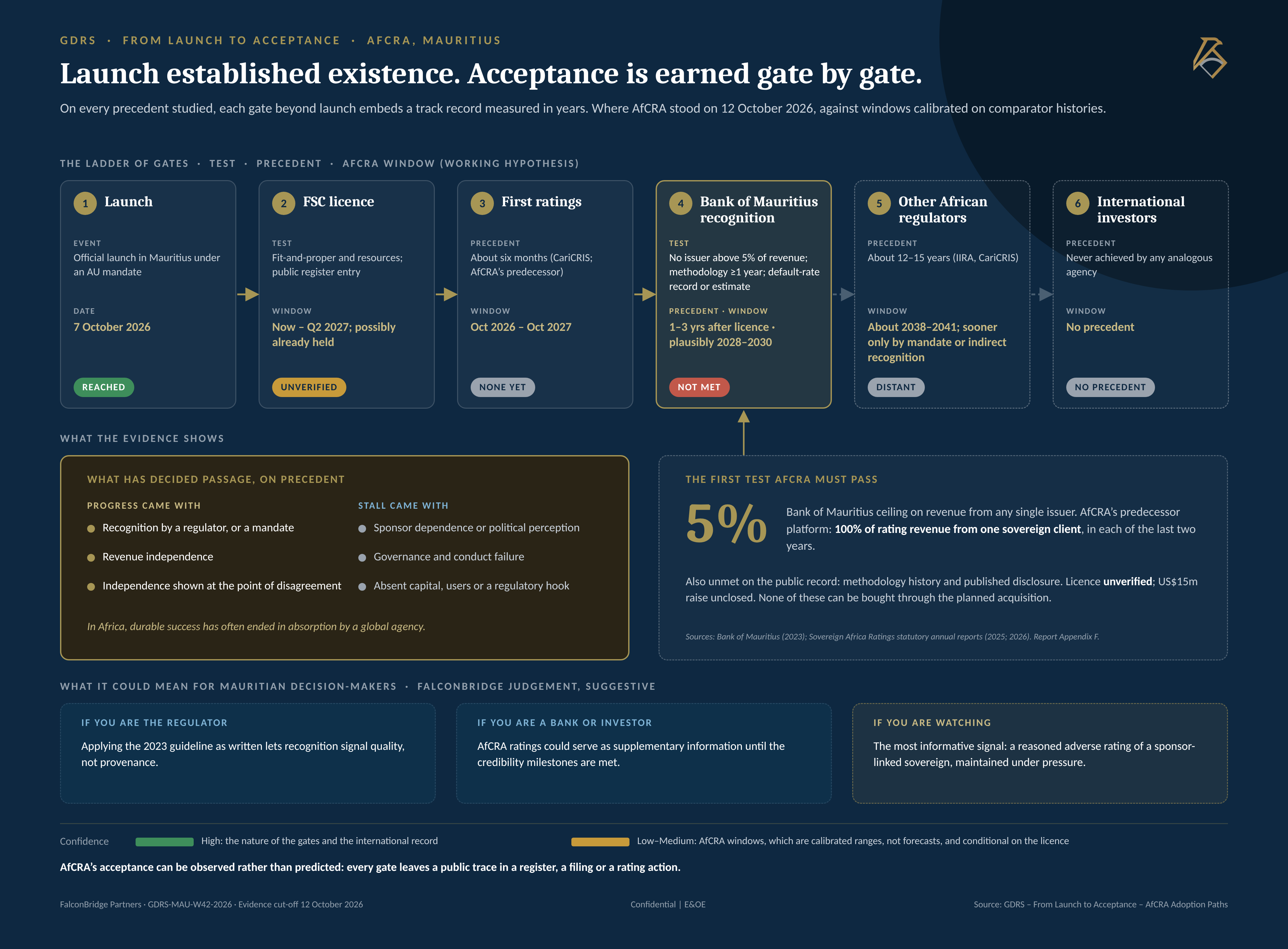
On 7 October 2026 the African Union-mandated Africa Credit Rating Agency (AfCRA) was launched in Mauritius. The study asked what the adoption paths of earlier regional and alternative rating agencies suggest about the timeline and conditions for its acceptance. It graded about thirty comparators and verified every source; thirty-six corrections are recorded, sixteen of them to facts the study team itself supplied. History separates launch from acceptance. Regulators define acceptance in law, as gates that each embed a track record measured in years: three years of institutional use for US registration; a methodology in use for one to three years for bank-capital recognition; at the Bank of Mauritius, a default-rate record and no single issuer above 5% of revenue. CariCRIS, a close sponsor-backed analogue, issued its first rating within six months but took about fifteen years to win its first foreign recognition, and its later revenue notes contain no line for that market. Use comes fast; reliance has followed only recognition or a mandate. No sponsor-backed, state-motivated or African agency in the study has won the reliance of international investors. Stall and reversal have followed sponsor dependence and failures of independence rather than operational shocks, and in Africa durable success has often ended in absorption by a global agency. AfCRA’s legitimacy is real: an AU Executive Council mandate, host-government support, and a coverage gap of 23 African states with no rating from S&P, Moody’s or Fitch. Its readiness is low. On the public record its Mauritian licence is unverified, its US$15m raise is unclosed, and no methodology or rating is published. Its predecessor platform drew 100% of its rating revenue from one sovereign client in each of the last two years. On precedent, Bank of Mauritius recognition is plausible in 2028–2030, first for a narrow segment; recognition elsewhere in Africa about 2038–2041 unless regulators create mandates; international reliance has no precedent. These are calibrated ranges, not forecasts, conditional on the one open gate, the licence, which a manual FSC register search can settle. No study yet measures African agencies’ effect on borrowing costs: the evidence-based case is coverage, not repricing. Mauritian decision-makers could treat AfCRA’s progress as something to observe rather than predict. The Bank of Mauritius could apply its 2023 guideline as written, so that recognition signals quality rather than provenance; banks and investors could treat AfCRA ratings as supplementary until the credibility milestones are met. The most informative early signal will be AfCRA’s first reasoned adverse rating of a sponsor-linked sovereign, maintained under pressure.
About fifteen years
CariCRIS, a close sponsor-backed analogue, issued its first rating within six months but took about fifteen years to win its first foreign recognition.
23 African states
AfCRA’s legitimacy is real: an AU Executive Council mandate, host-government support, and a coverage gap of 23 African states with no rating from S&P, Moody’s or Fitch.
100%
Its predecessor platform drew 100% of its rating revenue from one sovereign client in each of the last two years.
Mauritius · Week 42, 2026
The complete package
Six elements, tailored to the question and to how readers will use the work
Tell us who is reading and the pack is emailed to you straight away. The package is released under a Type-1 licence for the requester’s own use. Public access does not transfer ownership.
The sample demonstrates the work
Paragraphs one to five report the study’s verified findings; dates for future gates are its calibrated working hypotheses, not forecasts. Paragraph six is FalconBridge’s judgement, offered for the reader’s own decision. Evidence cut-off 12 October 2026.
Around this study
Other studies on Mauritius
Mauritius 2026
Mauritius executes what someone else scores
Mauritius raised its prices, not its taxes
How a study like this is commissioned: a question of your own, answered as a complete research package.

A conversation about your decision
What needs to be understood
before your next decision?
Bring the proposition, question or direction you are working on. Together, we can define the support it requires.
Start a conversation