Public study · USA · 2026 · From Data Release to Decision
Decide in advance what a jobs number may change
Monthly US labour data in board and lender decisions
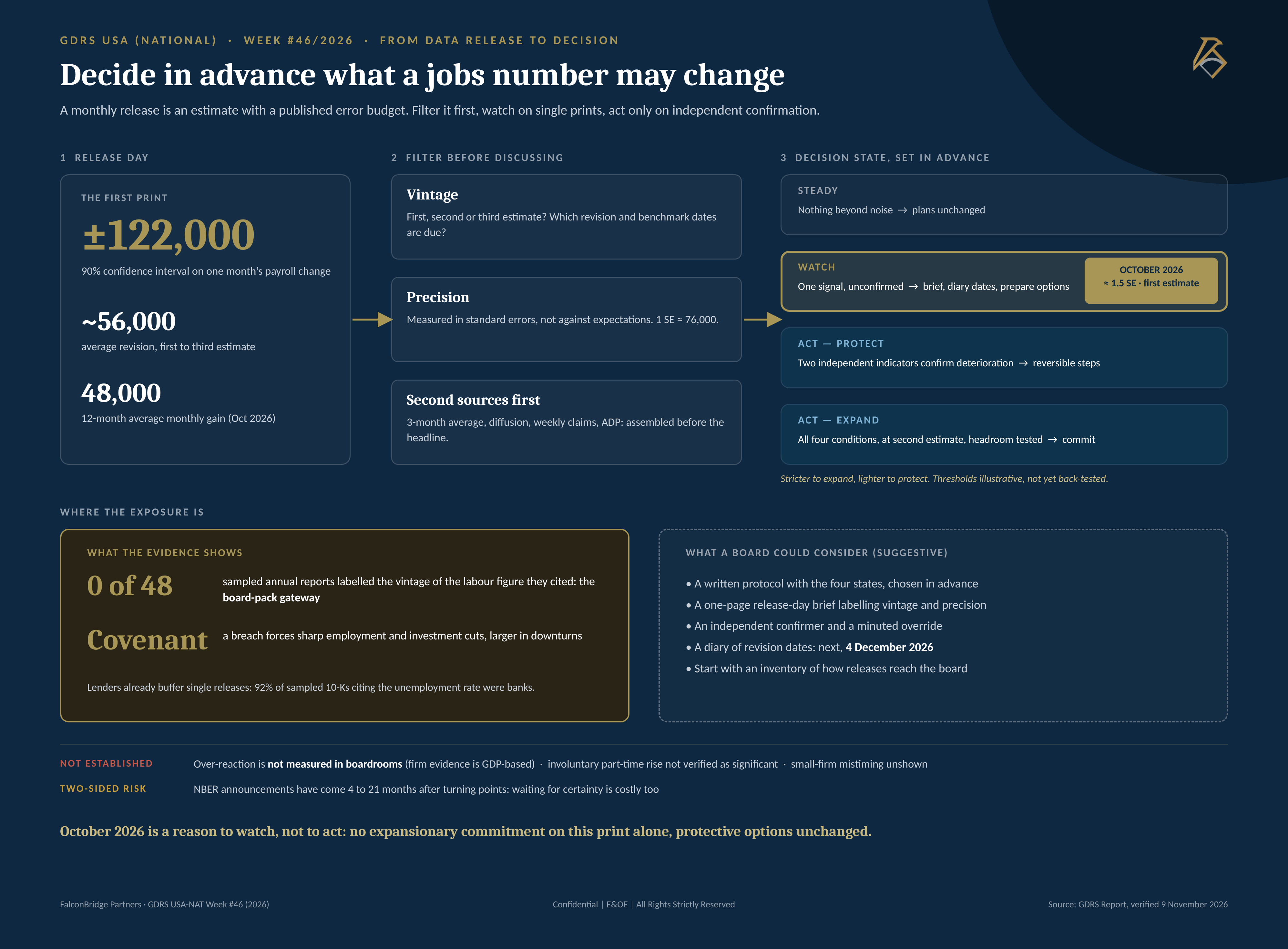
The October 2026 jobs report showed payrolls up 165,000 against a 12-month average of 48,000, in the same week as tighter small-firm lending standards and a sharp equity selloff. The study asked the question behind the headlines: how should boards and lenders decide which releases deserve action and which deserve watching? It uses only publicly verified evidence and makes no forecast. A monthly release is an estimate with a published error budget. The 90% confidence interval on a single month’s payroll change is ±122,000, and first estimates are revised by about 56,000 on average by the third estimate: as large as the current average monthly gain. Revisions have also run one way. In 2025 first prints were revised down on average by the full size of their typical revision, and the March 2025 benchmark removed 898,000 jobs from the level. Survey response has fallen materially since 2020, and October 2025 is missing from the household record permanently. The documented failure is less over-reaction than failure to filter: firms respond to the error in provisional macroeconomic data as to its true content, and profitability later reverses (the firm-level evidence is GDP-based). Lenders’ processes already buffer single releases through consensus paths, weighted scenarios and quarterly updates. The exposure sits at the gateway into the board pack, where none of 48 sampled annual reports labelled the vintage of the labour figure it cited, and in the borrower’s covenant, where a breach forces sharp employment and investment cuts. Under-reaction is the symmetric risk. NBER business-cycle announcements have come 4 to 21 months after the turning point, and the largest firms underreact most to macroeconomic news. Eight regimes that run on noisy data share five safeguards: smoothing, two independent conditions, pre-set thresholds, an explicit false-alarm budget and a recorded override, with asymmetric thresholds where costs are asymmetric. Applied to October 2026, about 1.5 standard errors above its 12-month average, a first estimate with breadth confirmed but sector and slack signals unconfirmed, the evidence says watch, not act: revisit on 4 December 2026 and make no expansionary commitment on this print alone. The over-reaction risk is plausible and indirectly evidenced, not measured in boardrooms; materiality is conditional on decisions following single prints without vintage and precision checks. The protocol’s thresholds are illustrative and not yet back-tested. Boards could consider an explicit protocol with four states (steady, watch, act–protect, act–expand), stricter confirmation to expand than to protect, chosen in advance, an independent confirmer and a diary of revision dates. Finance functions could adopt a one-page release-day brief that labels vintage and precision and presents second sources first. A first step is an inventory of how releases currently reach the board.
±122,000
±122,000 is the 90% confidence interval on a single month’s payroll change. First estimates are revised by about 56,000 on average by the third estimate.
0 of 48
0 of 48 sampled annual reports labelled the vintage of the labour figure they cited: the board-pack gateway is where the exposure sits.
4 December 2026
4 December 2026 is the next revision date. October 2026, about 1.5 standard errors above its 12-month average, is a reason to watch, not to act.
USA · Week 46, 2026
A monthly jobs number is an estimate. Boards should decide in advance what it is allowed to change.
The complete package
Six elements, tailored to the question and to how readers will use the work
Tell us who is reading and the pack is emailed to you straight away. The package is released under a Type-1 licence for the requester’s own use. Public access does not transfer ownership.
Around this study
Other studies on USA
The SEC's proposed Item 402 pay-disclosure reform
Workforce-Cost Release and AI Capital Expenditure
A setback in one AI-linked domain could reach the others through twenty-two graded channels. The public evidence is strongest where channels exist and weakest exactly where their severity would be decided.
How a study like this is commissioned: a question of your own, answered as a complete research package.

A conversation about your decision
What needs to be understood
before your next decision?
Bring the proposition, question or direction you are working on. Together, we can define the support it requires.
Start a conversation