Public study · USA · 2026 · From Prescription to Judgement
The disclosure decision moves from the rulebook to the boardroom
The SEC's proposed Item 402 pay-disclosure reform
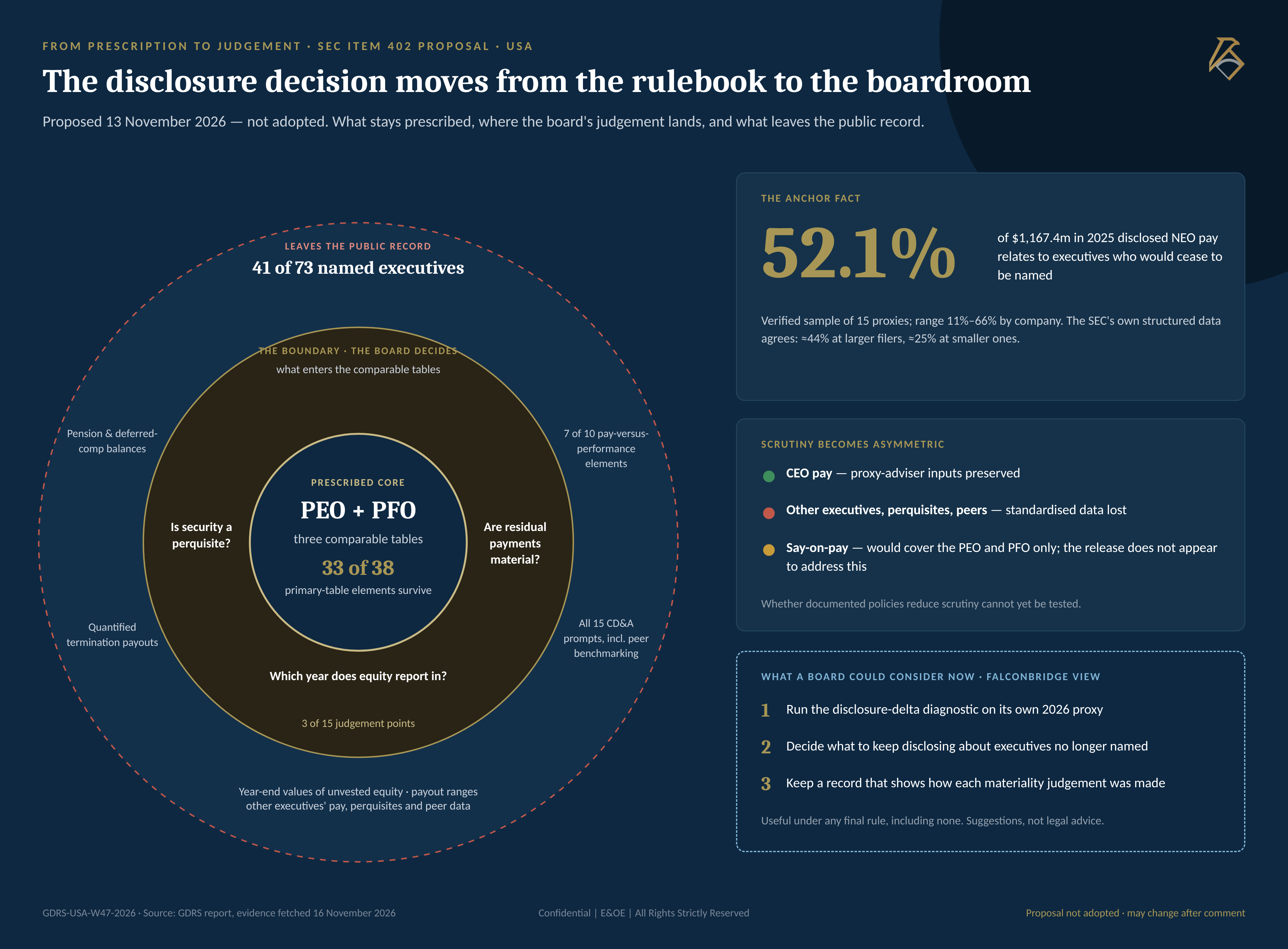
On 13 November 2026 the SEC proposed to rewrite Item 402 of Regulation S-K, the rule governing executive and director pay disclosure, to make it “more principles-based and materiality-driven”. The proposal is not adopted and no adoption date has been announced. The study tested, rather than assumed, what that would mean in practice, by mapping real 2026 proxy disclosures onto the proposed tables. The proposal does not simply reduce disclosure; it relocates the decision about what to disclose from the rulebook to the boardroom. In a verified sample of 15 proxies, 41 of 73 named executives would cease to be named, accounting for 52.1% of the $1,167.4 million of 2025 Summary Compensation Table pay disclosed (median 44.4% by company; range 11% to 66%). A population model built from the SEC’s own structured data agrees: about 44% at larger filers and 25% at smaller ones. What remains is a hybrid: a short, prescribed, comparable core for the principal executive and financial officers, inside a principles-based periphery with fifteen judgement points. The heaviest of those sit at the boundary of the core — whether executive security is a perquisite at all, whether residual payments are material, in which year to report equity — and so decide what enters the comparable tables. In three of eight sample chief executives above the new $150,000 threshold, the security classification alone decides the outcome. The change is not one-directional. For the two officers retained, 33 of 38 elements in today’s primary tables survive, re-based into opportunity (Granted) and outcome (Earned), and investors gain lifecycle tracking, standardised realised and target pay, and a reconciliation of non-GAAP targets they had asked for. The larger losses fall on other executives and on comparative data: peer-group TSR, the benchmarking prompt, pension balances, quantified termination payouts and a pay measure that could show downside alignment. Scrutiny becomes asymmetric: proxy-adviser screens of CEO pay survive, while scrutiny of everyone else loses standardised inputs, and the say-on-pay vote would cover only two officers — a point the release does not appear to address. Whether documented materiality policies would reduce scrutiny cannot yet be tested, and the final rule may change after comment. Boards and compensation committees could consider three steps that are useful under any final rule, including none: running the disclosure-delta diagnostic on their own 2026 proxy; deciding in principle what to keep disclosing about executives who would cease to be named; and building a short record showing how each materiality judgement was made. Selective comment — on the say-on-pay narrowing, the unreconciled May and November proposals and security classification — may also be worth considering.
52.1%
In a verified sample of 15 proxies, 41 of 73 named executives would cease to be named, accounting for 52.1% of the $1,167.4 million of 2025 Summary Compensation Table pay disclosed.
33 of 38
For the two officers retained, 33 of 38 elements in today’s primary tables survive, re-based into opportunity (Granted) and outcome (Earned).
15 judgement points
What remains is a hybrid: a short, prescribed, comparable core for the principal executive and financial officers, inside a principles-based periphery with fifteen judgement points.
USA · Week 47, 2026
The SEC's pay-disclosure proposal is not mainly about less disclosure. It is about who decides what is disclosed.
The complete package
Six elements, tailored to the question and to how readers will use the work
Tell us who is reading and the pack is emailed to you straight away. The package is released under a Type-1 licence for the requester’s own use. Public access does not transfer ownership.
The sample demonstrates the work
Figures above are findings drawn from the source report, based on public evidence fetched and confirmed on 16 November 2026 about a proposal that has not been adopted. Statements of implication and the options in the final paragraph are FalconBridge’s judgement, offered for the reader’s own decision; they are not legal advice.
Around this study
Other studies on USA
Monthly US labour data in board and lender decisions
Workforce-Cost Release and AI Capital Expenditure
A setback in one AI-linked domain could reach the others through twenty-two graded channels. The public evidence is strongest where channels exist and weakest exactly where their severity would be decided.
How a study like this is commissioned: a question of your own, answered as a complete research package.

A conversation about your decision
What needs to be understood
before your next decision?
Bring the proposition, question or direction you are working on. Together, we can define the support it requires.
Start a conversation