Public study · South Africa · 2026 · From Quota to Outcome
The net effect is unmeasured. The design is not.
The value, cost and design of ownership-based empowerment requirements
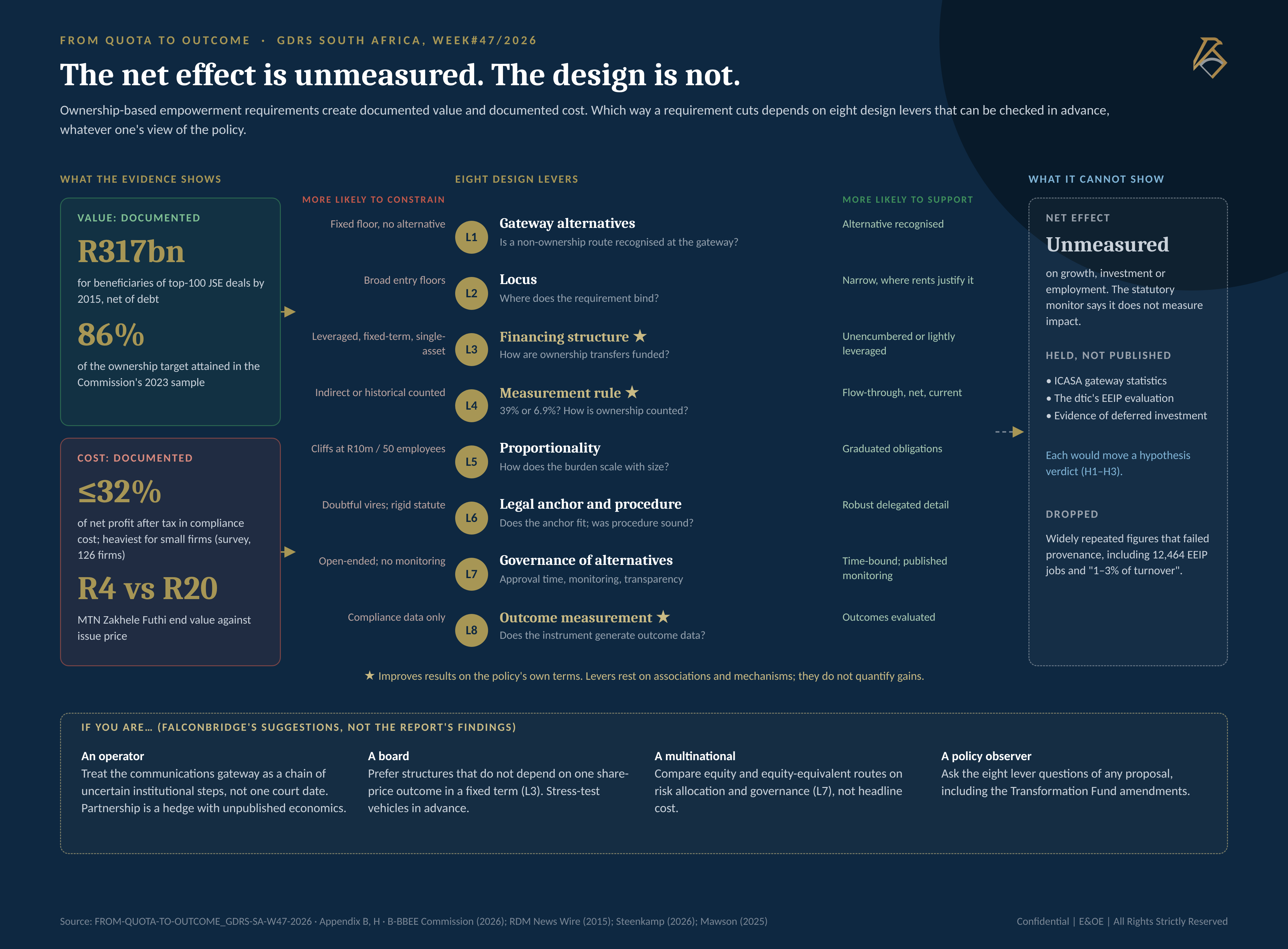
On 9 November 2026 Sakeliga asked the High Court in Pretoria to set aside ICASA's decision that it cannot give full effect to a ministerial direction recognising equity equivalent investment programmes as an alternative to the 30% historically disadvantaged ownership requirement for individual communications licences. The study asks what the public evidence shows about the value and cost of ownership-based empowerment requirements for investment, entry and employment, and which design features make the difference. It takes no position on the policy, any party or the litigation. The question as usually posed is the wrong one. South Africa runs three instrument families, not one requirement: a graded scorecard, an equity-equivalent route for multinationals with global no-dilution policies, and statutory floors at gateways. The dispute is about whether a statutory floor may be met in a currency the scorecard already accepts. Measurement shows why design matters: the Commission's 2022 figure for black ownership of JSE-listed entities is 39%; an independent estimate for the top 60 companies' South African assets is 6.9%, a gap attributed to the recognition of indirect holdings. Value is real where structures were sound: an estimated R317 billion for beneficiaries of top-100 JSE deals by 2015, net of debt, and ownership at 86% of target in the Commission's 2023 sample. Costs are documented and fall unevenly: a survey of 126 firms, without a described sampling frame, reports compliance costs of 1–1.5% of turnover and up to 32% of net profit after tax, heaviest for smaller firms. Leveraged vehicles have failed their beneficiaries; MTN Zakhele Futhi ended near R4 per share against an R20 issue price. The net effect on growth, investment and employment is not measured by any public source located, and the statutory monitor says it does not measure impact. Of five hypotheses, only one (variation by sector and size) is supported; the rest are partial or not established. Three verdicts would move if ICASA's gateway statistics, the dtic's commissioned EEIP evaluation, or evidence of deferred investment were published. What the evidence does establish is that eight design levers shape the balance of value and cost: gateway alternatives, locus, financing structure, measurement rule, proportionality, legal anchor and procedure, governance of alternatives, and outcome measurement. None requires abandoning the objective, and financing, measurement and outcome measurement improve results on the policy's own terms. The levers rest on associations and mechanisms; they do not quantify gains. Operators could consider treating the communications gateway as a chain of uncertain institutional steps rather than a single court date; boards could consider preferring unencumbered or lightly leveraged structures; and anyone using an ownership figure could state the rule that produced it. Policy observers could use the eight levers as neutral criteria for any proposal, including the Transformation Fund code amendments.
39% or 6.9%
The Commission's 2022 figure for black ownership of JSE-listed entities is 39%; an independent estimate for the top 60 companies' South African assets is 6.9%, a gap attributed to the recognition of indirect holdings.
R317 billion
Value is real where structures were sound: an estimated R317 billion for beneficiaries of top-100 JSE deals by 2015, net of debt, and ownership at 86% of target in the Commission's 2023 sample.
Eight design levers
Eight design levers shape the balance of value and cost: gateway alternatives, locus, financing structure, measurement rule, proportionality, legal anchor and procedure, governance of alternatives, and outcome measurement.
South Africa · Week 47, 2026
The complete package
Six elements, tailored to the question and to how readers will use the work
Tell us who is reading and the pack is emailed to you straight away. The package is released under a Type-1 licence for the requester’s own use. Public access does not transfer ownership.
Around this study
Other studies on South Africa
Durban's Exposure to Port and Route Substitution
Screening Manufacturers for Chinese Import Competition
Super El Niño and South African Maize Prices
How a study like this is commissioned: a question of your own, answered as a complete research package.

A conversation about your decision
What needs to be understood
before your next decision?
Bring the proposition, question or direction you are working on. Together, we can define the support it requires.
Start a conversation