Public study · South Africa · 2026
From Weather to Wallet
Super El Niño and South African Maize Prices
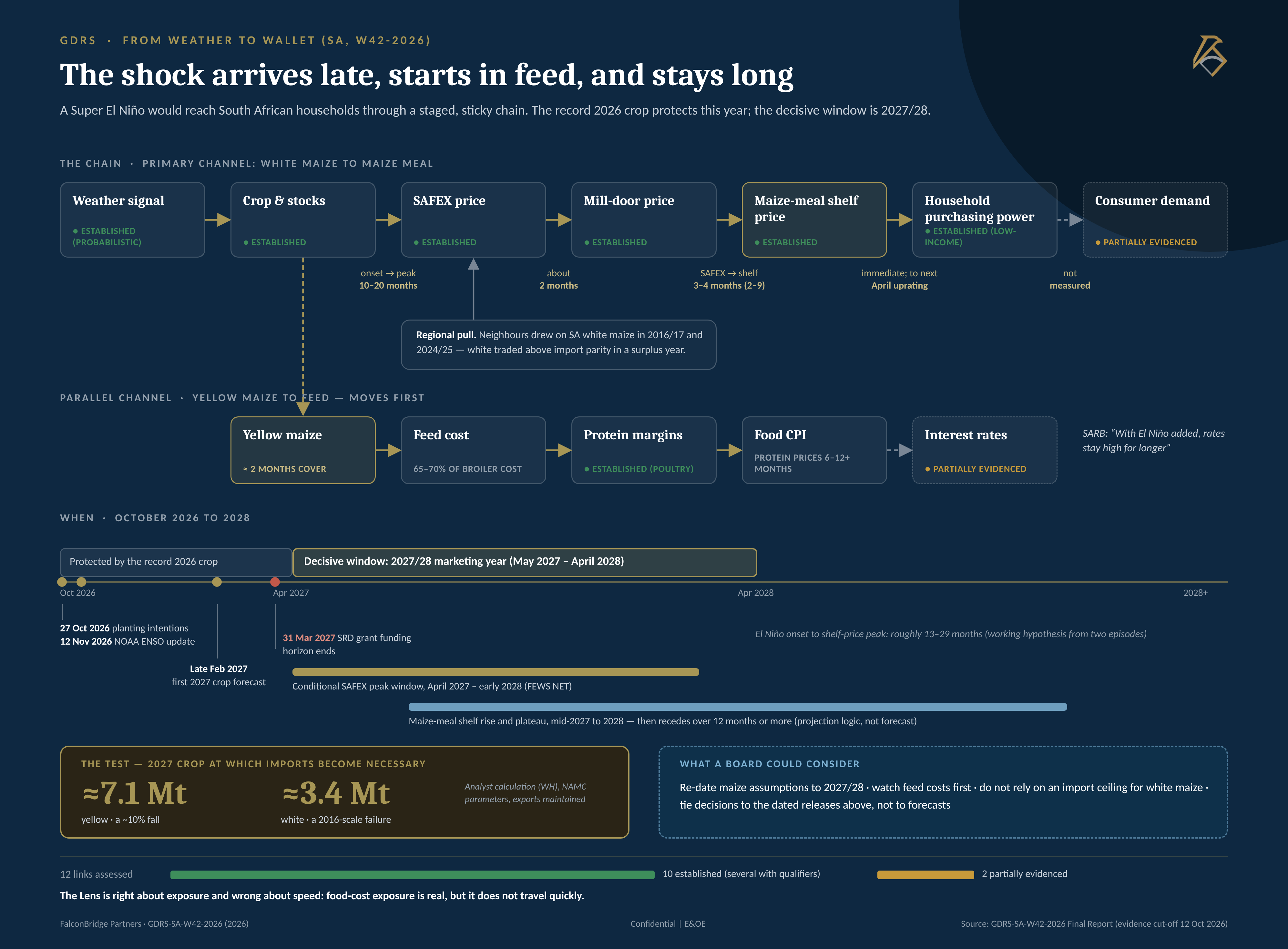
FalconBridge’s Weekly Signal of 12 October 2026 warned that a potential Super El Niño could raise South African maize prices through costlier imports passed on in maize meal, and its Lens held that such food-cost exposure “can travel quickly”. The study tested that claim link by link, from farm gate to shelf price, household purchasing power and consumer demand, against public evidence verified on 12 October 2026. The risk is real, but it is dated. South Africa harvested a record 17.52 Mt of maize in 2026, leaving projected stocks of 5.36 Mt at 30 April 2027 — about six months of use. That buffer protects the current marketing year, not the next. A drought this summer would hit the 2027 harvest, so the decisive window is May 2027 to April 2028. The shock would start in feed. Yellow maize has about two months of projected cover and would need imports after a crop shortfall of roughly 10%; white maize, the input to maize meal, has about nine months and would need imports only in a 2016-scale failure (both analyst calculations, working hypotheses). Grain prices rise first through local scarcity, and white maize has traded above import parity — including in the surplus year 2024/25, when neighbours drew on South African supply. Millers hold the main pricing discretion. Shelf prices follow grain by about three to four months (range two to nine) and fall later and less. The household burden is regressive and badly timed. Food is over 30% of spending for the poorest tenth of households, a 30 kg bag of maize meal costs about half a Child Support Grant, and the SRD grant is funded only to 31 March 2027. Households protect their staple and cut other spending, though that demand link is the least evidenced in the chain. The evidence does not support the claim that the shock travels quickly: household effects arrive roughly 13–29 months after El Niño onset (a working hypothesis from two episodes, not a forecast) and persist. Nor does drought follow automatically — the very strong 1997/98 event did not produce a severe one. The consumer-side policy toolkit is thin, and the middle of the chain, where pricing discretion sits, has become less observable since 2022. Boards could consider re-dating maize-related assumptions to 2027/28, watching feed costs first, and tying decisions to dated releases rather than forecasts: planting intentions on 27 October 2026, the first 2027 crop forecast in early 2027, and the SRD decision before 31 March 2027.
17.52 Mt
South Africa harvested a record 17.52 Mt of maize in 2026, leaving projected stocks of 5.36 Mt at 30 April 2027, about six months of use.
About two months
Yellow maize has about two months of projected cover and would need imports after a crop shortfall of roughly 10%; white maize, the input to maize meal, has about nine months (both analyst calculations, working hypotheses).
13–29 months
Household effects arrive roughly 13–29 months after El Niño onset (a working hypothesis from two episodes, not a forecast) and persist.
South Africa · Week 42, 2026
A Super El Niño could raise South Africa's maize prices. The bill would arrive late, and start with feed.
The complete package
Six elements, tailored to the question and to how readers will use the work
Tell us who is reading and the pack is emailed to you straight away. The package is released under a Type-1 licence for the requester’s own use. Public access does not transfer ownership.
The sample demonstrates the work
Figures above are verified findings, analyst calculations or labelled working hypotheses drawn from the -SA-W42-2026 Final Report; forecasts are attributed there to their issuers. The closing paragraph is FalconBridge’s judgement, offered for the reader’s own decision — not a finding of the report. The study describes exposure; it does not prescribe commercial responses.
Around this study
Other studies on South Africa
Targeted Sanctions: South Africa
South Africa's Rate Test Starts Above Today's Rate
What a board can establish before approving an insurance programme
How a study like this is commissioned: a question of your own, answered as a complete research package.

A conversation about your decision
What needs to be understood
before your next decision?
Bring the proposition, question or direction you are working on. Together, we can define the support it requires.
Start a conversation