Public study · South Africa · 2026
The risk to Durban is a carrier decision, not a foreign port
Durban's Exposure to Port and Route Substitution
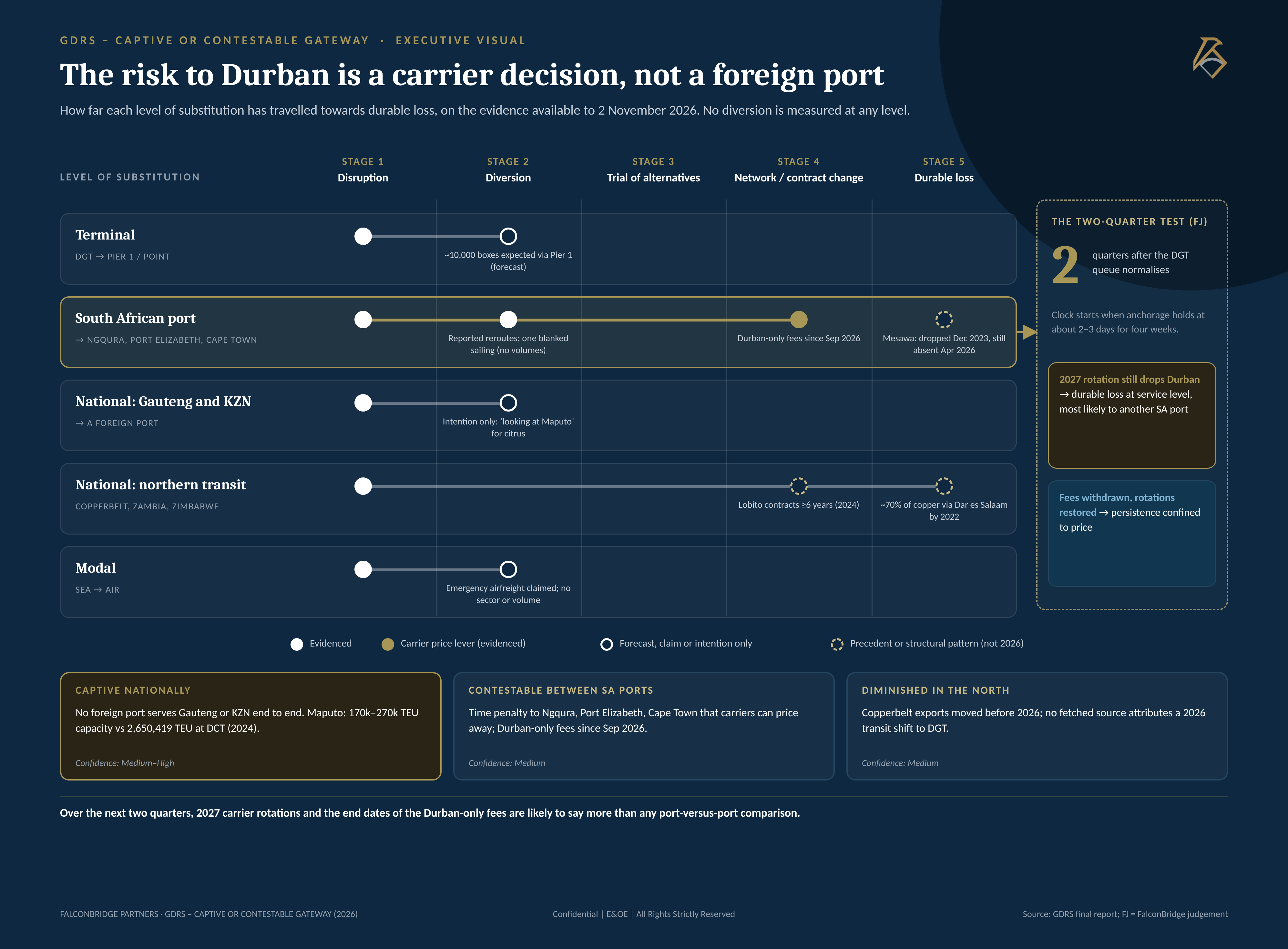
Reporting on the 2026 Durban Gateway Terminal (DGT) disruption suggested shippers were leaving Durban for Walvis Bay, Dar es Salaam, Mombasa and air freight. The study tested that claim segment by segment, at four levels of substitution: terminal, South African port, national and modal. No 2026 rerouting to those three ports is evidenced, and no diversion is measured at any level. Gauteng and KwaZulu-Natal cargo has no foreign alternative that is viable end to end. Maputo, the only foreign port with Gauteng reach, publishes 170k–270k TEU of container capacity, against the 2,650,419 TEU Durban Container Terminal handled in 2024; its 530k TEU expansion is a plan for 2027. Nationally, Durban is captive. But captive to South Africa is not captive to Durban. Gauteng imports can move via Ngqura, Port Elizabeth or Cape Town at a time penalty that carriers have shown they can price away, and since September 2026 Maersk and CMA CGM have priced Durban alone. Persistence follows carrier networks, not cargo value: Durban was removed from the Midas1/Mesawa service in December 2023 “until, at least, the end of January” and was still absent in April 2026. The record also runs the other way. Containers returned after the 2021 and 2023 episodes, and CPPI 2025 recorded Durban’s improvement as the world’s largest, on pre-disruption data. The one durable loss abroad, Copperbelt transit, was largely settled before 2026 and is not attributed to DGT by any fetched source. What cannot yet be seen is whether any 2026 shift will last. At about 18 weeks from onset (WH), the episode already exceeds those Durban recovered from; queue normalisation between late January and end-March 2027 is a working hypothesis at Medium–Low confidence. DGT’s own volumes are invisible in both Transnet’s and ICTSI’s reporting, so durable loss cannot be observed from public data at all. Readers could consider treating 2027 carrier rotations and the end dates of the Durban-only fees as the leading indicators. A rotation that drops Durban and is still in force two quarters after anchorage normalises would mark durable loss at service level, most likely to another South African port. Carrier-haulage importers could consider asking now for through-rates via Ngqura or Port Elizabeth.
No diversion
No 2026 rerouting to Walvis Bay, Dar es Salaam or Mombasa is evidenced, and no diversion is measured at any of the four levels of substitution.
170k–270k TEU
Maputo, the only foreign port with Gauteng reach, publishes 170k–270k TEU of container capacity, against the 2,650,419 TEU Durban Container Terminal handled in 2024.
Two quarters
A 2027 rotation that drops Durban and is still in force two quarters after anchorage normalises would mark durable loss at service level, most likely to another South African port.
South Africa · Week 45, 2026
Durban's port is under real strain. Its cargo is not yet leaving the country.
The complete package
Six elements, tailored to the question and to how readers will use the work
Tell us who is reading and the pack is emailed to you straight away. The package is released under a Type-1 licence for the requester’s own use. Public access does not transfer ownership.
The sample demonstrates the work
Figures above are findings verified in the source report; items marked WH are the report’s working hypotheses. Statements of implication, the two-quarter threshold and the suggested actions are FalconBridge judgement, offered for the reader’s own decision.
Around this study
Other studies on South Africa
Screening Manufacturers for Chinese Import Competition
Super El Niño and South African Maize Prices
Targeted Sanctions: South Africa
How a study like this is commissioned: a question of your own, answered as a complete research package.

A conversation about your decision
What needs to be understood
before your next decision?
Bring the proposition, question or direction you are working on. Together, we can define the support it requires.
Start a conversation