Public study · South Africa · 2026
From Exposure to Resilience
Screening Manufacturers for Chinese Import Competition
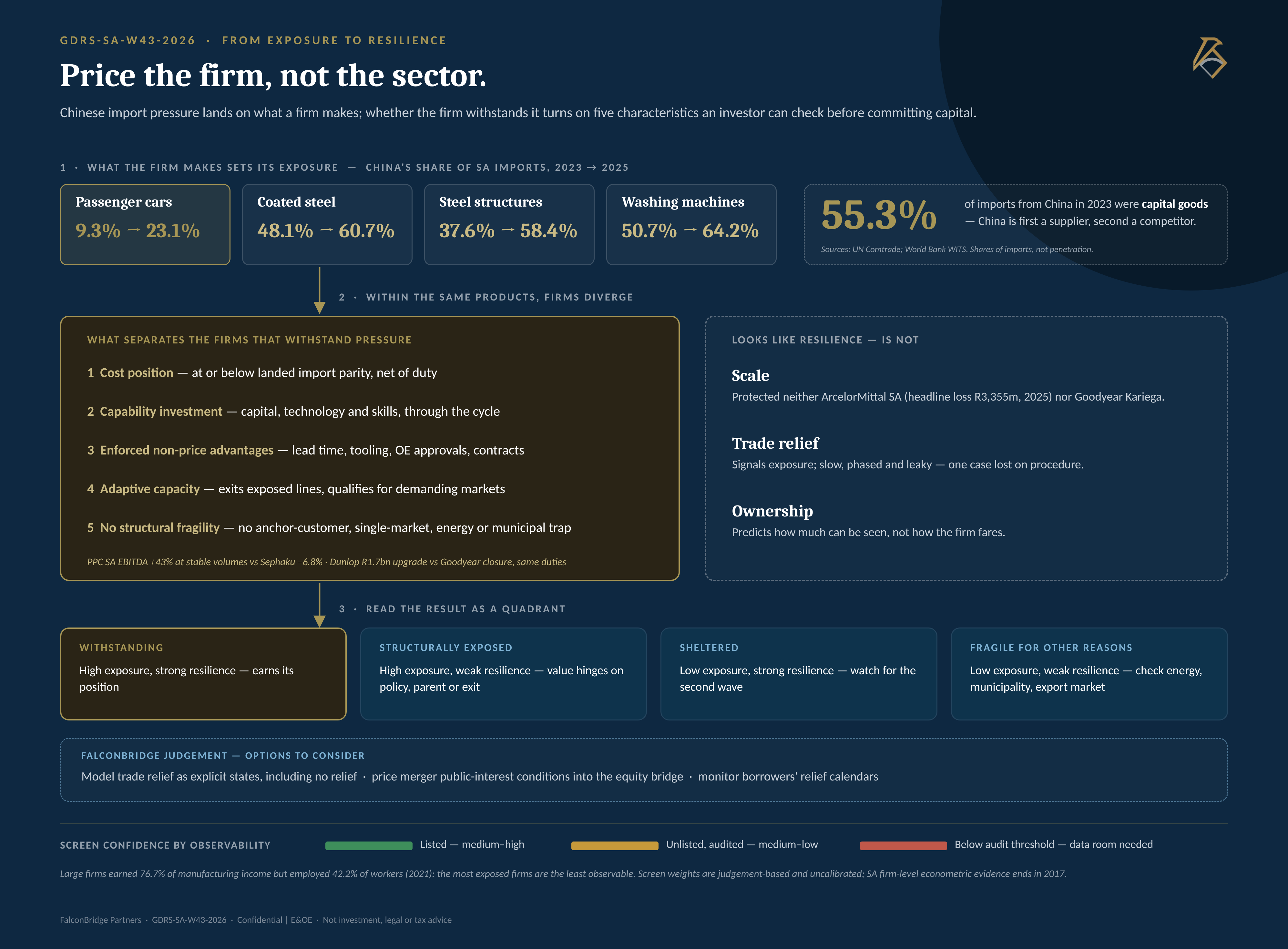
A BusinessTech republication of a Bloomberg report (18 October 2026) described a “R165 billion Chinese threat” to South African manufacturing. That figure is a rand conversion of Bloomberg’s “almost $10 billion” against a pandemic-depressed base, and no primary dataset behind it could be traced. The study therefore asked the question an investor needs answered: which manufacturers can withstand Chinese and Chinese-linked import competition, which are structurally exposed, and how would one tell before committing capital? The pressure is real but selective. China’s share of South African imports rose from 20.5% to 22.5% between 2023 and 2025, fastest in passenger cars (9.3% to 23.1%) and coated steel (48.1% to 60.7%). Yet 55.3% of what South Africa bought from China in 2023 was capital goods: for most manufacturers China is first a supplier and only second a competitor. Exposure is decided by what a firm makes. Within the same products, firms diverge. PPC raised South African EBITDA 43% at stable volumes while Sephaku’s EBITDA fell 6.8% and it relied on a R923m parent loan; Dunlop completed a R1.7bn upgrade under the same tyre duties that did not keep Goodyear’s plant open. Five characteristics separate the firms that withstand pressure: a cost position competitive with landed imports, sustained capability investment, non-price advantages that are contracted or enforced, adaptive capacity, and the absence of structural fragility. Scale is not a shield. Two things that look like resilience are not. Trade relief signals exposure but is slow, phased and leaky — one case was lost on procedure, and one anti-dumping duty payable above an existing safeguard starts at 5.5%. Ownership predicts how much an investor can see, not how a firm will fare. Several prominent closures were driven by electricity tariffs and municipal failure rather than imports. What remains open is material. In 2021 large firms earned 76.7% of manufacturing income but employed 42.2% of workers, so the most exposed firms are the least observable; small private firms are not screenable without a data room. The screen’s weights are judgement-based and uncalibrated, and South African firm-level econometric evidence ends in 2017. Investors could consider scoring exposure and resilience separately before taking a view, and modelling trade relief as explicit states, including a no-relief case. Acquirers could consider pricing merger public-interest conditions into the equity bridge; lenders could consider monitoring borrowers’ product exposure and relief calendars alongside financial covenants.
20.5% to 22.5%
China’s share of South African imports rose from 20.5% to 22.5% between 2023 and 2025, fastest in passenger cars (9.3% to 23.1%) and coated steel (48.1% to 60.7%).
55.3%
Of what South Africa bought from China in 2023, 55.3% was capital goods: for most manufacturers China is first a supplier and only second a competitor.
43% against –6.8%
PPC raised South African EBITDA 43% at stable volumes while Sephaku’s EBITDA fell 6.8% and it relied on a R923m parent loan.
South Africa · Week 43, 2026
Chinese imports are a real pressure on South African factories. They are not a verdict on any one of them.
The complete package
Six elements, tailored to the question and to how readers will use the work
Tell us who is reading and the pack is emailed to you straight away. The package is released under a Type-1 licence for the requester’s own use. Public access does not transfer ownership.
The sample demonstrates the work
Figures above are verified findings of the -SA-W43-2026 report, with its qualifiers. The final paragraph is FalconBridge’s judgement about what to do with them, offered for the reader’s own decision; it is not investment, legal or tax advice and is not a view on any named company.
Around this study
Other studies on South Africa
Super El Niño and South African Maize Prices
Targeted Sanctions: South Africa
South Africa's Rate Test Starts Above Today's Rate
How a study like this is commissioned: a question of your own, answered as a complete research package.

A conversation about your decision
What needs to be understood
before your next decision?
Bring the proposition, question or direction you are working on. Together, we can define the support it requires.
Start a conversation