Public study · USA · 2026 · From Boom to Buffer
Depth can be measured now. Timing cannot.
A Late-Cycle Resilience Diagnostic for US Boards and CFOs
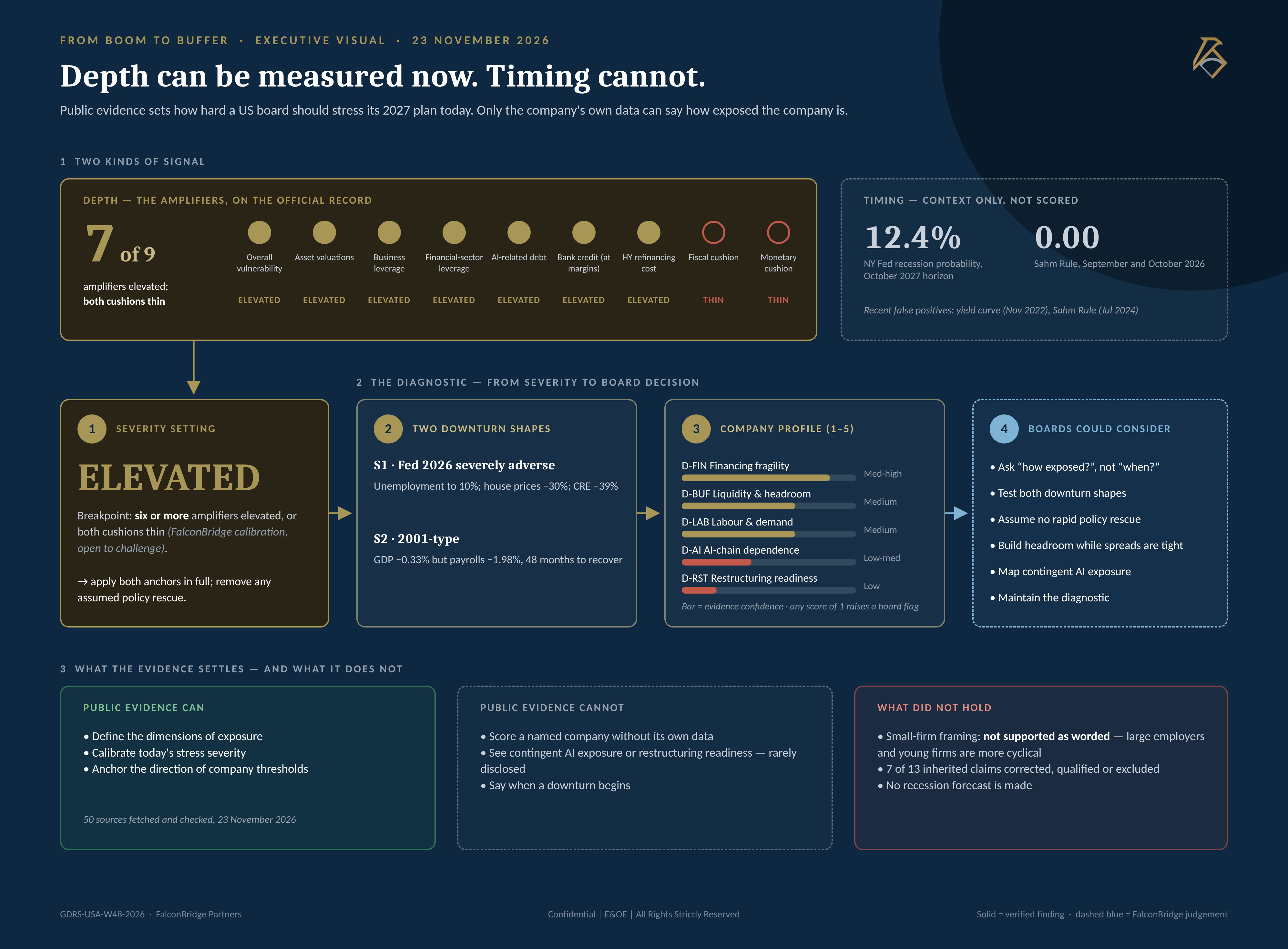
On 18 November 2026 Oxford Economics' Michael Pearce told Fortune that 2027 should be strong, but that the expansion is sowing the seeds of a deeper downturn: AI-related debt, weak small-firm hiring, a deferred AI labour adjustment and less fiscal room. The study asked whether public evidence can support a diagnostic that lets US boards and CFOs stress-test 2027 plans against such a downturn without timing it. The answer is a qualified yes. Timing signals are benign; depth signals are not. The New York Fed's model puts recession odds at 12.4% for October 2027 and the Sahm Rule reads 0.00, yet seven of nine amplifiers are elevated on the official record and both policy cushions are thin. Timing indicators have also failed recently in both directions, so they are kept as context and not scored. Pearce's AI-debt concern is confirmed and understated: advanced-computing debt issuance exceeded $680 billion by October 2026, with more than $1 trillion of not-yet-commenced leases and more than $2 trillion of other obligations. Much of it is contractual and opaque below the hyperscalers and largest banks. Deferred restructuring has strong historical support, though the size of any AI backlog is uncertain. The deficit is 5.8% of GDP, debt 100.6%, and fed funds 3.88% with a tightening bias. “Deeper” has two shapes. In 2001 real GDP fell 0.33% yet payrolls took 48 months to recover; 2007–09 was a deep financial shock. Firms that came through best differed in headroom and cost flexibility, not revenue stability. The evidence does not support every claim. The small-firm framing is not supported as worded: large employers and young firms are the more cyclical groups. Seven of thirteen inherited claims needed correction or exclusion. Banks are judged well capitalised, Moody's expects no broad rise in defaults, and the study forecasts neither a recession nor its timing. Boards could consider asking “how exposed are we?” rather than “when?”; testing plans against both downturn shapes without assuming a rapid policy rescue; using tight spreads to build headroom; mapping contingent AI exposure; and maintaining the diagnostic rather than running it once. Public evidence sets today's severity (Elevated); only a company's own data can score the company. Figures above are verified findings of the source report (sources fetched and checked 23 November 2026). The final paragraph is FalconBridge's suggestive judgement, offered for the reader's own decision. E&OE | All Rights Strictly Reserved
12.4%
NY Fed recession probability, October 2027 horizon. Timing indicators are context only and are not scored.
7 of 9
Amplifiers elevated on the official record; both policy cushions are thin.
50
Sources fetched and checked, 23 November 2026.
USA · Week 48, 2026
The next US downturn cannot be timed. Its depth can be measured now.
The complete package
Six elements, tailored to the question and to how readers will use the work
Tell us who is reading and the pack is emailed to you straight away. The package is released under a Type-1 licence for the requester’s own use. Public access does not transfer ownership.
Around this study
Other studies on USA
The SEC's proposed Item 402 pay-disclosure reform
Monthly US labour data in board and lender decisions
Workforce-Cost Release and AI Capital Expenditure
How a study like this is commissioned: a question of your own, answered as a complete research package.

A conversation about your decision
What needs to be understood
before your next decision?
Bring the proposition, question or direction you are working on. Together, we can define the support it requires.
Start a conversation