Public study · North Carolina · 2026
From Innovation Capacity to Regional Execution
A Top-Ten Ranking of Capacity, Not of Conversion
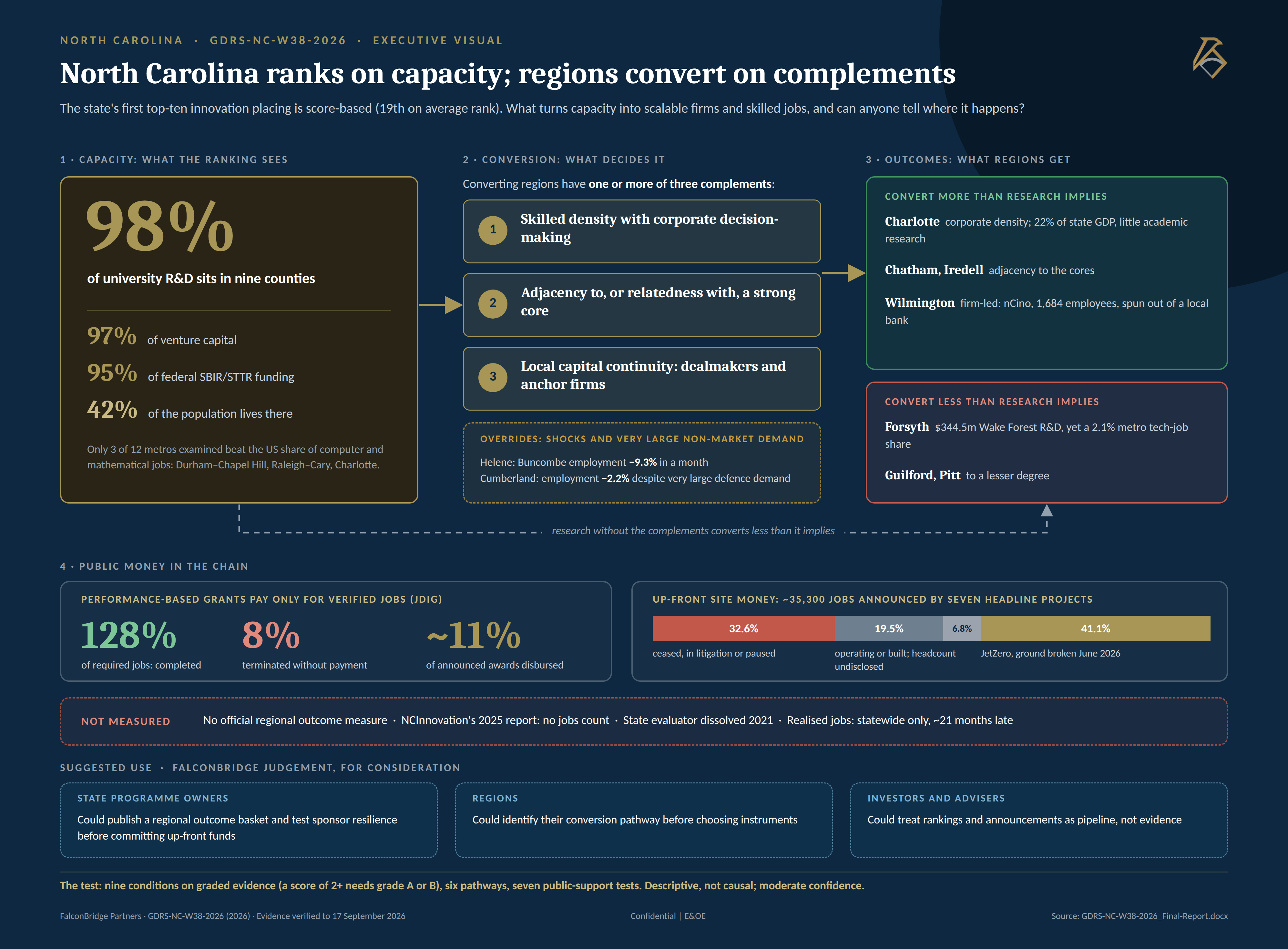
In September 2026 North Carolina entered the top ten of its national state innovation index for the first time. The placing is score-based; on a simple average of its ranks across the index's 41 measures, the state places 19th. The study asked what separates the regions that convert innovation capacity into scalable businesses and skilled employment from those that do not. The capacity behind the ranking is narrow. Nine counties hold 98% of university research spending, 97% of venture capital and 95% of federal SBIR/STTR funding, but 42% of the population. Only three of the twelve metros examined, Durham–Chapel Hill, Raleigh–Cary and Charlotte, exceed the national share of computer and mathematical employment. Research volume does not decide which regions convert. Converting regions have one or more of three complements: skilled density with corporate decision-making; adjacency to, or relatedness with, a strong core; and local capital continuity. Charlotte converts with little academic research. Chatham and Iredell convert through proximity. Wilmington produced nCino, now 1,684 employees, as a spin-out from a local bank. Research-rich Winston-Salem, home to Wake Forest's $344.5m of R&D, shows below-national skilled shares and wages. Shocks and very large non-market demand override the pattern: Hurricane Helene cut Buncombe's employment by 9.3% in a month, and Cumberland's employment fell 2.2% in the year to March 2026 despite very large federal defence demand. Public support shows both discipline and exposure. Performance-based JDIG grants pay only for verified jobs: completed grants delivered 128% of their required jobs, grants terminated without payment 8%, and disbursements were about 11% of the amounts announced. Up-front site money carries no such protection. Of about 35,300 jobs announced by seven headline projects since 2021, 32.6% sit in projects that have ceased, are in litigation or are paused, and 41.1% depend on JetZero, which broke ground in June 2026. What the state cannot yet show is where conversion happens. No official regional outcome measure exists. NCInnovation's 2025 statutory report contains no count of jobs created. The legislature's evaluation division was dissolved in 2021, and realised incentive jobs are published only statewide, about 21 months behind. The answer is therefore descriptive, not causal, and held with moderate confidence. The report's FalconBridge Regional Innovation Conversion Framework scores nine conditions on graded evidence, allowing a score of 2 or more only on grade A or B evidence. It recognises six conversion pathways and tests public-support propositions seven ways. Decision-makers could consider treating rankings and announcements as pipeline rather than outcomes, applying sponsor-resilience and downside tests before committing up-front site funds, and publishing a regional outcome basket alongside the index. Regions could consider identifying their pathway before choosing instruments. Figures are findings verified in the source report as at 17 September 2026; several matters, including the VinFast litigation, JetZero hiring, NCInnovation's 2026 report and western North Carolina's recovery, were still live. The final paragraph's suggestions are FalconBridge's judgement, offered for the reader's consideration rather than as directives.
19th
The placing is score-based; on a simple average of its ranks across the index's 41 measures, the state places 19th.
Nine counties
Nine counties hold 98% of university research spending, 97% of venture capital and 95% of federal SBIR/STTR funding, but 42% of the population.
32.6%
Of about 35,300 jobs announced by seven headline projects since 2021, 32.6% sit in projects that have ceased, are in litigation or are paused, and 41.1% depend on JetZero, which broke ground in June 2026.
The Weekly Signal behind this study
North Carolina · Week 38, 2026
The complete package
Five elements, tailored to the question and to how readers will use the work
Tell us who is reading and the pack is emailed to you straight away. The package is released under a Type-1 licence for the requester’s own use. Public access does not transfer ownership.

A conversation about your decision
What needs to be understood
before your next decision?
Bring the proposition, question or direction you are working on. Together, we can define the support it requires.
Start a conversation